JULIAN OF NORWICH, HER SHOWING OF LOVE
AND ITS CONTEXTS ©1997-2024
JULIA BOLTON HOLLOWAY
|| JULIAN OF NORWICH || SHOWING OF
LOVE || HER TEXTS || HER SELF || ABOUT
HER TEXTS || BEFORE JULIAN
|| HER CONTEMPORARIES || AFTER JULIAN || JULIAN IN OUR TIME || ST BIRGITTA OF SWEDEN
|| BIBLE AND WOMEN || EQUALLY IN GOD'S IMAGE || MIRROR OF SAINTS || BENEDICTINISM|| THE CLOISTER || ITS SCRIPTORIUM || AMHERST MANUSCRIPT || PRAYER|| CATALOGUE AND PORTFOLIO (HANDCRAFTS, BOOKS )
|| BOOK REVIEWS || BIBLIOGRAPHY ||© Julia
Bolton Holloway, Sweet New
Style: Brunetto Latino, Dante Alighieri, Geoffrey Chaucer,
Essays, 1981-2024, E-book
GOD'S PLENTY
TERENCE
IN DANTE, BOCCACCIO, CHAUCER, SHAKESPEARE
Homo sum; humani
nil a me alienum puto.
Heauton Timorumenos 77
(painted on Michel de Montaigne’s study tower’s ceiling)
’Tis sufficient to say,
according to the proverb, that here is God’s plenty.
John Dryden on Geoffrey Chaucer
Dedicated to Lucy
Walker, who produced Adelphoe
and Phormio in Denver
In the Laurentian Library in Florence are several manuscripts
written out in Boccaccio’s hand. One, Laurentian Pluteo
38.17, is of all Terence’s Comedies.
Another, Laurentian Pluteo 54.32, of all Apuleius’ writings.1 (Plut. 38.17 and Plut
54.32 are available virtually at http://teca.bmlonline.it/TecaRicerca/index.jsp.)
The marvellous mixture of two excellent African writers, Terence
and Apuleius, creates the Decameron
in Tuscan Italian. Which in turn creates the “God’s plenty” in
Middle English of the Canterbury
Tales. Already, before Giovanni Boccaccio and
Geoffrey Chaucer, Dante Alighieri, in the same century, had
created the Commedia
in Florentine Italian, though in exile from that city whose
bread has no salt. Tragedy is about dysfunctional royalty;
comedy, instead, is about healing democracy.2 These authors borrow from Terence
his circular theatre and they borrow from him his plots, his
tales. These authors, copying Terence, play games of dialogue
between noble and labourer, between women and men, and even
children; they play games of tales within tales, of narrations
within narrations, they indulge in Baktinesque and Gospel
Magnificat turnings of the world upside down, in which the
slaves, women and children come out on top to healing laughter
and applause. Such tales like those in Terence manuscripts can
end with 'FELICITER' in rainbow capitals.
It should be noted that Terence, the freed African slave
associated with the Scipios in Rome, wrote in such pure Latin
that his Comedies were
used throughout Europe in the Middle Ages and the Renaissance to
teach that language in monasteries, convents and schools, to
both men and women, and especially to children. England
possessed one such (ca. 1150 CE), which came to be owned by St
Albans Abbey and is now in the Bodleian Library (Auct.
F.2.13=27603). It is
one of the thirteen illustrated manuscripts from before 1300
that have survived for us; these typically provide the actors’
masks on their rack and often illustrate the plays’ scenes.3 Later
manuscripts could be lavishly illuminated, giving rise to
printed books with woodblocks for every scene.
There were two strands to the writing of plays. One was of
straight drama. The other came from the law courts of Athens,
where logographers trained defendants in trials to make their
own speeches—and who to do so astutely studied their clients’
psychology and the context of their crimes in order to present
convincingly what was a lie as a convincing alibi. These became
Theophrastus’ Characters
and Terence’s dramatis
personae—and even Brunetto Latino’s examples of law
cases in the Athenian, Roman, Byzantine, and Florentine agora in
his Rettorica and his
Li Livres dou Tresor
III.4 A drama
articulated a grouping of such character studies, setting the
masks, the personae,
the characters, as its machinery, in motion.5 The author thus multiplied his
voices, his own multiple personalities. Terence’s use of
intricate double-plotting created even further complications and
ironical conjunctions.6

For example, in the Adelphoe,
of the two younger pair of brothers, Aeschinus is in love with
an Athenian-born Pamphila, who is about to bear a child, while
he pretends to seize a flute-girl, procuring her in reality for
his love-lorn brother Ctesipho. Sannio is the slave dealer
seeking payment for the flute-girl; Geta is the slave appalled
at Aeschinus’ seeming betrayal. The older brothers, Demea,
the father of both boys, and Micio, who has adopted the older
one, disagree on how to raise them, Demea being severe, Micio
lenient. Sostrata, Pamphila’s mother, laments that her wronged
daughter has no dowry, and she has only a ring dropped by
Aeschinus. All the exchanging and disguising is resolved when
the father and uncle switch places: Demea, who had been harsh,
becoming too lenient.
The Woman from Andros,
like Shakespeare’s Winter’s
Tale, tells the story of a shipwreck, the father dying,
the baby living. Now grown, that child, Glycerium, in turn gives
birth to a child, its father’s father Simo preventing the
marriage because he believes her to be the sister of a
prostitute. Simo arranges instead for Pamphilus to marry
Chremes’ daughter, with whom Pamphilus’ friend Charinus is in
love. Pamphilus is distraught, nor does the slave Davus’
attempts to resolve the matter help. Crito arrives and
identifies Glycerium as the lost niece of Chremes and all ends
well with the double wedding of Pamphilus and Glycerium, of
Charinus and Chremes’ nameless daughter.
The other four Terentian dramas play similar games with youthful
heirs courting brides and concubines, their fathers instead
preoccupied with rank and dowries. As if in a quadrille danced
at Bath in a Jane Austen novel, the concerns are about class and
wealth, in Austen’s time being about getting a living in the
Church or a commission in the Army. Jane Austen’s mask is
Elizabeth Bennett (Austen=Augustinian; Bennett=Benedictine).
Terence’s mask is Geta, the slave, who so skilfully stage
manages the whole that all shall be well. Women and slaves
outside of power yet speak truth to that power. Here is Geta in
Phormio defending
himself to Demipho with the argument that he cannot accuse or
defend anyone in a court of law: servom hominem causam orare leges non sinunt / neque
testimoni dictiost (‘The laws don’t allow a slave to
argue a case in court or to give evidence’, 292-93). The endings
of both novels and plays then have their protagonists marry and
live happily ever after: vos
valete et plaudite.
We should not forget that liturgical dramas of scriptural events
and of saints’ legends were created in the monasteries, whose
libraries contained Terence manuscripts, for the young oblates
to act, thereby learning their Latin and their Gregorian chant
simultaneously—in play. Among these plays was the
Winchester/Fleury Officium
Peregrinorum of Luke 24, in which the disguised Christ,
with intense dramatic irony, appears as a pilgrim to Luke and
Cleopas, who do not recognize him; Jesus then dines with them at
the inn at Emmaus, blesses, breaks the bread, and vanishes.7 Other dramas, such as
the Resuscitatio Lazari
and the Visitatio Sepulchri,
movingly use the scarlet-clad figure of Mary Magdalen, in the
first with Lazarus, her dying leprous brother. All these dramas
were influenced by Terence, whose manuscripts were copied out in
monastic scriptoria and treasured in monastic libraries. Their
continuation, the vernacular cycle plays for lay audiences
enacted by guilds, are also influenced by Terence and explicitly
so in those plays written by the Wakefield Master.8
After Chaucer, there would be a flurry of fine illuminated
Terence Comedies in
Paris, often created to educate the King of France’s sons.
Besides the dramatis personae
and scenes of the plays these illustrations, both as manuscript
illuminations and as woodblock prints, could include a diagram
of a theatre, as it was later thought to have been, a structure
somewhat like the Globe of Shakespeare’s production or a baroque
opera house with the spectators ranged in tiers, the mimes on
stage, while Calliopius sings the chorus.9 The 1490, 1493 woodblocks go so far
as to show the prostitutes plying their trade outside these
theatres, reflecting Plato’s Symposium’s
flute girls, the Gospels’ Mary Magdalen, Boethius’ ‘whores of
the theatre’, and
the ‘red light cum theatre’ districts of Chaucer’s Tabard Inn
and Shakespeare’s London Globe Theatre in Southwark and New
York’s Forty-Second Street.10


I. Terence's Comedies
and Dante Alighieri’s Commedia
For his own theatre of Hell, Dante adopts a structure consisting
of circle upon circle of sinners in whose crimes he, and we,
participate. Their voices create dialogues across time and
space. Finally we meet their ‘author’, the ‘father of lies’,
enmeshed in icy silence with flapping bats’ wings, seeming like
a windmill, amidst giants who seem like towers (Inferno XXXIV). Dante then
turns this tragic theatre upside down, or the right way round,
as he and his now-lost guide Virgil climb into the Antipodes of
Purgatory to find a similar but inverse theatre of comedy, whose
actors/spectators interact upon the cornices of a mountain, now
facing outward instead of inward, to have Dante arrive at
Beatrice, leaving behind Virgil—and tragedy. Ultimately they
meet God, the supreme Author of the drama of mankind, the mirror
reverse of bat-like Satan, into whose playbook all the ‘God’s
Plenty’ of the scattered leaves of the universe are bound and
gathered up into one volume (Paradiso
XXXIII.85-90, 130-31). God is thus a mirror to Dante’s Terentian
motto, homo sum: humani nil a
me alienum puto.
Dante first has his mirroring authorial protagonist/sorcerer’s
apprentice journey through lugubrious Hell, guided by Virgil,
the poet of lacrimae rerum,
the ‘tears of things’. The pagan world viewed life as tragic, to
be confronted with Stoicism or Epicureanism. The ambience of
Christendom, instead, saw reality through the lens of mercy, of
redemption, honoring the outsider from power. Needing Latin to
be kept alive for centuries this now Christian cultural ambience
turned naturally to a writer like Terence, who wrote in a living
Latin, the Latin of families, the Latin presenting the
perspectives of slaves, children, and women, all of whom the
Christian Gospels upheld in a similar world upside down.
Hrotsvita and Heloise could feel comfortable, at home, within
the pages of a Terence manuscript. Dante knew this, but elected
even further to write in the vernacular, Florentine, the
language which even women and children had by then come to most
readily understand in Tuscany (De
vulgari eloquentia, I.1). He also shows us this culture
of oral literature in Italian of women and children in Paradiso XV.121-26, in a
landscape that foretells of Boccaccio’s Fiesolan Decameron:
L’una vegghiava a
studio de la culla,
e, consolando, usava l’idioma
che prima i padri e le madri
trastulla;
l’altra, traendo a la rocca la
chioma,
favoleggiava con la sua
famiglia
di’ Troiani, di Fiesole e di
Roma.
One woman watched with loving care the cradle
and, as
she soothed her infant, used the way
of speech
with which fathers and mothers play;
another, as she drew threads from the
distaff,
would
tell, among her household, tales of Trojans,
and tales
of Fiesole, and tales of Rome.
In doing so, Dante reflects his teacher Brunetto Latino’s choice
of writing in the vernacular. Brunetto’s family came from La
Lastra in Fiesole, Brunetto’s father and brother being notaries
to the Bishop of Fiesole, the Franciscan Filippo da Perusgia,
and with him were involved with embassies to Constantinople,
preserving classical humanism in the Middle Ages, which was then
taught to Guido Cavalcanti, Francesco da Barberino, and Dante
Alighieri. Brunetto translated the classic works of Aristotle
and Cicero into French and Italian but did so while also
expecting his students to learn to write in a living Latin.
Joseph Russo has argued that Dante could have had access to
Terence in Verona.11
It is far more likely that Dante alreadsy knew Terence as a
school boy studying under Brunetto Latino long before his exile
from Florence, in whose libraries can still be found important
manuscripts of Terence predating Dante’s time. (Florence’s
Laurentian Library, http://teca.bmlonline.it/TecaRicerca/index.jsp
has Plut.38.27 and Plut.38.24a; Plut.38.27 being a manuscript of
the ninth to eleventh century, which came to be owned by
Giannozzo Pucci, for whose wedding Botticelli painted a series
of paintings illustrating the Decameron’s
Fifth Day’s Eighth Tale, and then by a Medici son).
One can glimpse Dante’s love of Terence in the commentary
written by his son, Pietro Alighieri, on the Commedia:
Libri titulus
est: Comoedia Dantis Allegherii: et quare sic vocetur,
adverta. Antiquitatis in theatro, quod erat area
semicircularis, et in ejus medio erat domuncula, quae scena
dicebatur, in qua erat pulpitum, et super id ascendebat
poeta ut cantor, et sua carmina ut cantiones recitabat,
extra vero errant mimi joculatores, carminum pronuntiationem
gestu corporis effigiantes per adaptionem ad quem libet, ex
cujus persona ipse poeta loquebantur ... et a tale pulpitum
seu domunculum, ascendebat poeta, qui de more villico
caneret, talis cantus dicebantur comoedia ... Item quod
poeta in comoedia debet loqui remisse et non alte, ut
Terentius in suis comoediis fecit.12
The title
of the book is the Comedy
of Dante Alighieri: and pay attention why it is called so. In
antiquity in the theatre, which was a semicircular area, in
the center of which there was a small edifice, which was
called scena, in which was a pulpit, into which climbed the
poet or the cantor, in order to recite his song or sing it,
outside of which where miming actors, who, as the song was
pronounced, adapted the gestures of their bodies to it at
will, according to the person concerning whom the poet was
speaking ... and into such a pulpit or little edifice the poet
ascended from which he sang of common things, therefore such a
song was said to be a comedy ... Thus the poet in comedy ought
to speak of low things and not high, just as Terence did in
his comedies.
For Dante uses the word comedia,
as his son states, to mean writing in a humble style. For
instance, in the De vulgari
eloquentia, he says: deinde in hiis que dicenda occurrunt
debemus discretione potiri, utrum tragice, sive comice ... si
tragice canenda videntur, tunc assumendum est vulgare illustre
... si vero comice, nunc quandoque mediocre, quandoque humile
vulgare sumatur (‘about the possible subject matters of
poetry we must have the judgment to understand whether they are
to be written about in tragedy or comedy ... If they are to be
sung tragically, then the illustrious vernacular is to be used
... Or, if comically, then sometimes the middle level of the
vernacular, sometimes the low', II.4). In one of his Epistles
(XIII.10), Dante notes that the word comedia signifies ‘rustic song’ (villanus
cantus). He add that by nature comedy ‘deals with
certain adverse conditions but ends happily, as appears from the
comedies of Terence’ (comedia vero inchoat
asperitatem alicuius rei, sed eius material prospere
terminatur, ut patet per Terentium in suis comediis).
Concerning its diction, comedy employs an unstudied and low
style (vero
remisse et humiliter), and here Dante supports his
comments by quoting Horace’ Ars
Poetica (93-96). Then
he finally justifies the title of his own work:
et per hoc
patet quod Comedia dicitur presens opus. nam si ad materiam
respiciamus, a principio horribilis et fetida est, quia
Infernus, in fine prospera, desiderabilis et grata, quia
Paradisus; ad modum loquendi, remissus est modus et humilis,
quia locutio vulgaris in qua et muliercule comunicant.
And from this it is clear that the present work is
to be described as a comedy. For if we consider the
subject-matter, at the beginning it is horrible and foul, as
being Hell; but at the close it is happy, desirable, and
pleasing, as being Paradise. As regards the style of language,
the style is unstudied and lowly, as being in the vulgar
tongue, in which even women-folk hold their talk. And hence
it, is evident why the work is called a comedy.13
In the Purgatorio,
Dante has Statius ask Virgil where Terence is, and Virgil
replies that he is in the first circle of Hell, a circle
reserved for virtuous pagans like himself:
‘dimmi dov’è
Terenzio nostro antico,
Cecilio, Plauto e Varro, se lo
sai;
dimmi se non dannati, ed in
quel vico.’
‘Costoro e Persio, ed io, a
altri assai,’
rispuose il duco mio, ‘siam
con quel Greco
che le Muse lattar più
ch’altre mai,
nel primo cinghio del
carcere cieco.’ (XXII.97-105)
‘Tell me where is our ancient Terence, and
Caecilius
and
Plautus, where is Varius, if you know;
tell me
if they are damned, and in what quarter.’
‘All these and Persius, I, and many others,’
my guide
replied, ‘are with that Greek to whom
the Muses
gave their gifts in greatest measure.
Our place is the blind prison, its first
circle.’
It is with this encounter with the mask of Statius that we first
learn overtly that Dante has modeled each encounter of two with
a third, as it happens again and again in the Commedia, upon that other
drama, the Officium
Peregrinorum (Purgatorio
XXI.7-9). He equates Statius, the secretly baptized Roman poet,
with the disguised Christ, Virgil as the elderly Cleopas,
himself as the younger Luke, the omniscient writer of the text,
presenting himself as the foolish participant in the text, as
one whom Christ in the Gospel chides for being slow and dull of
heart not to recognise the Saviour.14 Indeed, the Officium Peregrinorum takes pains to note that
an oblate or the abbot is chosen ad representandum Christi. He is not Christ
but he acts the role, the mask, the disguise of Christ, further
disguised as a pilgrim who is not recognized as Christ. In a
similar mode, Dante can play games with real people acted out as
masks in a fiction, among them his own teacher, Brunetto Latino,
or pagan poets, such as Homer, Virgil, and Statius.
Terence populates his plays with masks of daughters, wives, and
prostitutes, with merchants, soldiers, sailors, sons, and
fathers, the full spectrum of the social order, as in the
prologue of Eunuchus:
qui magis licet
currentem servom scribere,
bonas matronas facere,
meretrices malas,
parasitum edacem, gloriosum
militem,
puerum supponi, falli per
servom senem,
amare, odisse, suspicari?
(36-40)
How is it
more permissible to present a running slave or good matrons or
wicked courtesans or a greedy parasite or a boastful soldier
or babies being substituted or an old man being deceived by
his slave or love or hate or suspicions?
Following the same pattern, Dante adds nuns, monks, and friars,
Emperors and Kings, Popes and Cardinals. Dante places these
Theophrastian and Terentian characters, modeled upon historical
persons within a further machinery, that of teaching Aristotle’s
Nicomachean Ethics,
acquired for Florence by Brunetto Latino, his Master, who
translated the text into the vernacular French and Italian, as
well as that of the Gospels and Christ’s world-upside-down
parables.
In the Commedia, we
listen to dramatic voices, but in Italian, to a dramatic
dialogue, as if from a Terence play. We listen to voices which
are placed even as if in Terence’s mansions, in the various
circles of Hell, Purgatory, and Paradise. Aristotle defines
tragedy as a work where the recognition, the anagnorisis, comes too
late, whereas in comedy it is timely. In Hell, for instance, the
knowledge comes too late, as in the scene with Guido
Cavalcanti’s father, in Inferno
X.61-72,15 while in
Purgatorio and Paradiso, knowledge comes
in time for redemption, as with the recognition by Statius of
Virgil to Dante’s laughter of delight (Purgatorio XXI.97-136).
Though Dante alludes to Terence’s Comedies in his writings, it has been
suggested that he may not have read the plays. The mention of
Chremes in Epistola
XIII, quoted above, is taken from Horace’s interpretation of
Terence. A reference in Inferno
XVIII.133-36 to the courtesan Thais, a character in the Eunuchus, shows that
Dante’s use of the play may derive from Cicero’s De amicitia, not from the Eunuchus itself;16 Hrotsvita also uses
powerfully the figure of Thais from the writings of the Desert
Fathers. But, given his arguments that we saw above, concerning
Terence’ humble style, we can note the ways in which he switches
codes: the poet displays remarkable versatility, from the proud
Ghibelline speech, which as logographer he concocts for Farinata
in Inferno X, to the
common words ‘giri . . . il villan la sua marra’ (‘let the
peasant turn his mattock’), about a contadino used in Brunetto Latino’s Inferno XV.96, which echoes
the discourse between laboring Menedemus and critical Chremes of
the Heauton Timorumenos
(53-174).
We can find the Terentian/Gospel hilarity in the account by the
Dominican St Thomas Aquinas of the life of the Franciscan
founder, St Francis of Assisi. Lady Poverty was wed to Christ,
then no one wanted the afflicted widow until St Francis came and
married her. Immediately, all his followers hurriedly pursued
her, as if she were the village prostitute.17 Giotto or a follower painted that
episode in Assisi’s Lower Church: Lady Poverty in rags, gaunt,
emaciated, with thorns about her, being married to Francis, the
singer of love songs to her.18
Shadowed behind that hilarity are those Terentian episodes of
the proud poor maidens who are ultimately revealed to be
Athenian citizens with dowries. Boccaccio’s, Petrarch’s, and
Chaucer’s Grisilda is shaped in their mould.


Francis weds
Povertà
The Marquis weds Griselda, far right
Despite its tragic ending, the real-life story of Piccarda
Donati resonates with Terentian comedy. Dante places the Donati
family siblings, to whom he was related by his marriage to their
cousin Gemma Donati, separately: Corso Donati in Hell (discussed
in Purgatorio
XXIV.82-87), Forese Donati in Purgatory (Purgatorio
XXIII.40-XXIV.25, 74-103), and Piccarda Donati in Paradise (Purgatorio XXIV. 10-15, Paradiso III.16-123).
Piccarda’s vocation as a virgin nun was brutally violated by her
brother Corso, who kidnapped her from her Clarissan house and
forcibly married her off to his associate Rossellino della Tosa.
We find her, still faithful to her Vows in spirit in the sphere
of the Moon in Paradise.
Ultimately the feliciter
of Dante’s text shall be St Bernard’s Hymn to the Virgin,
heaping paradox upon paradox, that she is daughter of her son,
this pregnant maiden, this madre
ragazza, who, as Theotokos,
births God in Paradiso
XXXIII.1-39, upon whom Dante and his Beatrice, the wife of
another, gaze.
The Florence of Dante and Boccaccio put into ethical practice
the Seven Acts of Mercy, giving drink to the thirsty, feeding
the hungry, clothing the naked, sheltering the stranger,
visiting the prisoner, tending the sick, burying the dead,
building vast hospitals for pilgrims and for abandoned babies,
such as the Buonomini di San Martino, the Arcispedale Santa
Maria Nuova, the most beautiful Ospedale degli Innocenti, which
taught the boys skills and gave the girls dowries, and the
Arciconfraternita della Misericordia members, who tend to the
sick and dying and who bury the dead, who laid the first stone
of the new Duomo seven hundred years ago, and whose feet each
Maundy Thursday the Cardinal washes. Those ‘world-upside-down’
structures continue into the present and, side by side with the
upstart Medici ascendancy, shaped a Florence which carefully
copied out Terence manuscripts. The Biblioteca Medicea
Laurenziana with its manuscripts of Terence, Apuleius,
Dante and Boccaccio, bound in red kermes leather with horn
labels, brass bosses and iron chains anchoring them to reading
desks, in Michelangelo’s design for them, was open
democratically to the public.
II. Terence's Comedies
and Boccaccio’s Decameron
We are not sure of Dante’s actual reading of Terence, though we
can be certain of his knowledge of him. We know that Giovanni
Boccaccio not only read all of Terence, but he even copied out
not only the Commedia
of Dante but also all the Comedies
of Terence in his own hand, the latter into the manuscript,
Laurentian Plut. 38.17 (http://teca.bmlonline.it/TecaRicerca/index.jsp).
To create his works, such as the Teseida and the Decameron, Boccaccio blended together
classical writers, among them Statius, Apuleius, and Terence, as
well as his beloved Dante.
Again, like Dante, he creates tales within tales, making use of
the dramatis personae,
the rank of masks, of daughters, wives, prostitutes, merchants,
soldiers, sailors, sons, and fathers, adding to these masks
those of nuns, monks, and friars. The seven women and the three
men, who meet in the church of Santa Maria Novella in plague
tide, and who then journey with their quarrelling tale-telling
servants to the abandoned villas around Fiesole telling ten
tales, each day for a fortnight, create thus a hundred tales,
mirroring Dante’s hundred cantos of the Commedia. From the midst of
tragedy and chaos of the city of Florence during the plague they
come to its beauteous countryside and repeat what Dante had
already described, of women telling tales while they rocked the
cradle and spun the yarn in Fiesole in centuries past. Pampinea,
the first Queen to be crowned to preside over the first day,
appoints Dioneo’s manservant, Parmeno—from the rotuli of Terence’s plays
and racks of masks—to be steward and to organize their lodgings
and meals for each day, while Chremes as a name is re-cycled for
Boccaccio’s Tenth Day’s Eighth Tale. The voices of Terence, the
conversations Dante holds with those whom he encounters in the
Cantos, the tales Boccaccio's brigata
of ten tell, multiply into the countless dialogues of countless
masks within their dramas, ‘God’s Plenty’.
Drama had been seen as therapy in the classical world,
especially at the great theatre by Aesculapius’ temple at
Epidauros. Similarly the telling of tales is about healing and
salvation, as with Scheherazade in a Thousand and One Nights. Shakespeare’s Winter’s Tale is a tale
much like those in Terence, of abandoned babies restored to
their parents. Bruno Bettelheim, survivor of Auschwitz, wrote The Uses of Enchantment,
advocating the telling of tales for children.19 Leslie Silko showed how the
telling of tales among Native people functions as consolation.20 Germaine Greer in her
Guardian essay,
‘Grandmother’s Footsteps’, eloquently advocates the telling of
such tales.21 While
Stith Thompson22 and
Vladimir Propp23
showed how these tales share in specific formulae, as indeed we
find is the case in Terence, Dante, Boccaccio, Chaucer, and
Shakespeare. Nor should we forget a marvelous bit of
self-referentiality in Boccaccio’s Sixth Day’s First Tale on how
not to tell a tale, particularly in confusing the characters and
jumbling the plot, that follows upon the servants’ row, in which
Licisca boasts of women’s sexual exploits and infidelities to
put down Tindaro. Chaucer will play the same joke with his
offending, aborted ‘Sir Thopas’ in the Canterbury Tales. We remember such moments of
seeming incompetence and muddle-headedness on stage engineered
by the hero-slaves cum author, who save the day and organize the
plot in Terence's Comedies
and in Luke's Gospel.
Let us now discuss some parallels between Terence’s Comedies and Boccaccio’s Decameron in more detail.
In Terence’s Hecyra,
Pamphilus, in love with the courtesan Bacchis, is married off to
Philumena against his will. She becomes pregnant by him when, in
his drunkenness, he rapes her, not knowing who she is, and takes
a ring from her by force. To hide her pregnancy she leaves her
mother-in-law, Sostrata, and returns to her mother, Myrrina.
Laches believes that the marriage breakdown is due to his wife,
not to his son. The child is born, and Pamphilus acknowledges
his wife and son only when the ring is recognized by Philumena’s
mother, Myrrina, through the kindness of Bacchis, the courtesan
with the heart of gold. All ends well, even though, as Pamphilus
says, in an exception to the rule of comedies (866-69), the
parents and his servant ignore the dark secret of his formerly
unknown consummation of marriage.
In the second prologue to the play, Terence requests that it
inspire others to write to follow suit: mea causa
causam accipite et date silentium, / ut lubeat scribere aliis
mihique ut discere / novas expediat posthac pretio emptas meo
(‘For my sake listen to my plea and grant me silence, so that
other authors may be encouraged to write and it may be worth my
while in the future to put on new plays bought at my own
expense,’ 55-57). Boccaccio indeed retells the story in the Decameron, as does
Shakespeare also in All’s
Well That Ends Well. In Boccaccio’s Third Day’s Ninth
Tale, Neifile, the Queen for that day, recounts the story of the
unwilling husband, Count Bertrand of Roussillon, his pregnant
wife, Gillette of Narbonne, and a ring. Gillette wins Bertrand
as her husband through curing the King of France of a fistula;
Bertrand is reluctant and replies to the king that he would
never marry a she-doctor. Rejected Gillette then follows
Bertrand to Florence where, disguised as a poor pilgrim, she
bears him twins. Shakespeare next turns the tale back into a
play with Bertrand and Helena/Diana for Philumena and Bacchis in
Terence, and doubles the rings: Helena’s is the gift from the
king whom she has healed, to exchange with Bertrand’s ancestral
one. Then Helena appears on stage not bearing two sons in her
arms but heavily pregnant (with twins?). Both Boccaccio and
Shakespeare dwell on the Count Roussillon’s snobbishness in not
wedding/bedding the low-born Helena, while in both works the
King of France disagrees with Roussillon’s arguments, as later
would Louis XIV in supporting Molière and his Tartuffe. Shakespeare then
ends the play with an epilogue straight out of Terence:
[King] The
king’s a beggar, now the play is done.
All is well ended, if this
suit be won,
That you express content;
which we will pay,
With strife to please you, day
exceeding day:
Ours be your patience then,
and yours our parts;
Your gentle hands lend us, and
take our hearts.
Exeunt omnes. (All’s Well, V, Epilogue,
335-40)
But the story of the unwanted wife and the ring in Terence,
Boccaccio, and Shakespeare has very ancient roots in drama: a
similar literary device is found in ancient Sanskrit drama, with
a notable example in Kālidāsa's play Abhijñānaśākuntalam ('The Recognition of
Shakuntala'), which is based on an episode from the earlier
Indian epic, the Mahabharata.
As the title suggests, The
Recognition of Shakuntala revolves around the idea of
recognition. It tells the story of King Dushyanta who, while on
a hunting trip, meets Shakuntala and marries her. A mishap
befalls them when he is summoned back to court: Shakuntala,
pregnant with their child, inadvertently offends a visiting sage
and incurs a curse, by which Dushyanta will forget her
completely, until he sees the ring he has left with her. On her
trip to Dushyanta’s court in an advanced state of pregnancy, she
loses the ring and has to come away unrecognized. The ring is
found by a fisherman, who recognizes the royal seal and returns
it to Dushyanta, who then regains his memory of Shakuntala and
sets out to find her. After more travails, they are finally
reunited.
All these versions of the tale, whether in India or in Rome or
in Florence or in London, lend themselves to analysis with Stith
Thompson’s Folklore Index
(1955-58) and Vladimir Propp’s ‘Functions’ (1968): ß =
absentation; g = interdiction; d = violation; e =
reconnaissance; z = delivery; h = trickery; B = mediation; C =
beginning counteraction; ↑= departure; D = first function of the
donor (testing or interrogation); E = the hero's reaction; F =
provision or receipt of a magical agent [ring/rings]; G =
spatial transference between two kingdoms; ↓ = return; O =
unrecognized arrival; M = difficult task; N = solution; Q =
recognition; W = wedding, concluding with the ‘FELICITER’ of
Terence manuscripts.
Emilia tells the Second Day’s Sixth Tale. It is a story in which
disaster at first threatens, then it is resolved, much in the
manner of The Woman from
Andros, with the recognition of a shipwrecked child.
Set in the times of Manfred and the Sicilian Vespers, in the
landscapes of Lunigiana and Sicily, it has one very moving
speech by the lost son, Giannotto/Giusfredi, who is imprisoned
for having seduced his host’s daughter. Giannotto/Giusfredi
speaks to Currado, father of the girl:
'Currado', he replied, 'neither the lust for power
nor the desire for riches nor any other motive has ever led me
to harbour treacherous designs against your person or your
property. I loved your daughter. I love her still, and I shall
always love her, because I consider her a worthy object of my
love (amai tua figliuola e amo e amerò sempre, per ciò che
degna la reputo del mio amore). And, if in wooing
her, I was acting in a manner that would commonly be regarded
as dishonourable, the fault I committed was one which is
inseparable from youth (la giovinezza congiunto), In
order to eradicate it one would have to do away with youth
altogether (che se
via si volesse tòrre, converebbe che via si togliesse la
giovinezza), Besides it would be considered half so
serious as you and many others maintain, if old men would
remember that they once were young, and if they would measure
other people's shortcomings against their own and vice versa.
(se
i vecchi si volessero ricordare d’essere stati giovani e gli
altrui difetti colli loro misurare e li loro cogli altrui).
I committed this fault not as your enemy, but as your friend.
It has always been my wish to do what you are now proposing,
and if I had thought your consent would be forthcoming,
I would have asked you long ago for your daughter's hand. . .
. Send me back to prison and have me treated as you like.
Whatever you do to me, I shall always love Spina, and for her
sake I shall always love and respect her father' (tanto
sempre per amor di lei amerò te e
avrotti in reverenza).24
These words epitomize Terence’s arguments in many of his
comedies, from Andria
to Adelphoe. This is
clearly a Terentian sentiment to be echoed also in Chaucer’s Knight’s Tale, ‘Wostow nat
wel the olde clerkes sawe/ That “who shal geve a lovere any
lawe?”’ (I.1163-64).
Terence’s Phormio and
the Decameron’s Fifth
Day’s Tenth Tale share the joke, in which what is criticized by
one participant turns out to be a mirroring wrongdoing, which
effectively silences both. Terence’s Phormio would have been better titled the Geta, for he, the slave, is
the true hero and resolver of difficulties. He has been left in
charge of two sons, Antipho and Phaedria, sons of Demipho and
Chremes respectively, two brothers, who are away on business.
Demipho returns first, furious that Antipho has married
dowryless Phanium, through the parasite Phormio’s ruse that an
Athenian citizen left orphaned must be married to her kin.
Phaedria is in love with a flute girl, Pamphila, and cannot buy
her from her slave-dealer, Dorio. In fact, Chremes/‘Stilpho’ has
gone to Lemnos seeking his daughter by a bigamous marriage only
to find that she and her mother had already come to Athens where
her mother died, leaving Phanium in the care of Sophrona, her
old nurse. Geta contrives the price for Pamphila by begging for
the dowry for Phanium to marry Phormio. There is wonderful stage
business, to be copied by Shakespeare in Winter’s Tale, where Geta
tells Antipho and Phormio of overhearing, off-stage, of Chremes
telling Demipho of parenting Phanium. Phormio then informs
Chremes’ first wife, Nausistrata. She next defends Phaedria’s
acquisition of the flute girl on the basis that Chremes had
thought he could get away with having two wives.
In Boccaccio’s Fifth Day’s Tenth Tale, told by Dioneo, both
wives in Perugia are being unfaithful to their rich elderly
husbands. The story ends with Pietro de Vinciolo agreeing to let
his wife’s lover share supper with them, and more than that.
Likewise in Phormio,
Nausistrata invites the parasite to join them at Chremes’ table.
A similar tale is found in Boccaccio’s Seventh Day’s Eighth
Tale, told again by Neifile, of aged Arriguccio Berlinghetti and
his young, unfaithful and noble wife, Sismonda, where again
silence is the response and resolution. (Compare this tale with
the Fourth Day’s Fifth Tale on Lisabetta/Isabella and the Pot of
Basil, mirrored in Keats’ poem on the same and in Pre-Raphaelite
Holman Hunt’s painting of his dying pregnant wife,25 which, however,
lacks an analogue in Terence but does show the power of these
tales to be mirrored/echoed through time, generation upon
generation.)

Medieval society had adopted classical society’s priestly
celibacy for their clergy. Both Boccaccio and Chaucer give
stories concerning scandals of clergy abuse. The Terence play
which comes closest to this is the Eunuch. Thais, the courtesan, is given by the
captain Thraso (who has a dissolute parasite companion, Gnatho),
an Athenian-born girl, who had been raised with her as her
sister. Phaedria, who is in love with Thais, presents her the
old eunuch Dorus. Chaerea, Phaedria’s brother, in love with
Thais’ young ward, disguises himself as a eunuch instead, on the
suggestion of the slave Parmeno, and enters the house to seduce
the maiden. Chremes, her Athenian brother, then arranges her
marriage to Chaerea.
In that play a scene caused Terence’s fellow-Carthaginian
Augustine’s concern (City of
God 2.7), where Chaerea, the young disguised hero, is
sexually aroused through seeing the erotic painting of Danae
where Zeus comes to her in a shower of gold. Dante’s rendering
of the real-life tale of Paolo and Francesco is in the tragic,
though Christian, Arthurian mode and that scene of pornographic
adultery does not partake of the imitatio Terentii, except for this scene, so
deplored by Augustine, when the pair read together of the story
of Lancelot and Guinevere’s adultery against their king and her
husband, Arthur, which becomes Inferno V.137’s meretricious line, ‘Galeotto
fu il libro e chi lo scrisse’ (‘A Gallehault indeed,
that book and he who wrote it, too’). Boccaccio even
draws that scene as well as writing it out in Riccardian 1035:

This engenders further Boccaccio’s:
COMINCIA IL LIBRO
CHIAMATO DECAMERON
COGNOMINATO PRENCIPE GALEOTTO,
NEL QUALE SI CONTENGONO
CENTO NOVELLE,
IN DIECE DÌ DETTE DA SETTE
DONNE
E DA TRE GIOVANI UOMINI
Here begins the book called Decameron, otherwise
known as Prince Galeotto, wherein are contained one hundred
stories told in ten days by seven ladies and three young men.
Dante and
Boccaccio have combined Terence’s scene from the Eunuch with the Matter of
Arthur, where, in the story of Guinevere and Lancelot, their
assignation takes place through the machinations of the Prince
Gallehault, and in the story of Tristan and Isolde, the boatman
who leads that pair astray into adultery is likewise named
‘Gallehault’; Dante’s Inferno
V is a ‘Galeotto’ to Paolo and Francesca in Ravenna and even to
himself and ourselves. Terence is writing plays for the
red-light district; the writers of Arthurian romances, Dante,
and Boccaccio are writing ‘pillow books’.
III. Terence's Comedies
and Chaucer’s Canterbury
Tales
Chaucer never mentions either Terence or Boccaccio, even though
he does refer to Dante and Petrarch. Arguably his clearest use
of Terence’s Comedies
is of the dramatis personae,
where the General Prologue
presents each pilgrim tale-teller assembled at the Tabard Inn
and ambling along the Canterbury road from London. For Chaucer
takes up the Boccaccian frame tale of tales being told,
marshaling his pilgrims together in a flock, not by the Parson,
but by Harry Bailly, the innkeeper of the Tabard, and includes
himself amongst their number on the journey to Canterbury. The General Prologue (and
especially so in the illuminated Ellesmere Manuscript), thus
functions like the Masks upon the Rack, so typical of early
illustrated Terence manuscripts, such as that at Oxford
(Bodleian Library Auct. F.2.13=27603).

The Table below gives the correspondences between Terence’s
characters and Chaucer’s:
| Mask |
Terence, Comedies |
Chaucer, Canterbury
Tales |
| Meretrix |
Bacchis, Heutontimorumenos
Thais, Eunuchus
Philotis, Bacchis, Hecrya
Bacchis (muta), Adelphoi |
Wife of Bath
Prioress |
| Obstetrix |
Lesbia, Andria |
|
| Nutrix |
Canthara, Heutontimorumenos
Sophrona, Eunuchus
Sophrona, Phormio |
|
| Anus |
Syra, Hecyra
Canthara, Adelphoi |
Wife of Bath |
| Ancilla |
Mysis, Andria
Pythias, Eunuchus |
|
| Virgo |
Blycerium
(muta), Andria
Antiphila, Heutontimorumenos
Pamphila (muta), Adelphoi |
Second Nun
Prioress |
Matrona
|
Sostrata, Heutontimorumenos
Nausistrata, Phormio
Sostrata, Myrrina, Hecyra
Sostrata, Adelphoi |
Guildsmen's
Wives
Wife of Bath |
Servos,
Laborator
|
Davos, Byrria,
Andria
Syrus, Dromo, Heutontimorumenos
Parmeno, Sanga, Eunuchus
Davos, Geta, Phormio
Parmeno, Sosia, Hecyra
Geta, Parmeno (muto), Adelphoi
|
Cook;
Ploughman; Miller, Reeve; Yoeman; Manciple |
| Lorarius |
Dromo, Andria |
|
| Leno |
Dorio, Phormio
Sannio, Adelphoi |
|
| Libertus |
Sosica, Andria |
Franklin |
| Narvarchus |
|
Shipman |
| Mercator |
|
Merchant,
Gildsmen |
| Medicus |
|
Physician |
| Puer |
Dromo, Adelphoi |
|
| Adulescens |
Pamphilus,
Charinus, Andria
Clitipho, Clinia, Heutontimorumenos
Phaedria, Chaeria, Chremes, Antipho, Eunuchus
Antipho, Phaedria, Phormio
Pamphilus, Hecyra
Aeschinus, Ctesipho, Adelphoi |
Squire |
| Eunuchus |
Dorus, Eunuchus |
Monk; Clerk;
Pardoner; Summoner; Friar; Nuns' Priest; Canon's Yoeman;
Parson |
| Advocati |
Hegio,
Cratinus, Crito, Phormio |
Man of Law |
| Parasitus |
Gnatho, Eunuchus
Phormio, Phormio |
|
| Miles |
Thraso, Eunuchus |
Knight |
| Senex |
Chremes, Crito,
Andria
Chremes, Menedemus, Heutontimorumenos
Demes seu Laches, Eunuchus
Demipho, Chremes, Phormio
Laches, Phidippus, Hecyra
Demea, Hegio, Adelphoi |
Reeve |
Harry Bailly, like Calliopus, like Chaucer
himself, defies pigeon-holing.
In this
arrangement, as had Dante and Boccaccio before him, Chaucer
adapts the masks of Classical Latin drama to the divisions of
Christian culture which kept aside God’s servants in sexual
abstinence, as if eunuchs, and which divided society into the
Three Estates of Ploughman, Knight, and Monk, each presented in
the General Prologue.26 The Ellesmere
Manuscript of the Canterbury
Tales27 and
the Luttrell Psalter28
are both exquisite—except for the comic faces and distorted
bodies of some of their characters. Then one realizes that both
illuminators, and also Chaucer himself, were familiar with
Terence’s Comedies, in
which this is the tradition. Terence, as much as Aristotle, gave
medieval culture a mirror in which to view itself, albeit at
times a distorting cruel funhouse, a writer’s desk with
pigeonholes, a set of mocking masks to don.
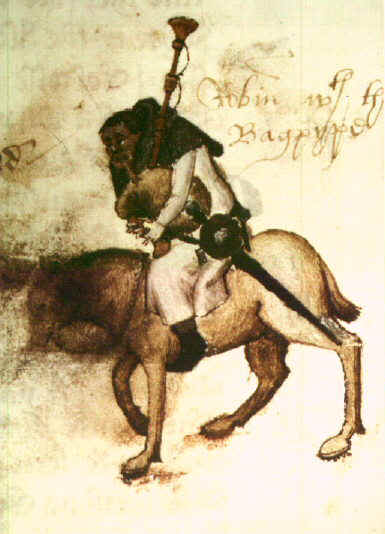
The Ellesmere Canterbury
Tales Miller

The Luttrell Psalter, Psalm 96, fol. 173
Chaucer’s Troilus and Criseyde based
on Boccaccio’s Filostrato
is magnificently illustrated in the Cambridge Corpus Christi
College manuscript, with Chaucer in a pulpit structure, a domuncula, preaching the
tale to his king, Richard II, who is clad in cloth of gold, and
to his court; behind them can be seen the scene of the prisoner
exchange of the tale.

In a word, it is
constructed as the Middle Ages perceived Terence’s theatre to be
with Chaucer as Calliopus.
The Canterbury Tales is also filled with references to
drama, to theatre. The Knight’s
Tale, based on Boccaccio’s Teseida, combines both tragedy and comedy. Its
tale of two young men, cousins, in love with the same maiden, is
resonant of many Terentian plots./30 Arcita is tragically killed
following his victorious duel/tournament played out in an
elaborate theatre built by Theseus, structured like a windrose,
a compass, where the mansions become temples, replete with
intense allegorical meanings (CT
KT I.1885-1892), while Palamon lives and marries
Emelye, following the funeral games, ‘Ne how the Grekes pleye / the wake pleyes’
(I.2959-60). We recall that two of Terence’s plays, Hecyra and Adelphoe, were performed at
the funeral games for Lucius Aemilius Paulus. This classic
construct is echoed in medieval plays in England, such as the Castle of Perseverance, where
the domunculus becomes
a castle,29 and in the Cornish
dramas30.

The Miller’s Tale
machinery involves the play of Herod and the Noah play (I.3384,
I.3513-82). The Wife of Bath enjoys going ‘to playes of myracles’ (III.558).
While the Franklin’s Tale
plays with the subtle and noble theatre of dinner
entertainments, of ships seeming to sail on oceans and hunting
scenes (V.1141-50, 1189-1204), evocative of Boccaccio’s Fifth
Day, Eighth Tale, painted by Botticelli for the wedding of
Giovanozzo Pucci.


Chaucer, though he never mentions Boccaccio, is Boccaccio in
English. He rewrites Boccaccio’s Filostrato as Troilus and Criseyde and Boccaccio’s
(Statius’) Teseida as
his Knight’s Tale.31 the first story of
the Canterbury Tales.
Chaucer thus creates of the Canterbury
Tales a sequel as it were, a copy, of Boccaccio’s Decameron. In addition to
Chaucer’s intertextual relationship with Boccaccio and thus with
Terence, there are his acknowledged debts to Dante and to
Petrarch: the Wife of Bath (CT
III.1125-1130) uses Dante’s Convivio
(IV.iii), to argue that ‘gentilesse’
is not from the hereditary nobility but accessible to all
through the practice of virtue, an argument also found in
Boethius, and influenced by both Terence and the Gospels; the Friar’s Tale against the
Summonour (CT III.1520)
mentions Dante; the Monk (CT
VII.2407-2462) retells Dante’s infernal tale of Ugolino of Pisa
(Inferno XXXIII.1-90),
and the Second Nun (CT
VIII.36-49) translates Paradiso
XXXIII,1-39’s invocation to the ‘Mayde and Mooder, doghter of thy Sone’.
Chaucer passes off Boccaccio’s final tale of the Decameron as Petrarch’s,
for Petrarch had admired it so much that he had translated it
into Latin, concealing its true source; Chaucer gave it to his
Clerk of Oxenforde to tell (CT
V.31-33, 1147-48).
To discuss the Decameron
and the Canterbury Tales
is to understand the second as using analogues of the first,
rather than as considering the Decameron as an open source. The Hundred Tales
of the Decameron veer
from courtly romance to raucous fabliau; and so do the Canterbury Tales. In
addition, we see in Chaucer the legends of saints and the kind
of moral and allegorical romance, found in the pages of the Golden Legend and the Gesta Romanorum. The Miller’s, Reeve’s, and Cook’s Tales are more
fabliaux than romance, more Boccaccio than Terence. The Miller’s Tale is of a
January/May marriage, and so is that of the Merchant. In
Boccaccio, this pattern even becomes the tale of the Tenth Day’s
Fifth Story, where the Lady asks the would-be lover for the
miracle of a May garden in January, which will become the Franklin’s Tale, given a
local habitation and a name in Brittany.
But let us pass over the parallels between Boccaccio and Chaucer
in this chapter on Terence’s influence upon both of them, and
instead delight in the fullness of all these authors, their
humanity, their celebration of diversity. E. E. Cummings best
caught the Terentian aspects of boundary transgression, of
pyramid busting, of pilgrimage liminality, in Chaucer’s great
comedy:
honour corruption
villainy holiness
riding in fragrance of
sunlight (side by side
all in a singing wonder of
blossoming yes
riding) to him who died that
death should be dead
humblest and proudest eagerly
wandering
(equally all alive in
miraculous day)
merrily moving through sweet
forgiveness of spring
(over the under the gift of
the sky
knight and ploughman pardoner
wife and nun
merchant frère clerk somnour
miller and reve
and Geoffrey and all) come up
from the never of when
come into the now of forever
come riding alive
down while crylessly drifting
through vast most
nothing’s own nothing
children go of dust.32
Let me also end with a fine aphorism in a Florentine Humanist
Terence manuscript, now in the British Library, that can embrace
all our writers, Terence, Luke, Dante, Boccaccio, Chaucer, and
Shakespeare: quid est comedia, comedia est imitatio vite, speculum
consuetudinis et imago veritatis (London, British
Library, Harley 2526, formerly owned by Randulphi de Ricasoli of
Florence).
Notes
Editions and translations used in this essay are: Terence, Publius Terenti Afer, Comoediae recognovervnt brevique adnotatione
critica instrvxerunt, ed. Robert Kauert and Wallace M.
Lindsay (Oxford: Clarendon, 1979) Oxford Classical Texts; The Lady of
Andros, The Self-Tormentor, The Eunuch. Sargeaunt, J,
trans. (Cambridge: Harvard
University Press, 1986) Loeb
Classical Library 22; Phormio, The Mother-in-Law,
The Brothers, trans. J. Sargeaunt (Cambridge: Harvard University Press, 1983) Loeb Classical Library 23; Dante
Alighieri, La Commedia secondo l'antica vulgata (Mondadori,
Milan, 1966); Tutte le
opere, ed.Luigi Blasucci, Luigi, ed. (Florence, Sansoni,
1987); The Divine Comedy,
trans. Allen Mandelbaum (New York: Bantam, 1902-1986);
Giovanni Boccaccio, Opere, ed.
Cesare Segre (Milan:
Mursia, 1978);
The Decameron, trans. C.H. McWilliam,
(Harmondsworth: Penguin, 1991); Geoffrey
Chaucer, The Riverside Chaucer, ed. Benson, Larry D.
Benson and F.N. Robinson (Boston, Houghton Mifflin, 1987); William Shakespeare, The Complete Works. ed. Hardin Craig and David
Bevington (Glenview: Scott, Foresman, 1973).
1 Italian
Humanist manuscripts of Terence derive from Angelo Poliziano’s
copy, Biblioteca Nazionale di Firenze, Banco Rari 97, made from
the fifth-century Vatican 3226 Bembino manuscript in rustic
capitals.
2 Victor
Turner, The Ritual Process: Structure and Antistructure
(Chicago: University of Chicago Press, 1968)
discusses pilgrimage and liminality which can be applied equally
well to comedy, in particular to Terence, in which social
distinctions are annihilated, as in Moliere’s Tartuffe where the
maidservant Dorine saves the day, and likewise the butler in
James M. Barrie’s The
Admirable Crichton.
3 Oxford, Bodleian
Library Auct. F.2.13=27603, is published in Major Treasures in the
Bodleian Library: Medieval Manuscripts in Microform, 9,
ed. W.O. Halsall (Oxford, 1978), and
discussed in Otto Pächt and J.J.G. Alexander, Illuminated Manuscripts in the
Bodleian Library (Oxford: Clarendon, 1981), III.16;
Leslie Webber Jones and C.R. Morey, The Miniatures of the
Manuscripts of Terence Prior to the Thirteenth Century (Princeton:
Princeton University Press, 1913).
4 Julia
Bolton Holloway, Twice-Told
Tales: Brunetto Latino and Dante Alighieri (Berne:
Peter Lang, 1993), 259-85.
5 Mary Hatch Marshall,
'Boethius’ Definition of Persona
and Medieval Understanding of the Roman Theater', Speculum
26 (1950), 471-82.
6 Sir
William Empson, ‘Double Plots,’ Some Versions of
Pastoral (New York: New Directions, 1960),
27-88.
7 Julia Bolton
Holloway, The Pilgrim and the
Book: A Study of Dante, Langland and Chaucer (Berne:
Peter lang, 1995), 27-55.
8 The Towneley Plays. (1897)
England, George F., ed. Early English Text Society, Oxford. EETS
71.
9 Millard
Meiss,
French Painting in the time of Jean de Berry: The
Limbourgs and their Contemporaries (Braziller, New York,
1974) passim and plates 7, 19, 63-64, 171-199, 201-221, 226-227,
230.
10 Arthur M. Hind, An
Introduction
to the History of Woodcut. (New York: Dover, 1963);
Pierre Courcelle, La Consolation de philosophie dans la tradition
littéraire, antécedents et posterité de Boèce (Paris: Etudes Augustiniennes, 1967).
11 Joseph Russo,
'Did Dante
Know Terence?', Italica 24 (1947),
217.
12 Pietro
Alighieri, Commentum
di Pietro Alighieri nelle redazioni ashburnhamiana e
ottoboniana, eds. Roberto Della Vedova, Roberto e Maria
Teresa Silvotti (Florence: Olschki, 1978), pp. 8-9.
13 Dante Alighieri,
De vulgari eloquentia, in Tutte le opere, ed.
Luigi Blasucci (Florence: Sansoni, 1981).
14
Holloway, The Pilgrim and the Book: A Study of
Dante, Langland and Chaucer (Berne: Peter Lang, 1987),
pp. 27-84.
15 Erich
Auerbach,
Mimesis: The Representation of Reality in Western
Literature, trans. Willard Trask (Garden
City: Doubleday, 1957), pp.
151-177.
16 Russo,
p. 212.
17 Auerbach, 'St. Francis of Assisi in
Dante’s ‘Commedia’, Scenes from the Drama of European Literature (New York: Meridian, 1959),
pp. 79-98.
18 Meiss,
Painting
in
Florence
and Siena after the Black Death: The Arts, Religion and
Society in the Mid-Fourteenth Century, (New York: Harper
and Row, 1973), p. 109, fig. 102.
19 Bruno
Bettelheim, The Uses of
Enchantment: The Meaning and Importance
of Fairy Tales (New York: Random House, 1977).
20 Leslie
Silko, 'Language and Literature from the Pueblo Perspective', Tales within Tales: Apuleius
through Time, ed. Constance S. Wright and Julia Bolton
Holloway (New York: AMS Press, 2000), pp. 141-156.
21 Germaine
Greer, ‘Grandmother’s
Footsteps’, Guardian
(http://www.guardian.co.uk/books/2010/may/15/germaine-greer-old-wives-tales).
22 Stith
Thompson, Motif-Index
of Folk Literature. A Classification of Narrative Elements
in Folktales, Ballads, Myths, Fables, Mediaeval Romances,
Exempla, Fabliaux, Jest- Books and Local Legends (Bloomington:
Indiana University Press, 1976), 6 vols.
23 Vladimir
Propp,
Morphology
of the Folktale, trans. Laurence Scott (Austin:
University of Texas Press, 1968).
24 Giovanni Boccaccio, Opere, ed. Cesare Segre (Milan: Mursia, 1963-78), pp. 116-17; Decameron, trans. G.M. McWilliam
(Harmondsworth: Penguin, 1995), pp. 119-120.
25 William Holman
Hunt buried his wife Fanny in Florence's 'English' Cemetery, in
a tomb he sculpted for her.
26 Georges
Duby, The Three Orders: Feudal Society Imagined,
trans. Arthur Goldhammer (Chicago: University of Chicago
Press, 1980); Jill Mann, Chaucer's
Medieval Estates Satire (Cambridge: Cambridge University
Press, 1973).
27 Theo
Stemmler, The Ellesmere Miniatures of the
Canterbury Pilgrims (Mannheim: University of Mannheim,
1977), Poetria Mediaevalis 2.
28 Janet
Backhouse,
ed. The
Luttrell Psalter (London: British Library, 1989).
39 David Anderson,
Before
the Knight’s Tale: Imitation of Classical Epic in
Boccaccio’s Teseida (Philadelphia: University of
Pennsylvania Press, 1988).
30 David
Bevington,
The Macro Plays: The Castle of Perseverance, Wisdom,
Mankind: A Facsimile Edition with Facing Transcriptions
(Washington, DC: Folger Shakespeare Library, 1972).
31 Richard
Southern, The Medieval Theatre in the
Round (London: Faber and Faber, London, 1957); Markham Harris, The Cornish
Ordinalia. A Medieval Dramatic Trilogy (Washington:
Catholic University of America Press, 1969).
32 E.E. Cummings,
Complete Poems, 1904-1962,
ed. George J. Firmage (New York: Liveright, 1991),
52, p. 661.
Go to:
Brunetto Latino and Dante Alighieri
I Bankers
and Their Books: Italian Manuscripts in French Exile
II Brown
Ink, Red Blood: Brunetto Latino and the Sicilian Vespers
III The
Vita Nuova's Pilgrimage Paradigms
IV
Stealing Hercules' Club: Inferno XXV's Metamorphoses
Geoffrey Chaucer
V Black and
Red Letter Chaucer
VI Fact
and Fiction: Women in Love
VII
Convents, Courts and Colleges
VIII
The Tomb of the Duchess Alice
Terence, Dante,
Boccaccio, Chaucer, Shakespeare
IX God's Plenty: Terence in
Dante, Boccaccio, Chaucer, Shakespeare Newest
Epilogue:
Attica State Prison, Boethius the Exile, Dante the Pilgrim

This is a Chapter from the Book, Sweet New
Style: Brunetto Latino, Dante Alighieri and Geoffrey Chaucer,
created, 1993; 'Sweet New Style' e-book Website
created, Pentecost 2003-10
JULIAN OF NORWICH, HER SHOWING OF LOVE AND ITS
CONTEXTS ©1997-2024
JULIA BOLTON HOLLOWAY || JULIAN OF NORWICH
|| SHOWING
OF LOVE || HER TEXTS
|| HER SELF || ABOUT HER TEXTS || BEFORE JULIAN || HER CONTEMPORARIES || AFTER JULIAN || JULIAN IN OUR TIME || ST BIRGITTA OF SWEDEN
|| BIBLE AND WOMEN || EQUALLY IN GOD'S IMAGE || MIRROR OF SAINTS || BENEDICTINISM|| THE CLOISTER || ITS SCRIPTORIUM || AMHERST MANUSCRIPT || PRAYER|| CATALOGUE AND PORTFOLIO (HANDCRAFTS, BOOKS
) || BOOK REVIEWS || BIBLIOGRAPHY ||© Julia Bolton
Holloway, Sweet New Style:
Brunetto Latino, Dante Alighieri, Geoffrey Chaucer, Essays,
1981-2024, E-book

