
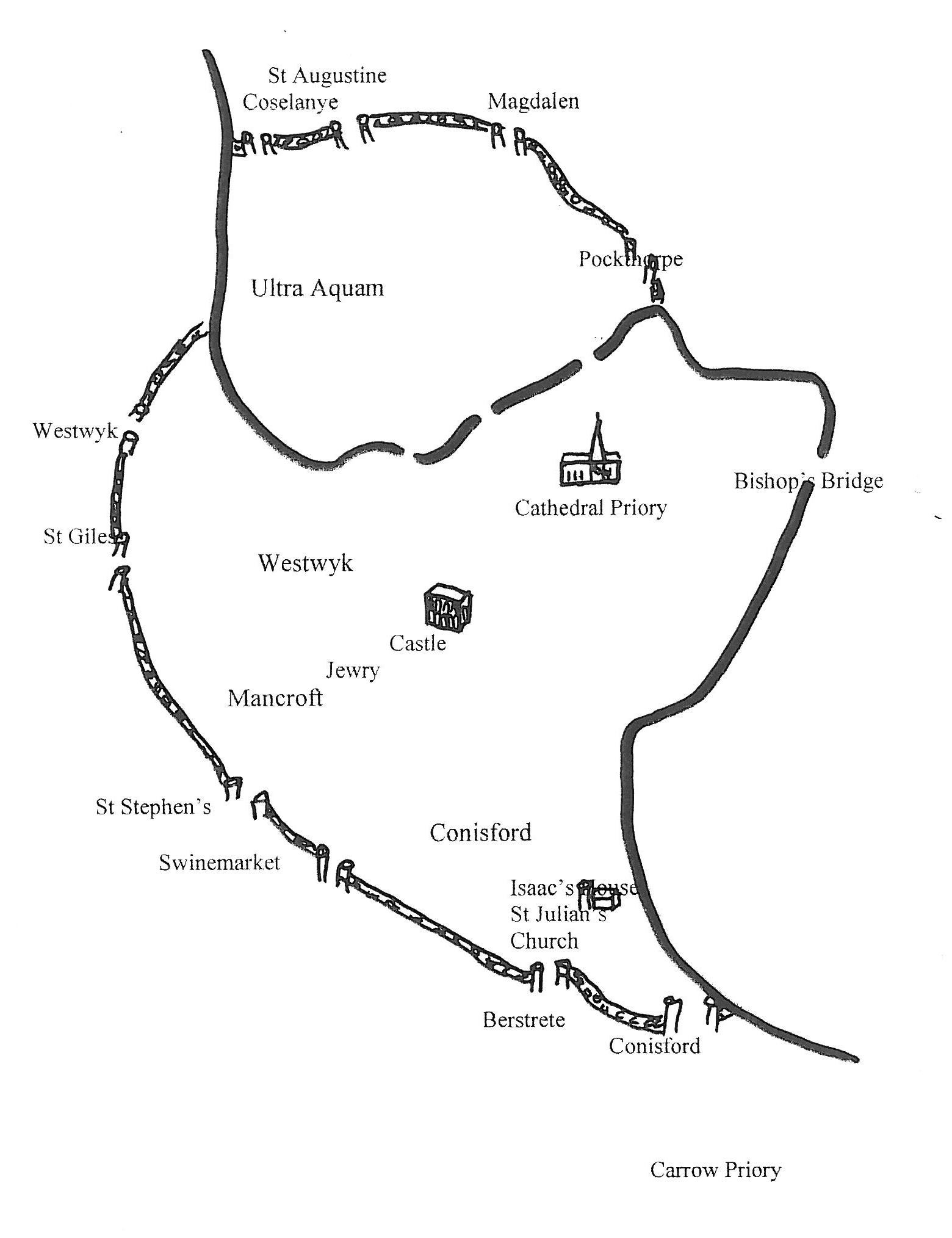
NORWICH, ST JULIAN'S CHURCH,
ISAAC'S HOUSE
AND CARROW PRIORY
 r download GoogleEarth and ask it to
show you Norwich, U.K., and zoom in until you are walking down
Rouen Road and Julian's Alley to the Music House (Isaac's
House) on King Street, continuing on to where King Street and
Rouen Road join, keep going past the ruined medieval wall
plastered together with cobble stones just as we see in the
Luttrell Psalter for Constantinople (which is really
portraying Norwich and her cathedral). until you can go no
further, then turn left until you come to the Unilever
security entrance, and there make an appointment to see what
Jeremiah Coleman called 'Carrow Abbey', really Julian's Carrow
Priory, which Colman's Mustard came to own. My family, the
Quaker Glorneys in Ireland, sold him the mustard secret and
monopoly, which they had obtained from marrying into French
royalty who were escaping the Revolution. The other Quaker
branches of my family, in England at this time, were Fry (a
relative, Norwich's Elizabeth Fry) and Cash. From both St Julian's
Church and from Carrow Abbey one can see how the city is
divided between Castle and Cathedral, glimpsing both imposing
structures. See also Adam Easton's schoolboy drawings of how
to measure the height of these.
r download GoogleEarth and ask it to
show you Norwich, U.K., and zoom in until you are walking down
Rouen Road and Julian's Alley to the Music House (Isaac's
House) on King Street, continuing on to where King Street and
Rouen Road join, keep going past the ruined medieval wall
plastered together with cobble stones just as we see in the
Luttrell Psalter for Constantinople (which is really
portraying Norwich and her cathedral). until you can go no
further, then turn left until you come to the Unilever
security entrance, and there make an appointment to see what
Jeremiah Coleman called 'Carrow Abbey', really Julian's Carrow
Priory, which Colman's Mustard came to own. My family, the
Quaker Glorneys in Ireland, sold him the mustard secret and
monopoly, which they had obtained from marrying into French
royalty who were escaping the Revolution. The other Quaker
branches of my family, in England at this time, were Fry (a
relative, Norwich's Elizabeth Fry) and Cash. From both St Julian's
Church and from Carrow Abbey one can see how the city is
divided between Castle and Cathedral, glimpsing both imposing
structures. See also Adam Easton's schoolboy drawings of how
to measure the height of these.

From an old engraving
of St Julian's Church with its tower as it was was before WWII
bombing.
http://www.the-plunketts.freeserve.co.uk§ give fine pre- and post-war photograph albums of Norwich created by George Plunkett, in particular of St Julian's Church and Carrow Priory.

27th June, 1942: St
Julian’s Church in King Street had almost everything excepting
its north wall and porch completely annihilated by a high
explosive bomb.


Isaac's House on King Street in Conisford is near St Julian's Church:

Continue down Rouen Road or King Street which join together. And before you get to Carrow Priory you see the ruins of Norwich's city walls. They are clearly identifiable with those in this scene from the Luttrell Psalter, which pretends it is of Constantinople:

Beyond
those ruined walls walk further, seeing a great ruined mansion
and restored conservatory built by the Coleman family. Go to the
end of that sreet, then turn left, until you come to Unilever.
Ask at security there for an appointment to see Carrow Priory.
It is as in these photographs, the Prioress' House kept
beautiful, the Priory destroyed by Henry VIII, but they have now
built a medieval herb garden from those still growing here from
the days of the nuns and they still market these herbs in oil to
Holland.


Marks on the bases of
the columns seem to identify the mason as the same who was
responsible for the building of the Infirmary at Norwich
Cathedral Priory, and the Jew’s House (Isaac’s Hall or the Music
House) in King Street.
Excellent resources for Julian's Norwich are
Francis Blomefield, An Essay towards a Topographical
History of the County of Norfolk . . . and other Authentick
Memorials (London: William Miller, 1805-10), 11 vols:
Volume IV, 1806, 81-3, 524-30, especially the manuscript
volumes in the British Library Manuscript Reading Room which
are illustrated with water colour sketches; and Walter Rye, Carrow
Abbey, Otherwise Carrow Priory, near Norwich, in the County
of Norfolk, Its Foundations, Officers and Inmates, Norwich,
1889.
For Carrow Priory, see also http://www.british-history.ac.uk/report.asp?compid=38270§,
http://monasticmatrix.usc.edu/monasticon/index.php?function=detail&id=1018§
For Chaucer's
Prioress, see Michael Calabrese 'Performing the Prioress'
at http://www.geocities.com/salferrat/chauccal.htm
Indices to
Umiltà Website's Essays on Julian:
Preface
Influences
on Julian
Her Self
Her
Contemporaries
Her Manuscript
Texts ♫
with recorded readings of them
About Her
Manuscript Texts
After Julian,
Her Editors
Julian in our
Day
Publications related to Julian:


Saint Bride and Her Book: Birgitta of Sweden's Revelations Translated from Latin and Middle English with Introduction, Notes and Interpretative Essay. Focus Library of Medieval Women. Series Editor, Jane Chance. xv + 164 pp. Revised, republished, Boydell and Brewer, 1997. Republished, Boydell and Brewer, 2000. ISBN 0-941051-18-8
 To see an example of a page inside with
parallel text in Middle English and Modern English, variants
and explanatory notes, click here. Index to this book at http://www.umilta.net/julsismelindex.html
To see an example of a page inside with
parallel text in Middle English and Modern English, variants
and explanatory notes, click here. Index to this book at http://www.umilta.net/julsismelindex.html
Julian of
Norwich. Showing of Love: Extant Texts and Translation. Edited.
Sister Anna Maria Reynolds, C.P. and Julia Bolton Holloway.
Florence: SISMEL Edizioni del Galluzzo (Click
on British flag, enter 'Julian of Norwich' in search
box), 2001. Biblioteche e Archivi
8. XIV + 848 pp. ISBN 88-8450-095-8.
 To see
inside this book, where God's words are in red, Julian's
in black, her editor's in grey, click here.
To see
inside this book, where God's words are in red, Julian's
in black, her editor's in grey, click here.
Julian of
Norwich. Showing of Love. Translated, Julia Bolton
Holloway. Collegeville:
Liturgical Press;
London; Darton, Longman and Todd, 2003. Amazon
ISBN 0-8146-5169-0/ ISBN 023252503X. xxxiv + 133 pp. Index.
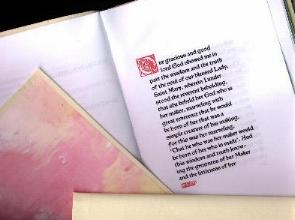 To view sample copies, actual
size, click here.
To view sample copies, actual
size, click here.

'Colections'
by an English Nun in Exile: Bibliothèque Mazarine 1202.
Ed. Julia Bolton Holloway, Hermit of the Holy Family. Analecta
Cartusiana 119:26. Eds. James Hogg, Alain Girard, Daniel Le
Blévec. Salzburg: Institut für Anglistik und Amerikanistik
Universität Salzburg, 2006.

Anchoress and Cardinal: Julian of
Norwich and Adam Easton OSB. Analecta Cartusiana 35:20 Spiritualität
Heute und Gestern. Salzburg: Institut für Anglistik und
Amerikanistik Universität Salzburg, 2008. ISBN
978-3-902649-01-0. ix + 399 pp. Index. Plates.
Teresa Morris. Julian of Norwich: A
Comprehensive Bibliography and Handbook. Preface,
Julia Bolton Holloway. Lewiston: Edwin Mellen Press, 2010.
x + 310 pp. ISBN-13: 978-0-7734-3678-7; ISBN-10:
0-7734-3678-2. Maps. Index.

Fr Brendan
Pelphrey. Lo, How I Love Thee: Divine Love in Julian
of Norwich. Ed. Julia Bolton Holloway. Amazon,
2013. ISBN 978-1470198299

Julian among
the Books: Julian of Norwich's Theological Library.
Newcastle upon Tyne: Cambridge
Scholars Publishing, 2016. xxi + 328 pp. VII Plates, 59
Figures. ISBN (10): 1-4438-8894-X, ISBN (13)
978-1-4438-8894-3.

Mary's Dowry; An Anthology of
Pilgrim and Contemplative Writings/ La Dote di
Maria:Antologie di
Testi di Pellegrine e Contemplativi.
Traduzione di Gabriella Del Lungo
Camiciotto. Testo a fronte, inglese/italiano. Analecta
Cartusiana 35:21 Spiritualität Heute und Gestern.
Salzburg: Institut für Anglistik und Amerikanistik
Universität Salzburg, 2017. ISBN 978-3-903185-07-4. ix
+ 484 pp.
  |
To donate to the restoration by Roma of Florence's
formerly abandoned English Cemetery and to its Library
click on our Aureo Anello Associazione:'s
PayPal button: THANKYOU! |
JULIAN OF NORWICH, HER SHOWING OF LOVE
AND ITS CONTEXTS ©1997-2024 JULIA
BOLTON HOLLOWAY
|| JULIAN OF NORWICH || SHOWING OF
LOVE || HER TEXTS ||
HER SELF || ABOUT HER TEXTS || BEFORE JULIAN || HER CONTEMPORARIES || AFTER JULIAN || JULIAN IN OUR TIME || ST BIRGITTA OF SWEDEN
|| BIBLE AND WOMEN || EQUALLY IN GOD'S IMAGE || MIRROR OF SAINTS || BENEDICTINISM || THE CLOISTER || ITS SCRIPTORIUM || AMHERST MANUSCRIPT || PRAYER || CATALOGUE AND PORTFOLIO (HANDCRAFTS, BOOKS
) || BOOK REVIEWS || BIBLIOGRAPHY ||


