
AND HOLMHURST ST MARY
St Agnes, Basilica of Sant'Agnese, Rome

Arson Steps and Terrace, then St Teresa and Utopia,
above Hebron and Salem dormitories,
Hebron having been Augustus
Hare's library causing its floor to slope from the weight of
books
 n the early 20th Century, when Mother
Agnes Mason, CHF,
first saw Holmhurst St Mary, the place was abandoned, empty,
with wild roses growing in profusion everywhere. She had
fallen in love with Italy, and, while sitting in an olive tree
above Florence, had first planned the
n the early 20th Century, when Mother
Agnes Mason, CHF,
first saw Holmhurst St Mary, the place was abandoned, empty,
with wild roses growing in profusion everywhere. She had
fallen in love with Italy, and, while sitting in an olive tree
above Florence, had first planned the

Augustus Hare had planted an Italian pomegranate in the verandah built against the wall here, since taken down but the pomegranate was still flowering as late as ten years ago. To the right, Singleheart and Siris, Siris in my day having framed photographs of many Church of England dignatories who were Mother Agnes' relatives and friends, upstairs the domitory Salem, to the left, Arcadia and St Teresa, the Community's first chapel, upstairs Beulah and Hebron. In our schooldays in the forties and fifties Holmhurst still had Italian louvred shutters in green on every window.

The rooms at the left were added by Lady Kennedy between the occupancies of Augustus Hare and the Community of the Holy Family and downstairs housed Pilgrim's Progress, the Sixth Form room, and upstairs Siloam. In the centre are Singleheart and upstairs, Carmel, which were the original eighteenth-century building before Augustus Hare enlarged it.
This is because Holmhurst had been built around one small original house from the financial proceeds of the books Augustus Hare, the Victorian travel writer, published, in black and red covers, filled with delicate engravings made from his own excellent sketches in situ. To the original structure he added a most lovely Italian Renaissance terrace, placing on it a Byzantine stone wellhead, carved with grape vines (amusingly placed by him upside down, the grape clusters pointing up rather than down), brought back from Venice,

Venetian Wellhead on Terrace. This photograph taken at a time when Holmhurst was neglected. We schoolgirls used to play hopscotch with these wind-blown broken slate rooftiles, drawing the lines upon cement to skip upon. Hop-scotch lines even map the blue/red/print of an ideal church, its final square, 'Paradise'. Today Holmhurst St Mary's premises are well-maintained, and we have offers of workcamps of young Italians desiring to learn English and willing to work on needed repairs to what is essentially an Italian structure. But the Trustees, though their documents say it is for sale, will not sell it back to us.

St Teresa, formerly Augustus Hare's dining room, then the original chapel of the Community of the Holy Family. Augustus Hare had a verandah running alongside Singleheart, Siris, and St Teresa.
At the terrace's end is the Ave/Vale Gate and steps, our Latin lessons having begun with searching out in the grounds all the Latin mottoes inscibed upon stone.

a great room opening onto it with a William Morris wallpaper, called 'Utopia', after St Thomas More's book, by Mother Agnes, and a gallery reaching it, called 'Arcadia', after Sir Philip Sidney's book written for his sister, the Countess of Pembroke, by Mother Agnes, which Augustus Hare had filled with medieval and Renaissance wood panelling. In my day a great sepia photograph had hung above Utopia's fireplace of the Roman Forum.

Arcadia's Medieval and Renaissance Wood Panelling
Beyond is Utopia with the
William Morris wallpaper, its windows
looking on the Terrace, Venetian
wellhead, and the sea.
Modern furniture, fluorescent
lights are hideous! Mother
Agnes said a sin against beauty
is a sin against God.
The statue of the Madonna and
Child is by Michael
Fairless, Mother Agnes' friend.
I restored it, including the
broken blessing hand of the
Child. I restored the thousands of
books and shelved them. And
restored all the floors, of Arcadia,
Utopia, the Chapel, the
Scriptorium, and many others.

How it was in our day
Mother Agnes Mason, in her Conferences, learnedly and joyously spoke with her Sisters, of Hebrew and Greek studies in tandem with the Bible, of a sin against beauty as a sin against God, against the Holy Spirit, and of caring for all, educating all, women educating women, rich and poor, white and other, in England, in India, in Africa, in America. She and her brothers shared a dream for the Church of England, of informing the Archbishop of Canterbury of Bede College at Umtata, of All Saints at Naini Tal. It was a possible and glorious future. Shattered by what made the Community of the Holy Family and the Church of England dysfunctional. This essay, in the spirit of Archbishop Desmond Tutu's Truth and Justice 'healing of memories' invites St Mary's former schoolgirls to share what was valuable and lovely about our schooling, and to lay down what was ugly and wrong about it. I can assure you I found that in reading the archives what later went wrong was not there in those early days of innocence, devotion, beauty, learning.
Mother Agnes Mason's account of Holmhurst St Mary begins by describing the difficulties of the move from London to Sussex, the children being in the beautiful house, the Sisters in cramped and very unhealthy quarters first in the Hospice, then in the Coach House, and no decent drains built yet. But she exults in the land, the views, and the architecture. She writes:


These two paintings are by Sister Christine C.H.F.'s artschool friend, Fanny Borrow. Compare with Augustus Hare's own engraving of his Italianate Renaissance terrace.
Then inside the house; you go in - Companions have seen the picture of the porch with St. Cuthbert and St. Cecilia [since stolen], (with a Latin inscription-pax intrantibus-salus exeuntibus-benedictio habitantibus:) - then you go into a long hall, gallery we should call it in a College except that it is on the ground floor; an oak corridor, where Mr. Hare had collected all kinds of carved pieces of oak, all different, and all beautifully harmonious: it is all wainscoted, the whole of the gallery. We have made this into the children's dining room [Arcadia].
Then you go along this corridor into a beautiful room, the children's sitting room, with a bay window, looking over the terrace. There they have all their joys, rocking horse, etc [Utopia]. Then you go up a rather curious little staircase, a little winding staircase and you come to an upper corridor, where we have made two class rooms. We had a window put in and it has made a charming little classroom with a bookcase jutting out setting other things there, and beyond is another little class room [Beulah]. We shall be able to make room for a few more children by making ourselves a little more uncomfortable - before Easter - when we shall begin to build. . . .
Our Chapel will be a great joy to us; it is unmistakeably a stable [St Mary's Chapel]. I persuaded the men to leave the beams: it will be all white inside . . . then we have taken in a little shed at the back, making a beautiful little ante Chapel - we shall have the frontal case and a bookcase there - we can see the Altar. The Altar will be the one that we had here, and the four little windows high above it, as high as we could get them [Later glazed with Raphael, Gabriel, Michael and Uriel]. You come into the Chapel between the stalls. We are going to have the Crucifix put up on the gable of the Coachhouse [Ecco Amor Dei], and here we have a turret and bell.
The last cause for thankfulness is that we ourselves are extremely uncomfortable. In our Refectory there is not much room to sit at table as it is, and we have no other room, as the Library and Common Room [St. Theresa] we are using for a Chapel - we have only the Refectory to sit in. Then part of the table can't be occupied because of the bowls to receive the drippings of water when it rains. And I must confess we are very tightly packed - in the Hospice there are eight people where there ought to be five. It will be better when we have finished turning the coachhouse into bedrooms. There will be more room for children after that.

Mother Agnes built on to the original buildings, this part becoming the classroom, Edgeworth, and a long corridor with music rooms, upstairs, nuns' cells and dormitories named after the letters of the Greek alphabet, finally the gymn which became the library.

This is Edgeworth classroom, with our old sloping desks, much better for eyes than modern flat ones, and inkwells.
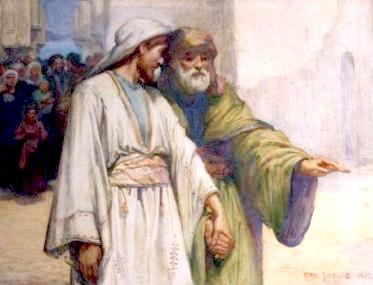
Many of these treasures were thrown into the old School Chapel, when the Sisters had the modern ugly one built. This was where I found the first complete edition of Hooker's Ecclesiastical Polity thrown into a tea chest, its cover ripped off. But this was our Chapel where we were confirmed by the Bishop. This was where we could study the great reproduction of the Van Eyck altarpiece during sermons. This was where we came as close to Christ as does the blind man in Myra Luxmore's gentle painting.

One of my school friends in far-away Canada wrote
the following, more beautifully than I could have, but of
exactly the same treasured memories of St Mary's in our hearts
and in our souls.
| REMEMBRANCE
I remember the many
times |
How in Spring's new air The crocuses erupted On the sloping lawn, Summer's scented flowers Following close behind. Then Autumn's time to die, And Winter's naked form Shiv'ring under oatmeal sky. I remember the pebbled terrace, Faded mosaic telling of Better yesteryears; Regal steps descending Fan-wise to lower lawn, Where the mulberry Stooped her great age. And Queen Anne's statue stood A relic of the past, Not to be forgotten. I remember the narrow passageways Fading into darkness, The old oak panels And dark, strong beams. Girlish laughter echoing In the catacomb of ante-rooms Throughout the house, Harbouring our childish dreams. Now, nursing a wistful heart, I look back at that house Upheld by faith, To its people cacooned Within its walls; For its sheltered life I have had to leave To enter another Large and crude. But its beauty I shall never forget, Nor its constant mood, And I pray God It will not be spoilt, But remain a sanctity Of holy good. Hazel Pigott, 1967-68 |

Hazel also sent me many of these photographs of Holmhurst from Canada. An earlier set she had sent me were destroyed in an action contrived by the Mother Agnes Trust formed to protect and foster the Community's properties and educational endeavours, with my barrister's file being deliberately stolen and burnt.
I made my Vows in 1996 as Anglican but in Italy, in
a church like my school dedicated to St Mary, forever yearning
to return to this dream place in Sussex. Before I had left I
had detailed how its extensive buildings and land could be
used to help not only the local neighbourhood but the whole
world, according to Mother Agnes Mason 's
vision and charism, now using the Internet as the Apostolate
of the Scribe, at Holmhurst, in its great rooms and classrooms
and with its fine library, giving academic courses and
conferences, holding retreats, training young people out of
work, with no skills, no hope, in Hastings, how to bind books
using the equipment the Sisters had there, great Victorian
wood book binding presses, how to frame pictures, how to do
cabinetry, how to be carpenters, like Christ, and, with the
stone quarry in the grounds, how to be stone masons, from the
drawers and drawers filled with coloured silks and gold thread
how to do ecclesiastical embroidery, make vestments, altar
linens, with the land, how to garden and grow produce, keep
chickens to have fresh new-laid brown eggs for themselves and
guests coming here, milch cows and goats and sheep, for milk
and cheeses, so much else. But my proposals were met with
'Julia's desire to be practical is impractical'. And so the
secular buildings were offered for commercial sale, the
convent, the chapel, the sacred buildings, destroyed, while I
lived in one room, without heat, on foot, for four years,
until given a graveyard took after in the heart of Florence,
wherein are buried so many Church of England clergy, my task
now to find the funds to restore their neglected monuments and
to apprentice myself to a stone mason to learn how to do
repairs to the tombs, many of which have had their crosses in
Carrara marble vandalized. And where I continue as librarian
of a theological library, the Biblioteca e
Bottega Fioretta Mazzei I have founded, whose shelves I
built myself like those of the Bodleian, and in which we teach
paper marbling and book binding to old and young, in which we
teach the alphabet to a gypsy mother, in which we teach
starving artists how to make their frames, in which we read
Dante's Commedia in Italian on Thursdays by
candlelight, in which on Sundays by candlelight we meet for
prayer and supper, Florentines accepting this English hermit
dressed in the blue and veil of her lost Community of the Holy
Family. The Godfriends which started in the Library at
Holmhurst St Mary of Anglicans, Quakers, Catholics, Jews,
continues now in cyberspace and on every continent but
Antarctica.

Older Convent /Modern Convent/Holmhurst St
Mary/Terrace
Modern
Chapel/Library/Classrooms/Further Classrooms
(of which the convent, chapel,
library and classroom buildings are now torn down)
Farm beyond road at left top,
also 'Further Classrooms', not included in Sale.

Blessed Sacrament Chapel, Holmhurst St Mary
Mother Agnes worked hard to have two things, the Blessed Sacrament reserved in a special chapel built out of the stable, as had St Teresa of Avila done, and to have a burial ground for the Sisters, after the burial of the first two sisters in Westfield. In the latter case she was told by the city authorities this was forbidden. She then asked what the farmer did when his cows died. On being told he buried them in a field, she replied 'What is good enough for his cows, is good enough for my nuns'. She won. The graveyard lies beyond Augustus Hare's Rocky Valley. Simple wooden crosses have now been replaced by iron ones, the great cross of Sussex oak under which Mother Agnes was buried also replaced. These Sisters had been in India, had been in Florence, one coming from Germany with a vast library of books in fraktura. Mother Agnes and generations of her school girls were good stewards of the beauty of Augustus Hare's dream house. If you can visit, please lay flowers on the graves of Mothers Agnes, Gwendolyn, Muriel, Sisters Barbara, Catherine, Charlotte, Christine, Eileen, Florence, Helen, Joan, Lucy, Margaret, Mary, Mary Frances, Phyllis, Valerie, Veronica, most of them my teachers, in my name.
The Sisters of the Community, from the school and from the property, land being sold for the modern Conquest Hospital next door, had become millionaires, which I did not know when I joined them. That was tragic, resulting in a retirement from Christian service, apart from a few retreats a year. It was a women and children's Utopia, which could have been now shared with men. It was of great learning, of great Christianity, so very much needed in the Church of England today; it could have been revived and been of use again for love of God and neighbour. We didn't need the money. We needed the books, the buildings, the land. All of which were already there, being Mother Agnes Mason's heritage for Sussex and the world. Mother Agnes wrote into her Rule that we schoolgirls were to go out into the world, with the love of beauty, the love of poverty, and with the salt of good learning.
The love of beauty is only superficially and not really opposed to the love of poverty, but the union of the two produces a peculiarly clean and attractive type of Christian character and work. And we should aspire to have our pupils enrich and purify the world with this salt.

Return to Augustus Hare's Holmhurst (http://www.umilta.net/holmhurst1.html)
Go
to How They Subdivided Holmhurst
(http://www.umilta.net/holmhurst3.html)

  |
To donate to the restoration by Roma of Florence's
formerly abandoned English Cemetery and to its Library
click on our Aureo Anello Associazione's
PayPal button: THANKYOU! |