Ante concocts
his dream landscape from the text he was reading when he
fell asleep over it, Virgil’s Aeneid VI. It is the
same map, the same monsters. But there are other
landscapes patchworked into the text. Dante as a child
played in the 14.Piazza Donati (Plate XXVI a, b). But in the hot
Florentine summers all these families went away into the
countryside where the land was higher and more healthy,
where the Etruscans had dwelled in citadels, in contrast
to the Roman love of low-lying mosquito and
malaria-infested river valleys. Dante’s own family, the
Alighieri, and that of the Portinari, would have exited
from the Porta a Pinti, the Porta Fiesolana, out into the
countryside around Ontignano and Santa Brigida, around
Monte Ceceri of the Domenico di Michelino painting in the
4. Duomo (Plates XIX, LXVII a, b, c), Montesenario
and Sasso, the region where I heard contadini
still reciting Dante’s Commedia cantastorie by
heart when I lived for four years as a hermit in that
region.
An Irish pilgrim was coming through Fiesole’s town square
during the election for a new bishop and so “Sanctus Donatus
Scotus” was himself elected, the writer of Latin poetry about
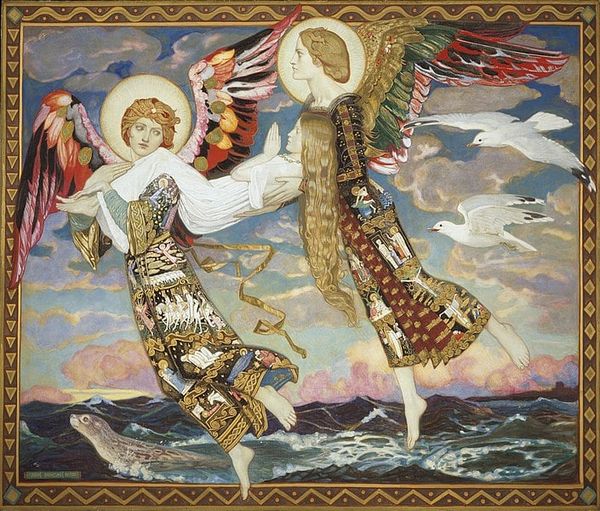
St Bridget of Ireland and the first to tell of the miracle of
her placing her wet cloak on a sunbeam to dry, a tale I found in a
manuscript (BML
Mugellanus de Nemore 13), written out in the
twelfth century in the Mugello, that was so huge that I had to
stand to read it in the Laurentian Library. Sant’Andrea also
arrived from Ireland and became a hermit on the mountain of
Sasso, 829, San Donato then having him be his Archdeacon, and
who became Bishop of Fiesole in turn. Sant’Andrea built the
church of San Martino in Mensola that is below Harvard’s I
Tatti, its altar, decorated by Fra Angelico, telling his
legend from the ninth century. His sister, a different and
later Santa Brigida, likewise came over from Ireland and lived
in a grotto below that of Sant’Andrea’s cave at Sasso (a
mirroring of Benedict and Scholastica’s Subiaco), the little
Tuscan town of Santa Brigida growing up around her and to whom
she taught the Bible. Locally the people think Donatus and
Andrea came from Scotland as they were named ‘Scoti’ in the
Latin documents about them. But the Irish, known as ‘Scoti’,
settled Scotland from Ireland giving that region their name.
Then, 2 July 1490, during the Renaissance, the
Virgin next appeared to the two Ricoveri shepherd girls at
Sasso, their father imprisoned and ill in the Stinche, telling
them to tell Florence to study the Bible. When the girls were
not obeyed, she next healed their father’s illness, freed him,
and appeared to the adults, telling them to believe the
children, giving to all the same Magnificat world-upside-down
message, that Florence must study and live the Gospel.
Pilgrims from the regions around would come to the beautiful
church and their own hospices at Sasso, these being bombed in
WWII, though pilgrims are still welcomed there.
The next mountain over, Montesenario, was the
site and still is the monastery, where seven rich merchants’
sons, all Florentines, and members of a Compagnia dei
laudesi, had a vision of the Virgin, 15 August 1233, and
several more following that. They gave up all to be the Servi
di Santa Maria, the niece of one of them, Santa Giuliana
di Falconieri, next founding the lay Order of the Servites, of
which I am one. Their church in Florence is the Santissima
Annunziata with its legend of the miracle-working frescoed
Madonna at the Annunciation as finished by an angel.
I learned these stories mainly orally, taking
them with a grain of salt but also with the Coleridge’s
“willing suspension of disbelief”. Just as I had in accepting,
in Complementarity, St Helena’s choice of Mount Sinai, though
knowing she had got it wrong, when I climbed it in 1992.In 2001 I organized
an international conference on the Alphabet and the Bible to
which Jewish, Russian, Icelandic, Spanish, Irish and English
scholars came and I took them to these sites, St Bridget’s
grotto at Santa Brigida, Sant’Andrea’s hermitage at Sasso, the
monastery of the Servites at Montesenario, explaining that
these oral traditions about Irishmen in the region where Dante
and Beatrice as children went each summertide could well have
meant that Dante heard the likewise mainly oral traditions of
the tales of the Voyage of Bran, of the Voyages of
St Brendan, of St Patrick’s Purgatory.1
Dante gave that voyage beyond the Straits of Gibralter, of the
Pillars set by Hercules, which Francesco da Barberino
illustrated in the Tesoretto (Plate LXXVI c, BML
Strozzi 146, fol. 10r), to Ulysses in Inferno
XXVI.2 And then he gave that landscape, of the
island of Purgatory in the midst of the Ocean at the
Antipodes to Jerusalem, to himself as a Pilgrim in the
Purgatorio. Indeed, the Catholic Church had
already taken on board that Irish concept of
Purgatory, which came to permeate European culture,
just as did also Celtic rhyming take over from Latin’s
long/short quantitative measures. Dante’s terza
rima is still sung today in cantastorie
by Tuscan contadini. I have heard and recorded
their chanted poetry for you.3
1 Maire Herbert, “The Celtic Otherworld and the Commedia/
L’Aldilà Celtico e la Commedia”, The City and
the BookII:
The Manuscript, the Illumination, Accademia delle Arti
del Disegno, via Orsanmichele 4, 4-7 September, 2002,
https://www.florin.ms/beth3.html#herbert; “The
Legacy of the Irish Peregrini in Tuscany/ Il
Retaggio dei Peregrini in Toscana”. The City and the Book Conference I: The
Alphabet and the Bible: International Conference in
Florence’s Certosa, 30,31 May, 1 June, 2001. https://www.florin.ms/aleph3.html#cork; see also Massimo Bonafin, “Relativistic
Time and Space in Medieval Journeys to the Other World”, Cognitive
Philology 2 (2009).
2 W.B. Stanford, The
Ulysses Theme: A Study in the Adaptability of a
Traditional Hero;Kuno Meyer
translated the Irish Merugud Uilix Maicc Leirtis:
 Ante concocts
his dream landscape from the text he was reading when he
fell asleep over it, Virgil’s Aeneid VI. It is the
same map, the same monsters. But there are other
landscapes patchworked into the text. Dante as a child
played in the 14. Piazza Donati (Plate XXVI a, b). But in the hot
Florentine summers all these families went away into the
countryside where the land was higher and more healthy,
where the Etruscans had dwelled in citadels, in contrast
to the Roman love of low-lying mosquito and
malaria-infested river valleys. Dante’s own family, the
Alighieri, and that of the Portinari, would have exited
from the Porta a Pinti, the Porta Fiesolana, out into the
countryside around Ontignano and Santa Brigida, around
Monte Ceceri of the Domenico di Michelino painting in the
4. Duomo (Plates XIX, LXVII a, b, c), Montesenario
and Sasso, the region where I heard contadini
still reciting Dante’s Commedia cantastorie by
heart when I lived for four years as a hermit in that
region.
Ante concocts
his dream landscape from the text he was reading when he
fell asleep over it, Virgil’s Aeneid VI. It is the
same map, the same monsters. But there are other
landscapes patchworked into the text. Dante as a child
played in the 14. Piazza Donati (Plate XXVI a, b). But in the hot
Florentine summers all these families went away into the
countryside where the land was higher and more healthy,
where the Etruscans had dwelled in citadels, in contrast
to the Roman love of low-lying mosquito and
malaria-infested river valleys. Dante’s own family, the
Alighieri, and that of the Portinari, would have exited
from the Porta a Pinti, the Porta Fiesolana, out into the
countryside around Ontignano and Santa Brigida, around
Monte Ceceri of the Domenico di Michelino painting in the
4. Duomo (Plates XIX, LXVII a, b, c), Montesenario
and Sasso, the region where I heard contadini
still reciting Dante’s Commedia cantastorie by
heart when I lived for four years as a hermit in that
region.