 he nuns went to Mass. The circle-dancers danced. A
yoga group was in full session in the corner. A tree-hugging
group swayed around the trees. Chanters wafted Indian music in
the distance. Some just went to breakfast.
he nuns went to Mass. The circle-dancers danced. A
yoga group was in full session in the corner. A tree-hugging
group swayed around the trees. Chanters wafted Indian music in
the distance. Some just went to breakfast. You
who turned back the streams of war
whose name invoked stilled monsters in the seas
whose cross remains a resplendent, golden sparking flame
come again from the dark bog and forge us anew.4
whose name invoked stilled monsters in the seas
whose cross remains a resplendent, golden sparking flame
come again from the dark bog and forge us anew.4
Patronness of smithwork
The
blacksmith, the traditional figure of alchemy, magic, and
culture, was a feared and revered figure in most traditional
societies and Indo-european mythology.5
He transformed nature to culture, forged the instruments of
agriculture, shod the animals and often maintained the
village fire. As we will see when we turn to the sources,
there is much more to Brigit and the blacksmith than
originally meets the eye: Brigit's smithwork proves to be
quite unique.
Old Irish mythology
In old Irish mythology, in The Book of Invasions, we find evidence that the figure of the blacksmith was distinctly problematic.6 The king of the Tuatha Dé Danaan (People of the Goddess Danu), King Nuadu, lost his arm in battle. Because he was now physically blemished, Nuadu had to resign from the kingship.
His resignation made way for Bres, of the Fomorian race, (one of the invaders) who was granted the kingship provided he treated the people well. However, Bres began to levy heavy taxes on the people and they groaned under the weight of the oppression.
In the meantime, Dian Cecht, blacksmith of the Tuatha Dé Danaan, had made Nuadu an arm of silver, but he was still technically blemished and the arm had begun to fester. But Dian Cecht, had a son, Miach and a daughter, Airmid, both doctors. Going to Nuadu, they actually grew another arm for Nuadu, using the words, sinew to sinew, and nerve to nerve be joined. Nuadu was able to resume the kingship and dethrone the oppressive powers.
But they had reckoned without Dian Cecht . Profoundly jealousy of his son's achievement, Dian Cecht attempted to kill Miach. Three times he wounded him seriously, but on each occasion, Miach was able to heal himself. On the fourth and final attempt, Dian Cecht su cceeded.
Airmid was grievously distressed at what had happened and wen t to her brother's grave. On Miach's grave, three hundred and sixty five types of herb were growing: one for every day of the year, for every nerve in the body, and every human ailment. She began to gather the herbs, arranging them carefully on her cloak, systemising their properties. Dian Cecht, incensed at the powers of his son and daughter, irretrievably scattered the herbs.
The legend ends that had it not been for the jealousy of Dian Cecht, the blacksmith, we might have lived forever wi th medicines to cure all ills. The story clearly reverses some mythological themes. Death enters the world, not through Eve's sin or Pandora's chaos, but through the jealousy of the blacksmith father. Like Antigone, Airmid attempted to honour her brother's memory, but was caught up in patriarchal jealousy and rivalry.
Already, therefore, the figure of the blacksmith is problematic. Miach and his sister, Airmid, drew, not on the transformative power of metal, but the transformative powers of life to bring about their healing. The culturally constructed silver arm cannot compete with the power of life itself. The rejection of their arts would have far-reaching con sequences.
The ambivalence of the blacksmith recurs in another tale, The Battle of Moytura.7 Irish legend tells of many invasions, but the invaders were always made welcome, provided they respected the ways of the Irish and honoured their goddesses. For instance, they were allowed to come to Ireland provided they honoured the ways of the goddess by giving the goddesses' names to the land. Marriage and syncretism traditionally enabled the Irish to tolerate diversity, to welcome the stranger.
In The Battle of Moytura things began to take an ominous turn. Goibniú was the smith of the People of the Goddess Danú, but the weapons he made were magical. Brigit was a member of the Tuatha Dé Danaan and in order to cement relations between two distinct peoples, she married one of the invaders, Bres of the Fomorians. Goibniú made a weapon for Brigit's son, Ruadán, who thanked him by turning the weapon on him and attempting to kill him.
Goibniú survived the triple attack but then turned the weapon on Ruadán killing him. On hearing of the death of her son, Brigit shrieked and wailed. According to the text: this was the first time shrieking and wailing was heard in Ireland. The Battle of Moytura ends with an ominous intonation from the Goddess, Morrigú, signalling the end of matri-centred Ireland:
Peace up to heaven,
Heaven down to earth,
Earth under heaven,
Strength in every one,
I shall not see a world that will be dear to me
Summer without flowers,
Kine will be without milk,
Women without modesty,
Men without valour,
Captures without a king...
Woods without mast,
Sea without produce...
Wrong judgements of old men,
False precedents of lawyers,
Every man a betrayer,
Every boy a reaver.
Son will enter his father's bed,
Father will enter his son's bed,
Every one will be his brother's brother-in-law...
An evil time!
Son will deceive his father,
Daughter will deceive her mother.8
Lives of Brigit
Clearly the culture of weapons, made possible by the arts of the blacksmith, is distinctly problematic: the spirituality of the old pre-Celtic matri-centred Ireland was antithetical to the new spirit now being introduced. In the Christian Lives of Brigit, this theme continues.
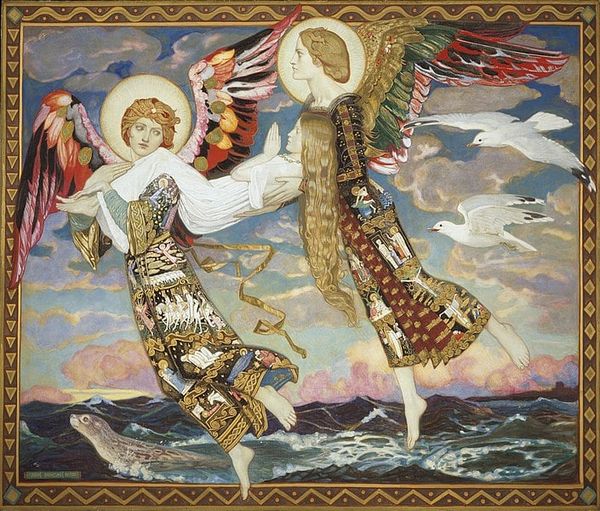
In one version of her Life, Brigit had a bishop, Conlaed who was particularly fond of fine vestments. Brigit gave these vestments away to lepers, beggars, or to whomsoever she felt needed them more. Several times she had to make the clothing reappear to appease Conlaed's wrath. A crisis arose when he appeared one day in search of them, and all she had to offer was a garment like to the skin of a seal's head. Exasperated, Conlaed set out for Rome for the third time, presumably to get more vestments, but Brigit said to him: You will not get there and you will not come back. And so it was fulfilled, for wolves devoured him.9
Possibly it was in relation to this and other incidents that a famous refrain of the early Celtic church was composed:
To go to Rome, much labour, little profit
The King whom thou seekest here,
unless thou bring him with thee, thou findest him not.
Much folly, much frenzy, much loss of sense, much madness (is it), since going to death is certain, to be under the displeasure of Mary's Son.10
In another version of this story, however, Connlaed is not a bishop, but a smith. The garments of the religious officiaries of old Europe, the garment like to a sealskin, referred to the power to be found by returning to the womb, symbol of the source of life itself. We know that in the old Indo-European tradition officiating priests curled up in such garments during their rites.11 The seal was a symbol of immortality, but equally, the sealskin garment simulated the womb. In other rituals (possibly later) kings bathed in the blood of the slain mare, or entered menstrual huts at specific boundaried times to immerse themselves in female entropy.12
The old European priests entering the seal skin garment, the cave of Newgrange, or Loch Derg were returning to the womb of the earth for re-birth and regeneration. Even the early Christian churches remembered this: figures known as sheela-na-gigs were often placed on the door lintels. Foetal-like in appearance, they held their genitals apart signifying to the person coming in that they were re-entering the womb/church, a place where our origins were honoured and remembered. The church was a place of peace: weapons must be left aside; the power of life and death remained the prerogative of divinity.13
This anecdote by the early church historian, Bede, is telling in this respect: When the Chief Priest of the British, Coifi, had heard the message of Christianity (C.E. 627), he, together with the king, renounced his faith and set about destroying the temples and altars that he himself had previously dedicated. And so Bede relates, "He formally renounced his empty superstitions and asked the king to give him arms and a stallion-for hitherto it had not been lawful for the Chief Priest to carry arms or to ride anything but a mare-and thus equipped, he set out to destroy the idols." 14
In the culture of the blacksmith, social prestige has resided not in the ability to enhance and co-operate with the life-force and the earth, but in the military ability to effect victory, develop weapons, and dominance based on grandiosity.
Whether smith or bishop, Connlaed represented the emerging culture where nature was not enhanced but superseded. The bishop, Connlaed's, fine vestments were outer garments of grandiosity, pretension, and power. Holiness and awe was not naturally encountered in the artefacts of nature, but socially, culturally, and artificially induced by the ostentatious garments of religious culture.
It goes without saying that only privileged members of the privileged sex could wear such garments. Moreover, such new religious officiaries would have to free themselves of all the symbols of abjection, that is to say all reminders of origins: menstrual blood, milk, contact with women. Not accidentally, the twelfth century Synod of Cashel forbade the Irish to baptise their children in milk--one of the last symbolic remnants of matrilinearity. 15
A clear set of oppositions appears to be emerging. The first is the cultural transformation represented by the blacksmith: the culture of rivalry, ostentatious, war, destruction and death. The other is the transformation found when entering the womb/earth/cave or other representation of birth and re-birth, the transformation made possible by contact with the sources of life itself. The fires of the blacksmith apparently turn nature into culture, but what kind of culture and at what cost?
The culture of the blacksmith
The problem may well be related to the profound cultural changes induced by the manufacture and culture of weaponry that the blacksmith made possible. Scholars as diverse as Marija Gimbutas, René Girard, and Riane Eisler have argued that profound cultural changes were brought about with the introduction of weaponry.
Girard points out that while animals fight, they seldom fight to the death. However, the human development of projectiles and missiles short circuits the instinctual brakes to mimetic crisis found in animals. Therefore, he argues, the rise of weapons and the ability of humans to use projectiles in their battles is what finally distinguishes humans from animals.16
Patriarchy has thrived on developing and maintaining various dualisms: heaven/earth, sacred/profane, male/female, culture/nature, pure/impure. Such dualisms and logical oppositions are now clearly exposed as predicates of power relations. Nevertheless, they continue to grip unsuspecting imaginations in their power.
This culture was sacrificially achieved by the profound cultural splitting at the heart of the last two thousand years of patriarchal development. As I have argued elsewhere, such sacrificial practices and theologies are lethal in their consequences.17
At the turn of this century, against the sacrificial fires of the First World War then burning throughout Europe, a young Irishman, James Joyce, set out, self-consciously in his own words: to encounter for the millionth time the reality of experience and to forge in the smithy of my soul the uncreated conscience of my race.18
At a time when the boundaries of Europe were being re-drawn, Joyce's definitive gesture embodied Nietzsche's critique:
But blood is the worst witness of truth; blood poisons and transforms the purest teaching to delusion and hatred of the heart. And if someone goes through fire for his teaching--what does that prove? Truly, it is more when one's own teaching comes out of one's own burning! 19
Joyce's craft was exile; his anvil, loneliness, and his gesture broke definitively with the security of his upbringing. One of the first post-modernists, his intellectual and moral courage inspired a whole new generation of intellectuals to break with the sacrificial oppositions and their political and religious counterparts.
Today, Irishwomen are perhaps being asked to go further: to encounter again the transforming powers of Brigit, our Soulsmith for the new millennium.
The Fire that does not Burn
Brigit as patroness of smithcraft had transformative powers that lay in a very different kind of fire than that used by the blacksmith. Fine vestments and military weapons both signified a culture of power, dominance and elitism.
Brigit used very different weapons. At times of battle, like the Morrigan, she used magic mojo, psychic warfare, rather than weapons to confuse the opposing sides.20 She put them to sleep and gave them sweet dreams of victory without harming anyone; she placed clouds between opposing sides in battle so they could not see one another. At one of her major sites, the Curragh in Kildare (the Church of the Oak), no weapons were allowed to touch her sacred oak tree. Not only did Brigit give vestments away, but she also gave her father's sword away to a passing beggar.
The smith fires of Brigit are also quite different. In her church at Kildare in the fire-temple (it can be seen to this day), her nuns tended the fire for twenty days. On the twenty first, they left it to Brigit to tend it her self. 21 Like the Vestal Virgins of ancient Rome, whose dedication and purity of intention safeguarded the integrity of the political order, Brigit's nuns were charged symbolically and actually with maintaining the fires, the symbolic heart (hearth?) of the state.
Fire was also the means through which Brigit knew if her nuns had been faithful. Every morning, one of her nuns, Darlughdacha (the Daughter of Lugh) went to collect the seed of the fire. On one unfortunate morning, when she returned, the fire had burned through her apron, symbolising that her purity had been compromised. Shamefully, she confessed to Brigit that indeed a blacksmith had admired her ankles.22 Brigit told her to put coals in her shoes to purify herself once again, and Darlughdacha eventually became her successor at Kildare.23
The stories bear evidence of an old purification fire ritual, but the importance for us is that Brigit's followers were charged with holding the seed of the fire on behalf of the community. The fire would not burn providing they remained focussed, and undistracted by flattery.
Like her counterpart, Sul/Minerva, in her fires at Bath, the fires of Brigit did not burn. This theme emerges clearly in her Lives.
When she was born, the surrounding people saw pillars of fire shoot from her house, but were amazed that the house was intact. At her ordination as bishop (another story!) a fiery column shot from her head and was seen for miles around.24 Brigit was known as the Fiery Arrow. 25
In an old Genealogy of Brigit those who invoke her protection chant the following words:
I shall not be slain
I shall not be wounded
I shall not be prisoned
I shall not be gashed
I shall not be torn asunder
I shall not be plundered,
I shall not be downtrodden,
I shall not be stripped,
I shall not be rent in two,
Nor will Christ let me be forgotten.
Nor sun shall burn me,
Nor fire shall burn me,
Nor beam shall burn me,
Nor moon shall burn me.26
For Irishwomen today our questions are these: What kind of fire does not burn? How do we keep Brigit's flame alive? How can we guard and protect the seed of the fire? These were the questions we wrestled with in Belfast at Brigit's festival. In the space here, I can only make hints and suggestions for our future journeys.
As a nun in the prophetic tradition Brigit took mercy as her distinct virtue. Her transforming powers, her smithwork, are allied to those of healing and poetry. Her fire is the fire that burns within, the life-force infused at birth into each one of us.
Her festival traditions recognised as much. On the morning of Brigit's day, traditionally women took a seed of the fire, put it in a sock, and went out to pound the earth. They were waking the gnéart (life-force), reminding the cold winter earth that spring had come. Their song was significant:
Today is the Day of Bride
The serpent shall come from the hole
I will not molest the serpent,
Nor will the serpent molest me.27
On February 1st the serpent, the symbol of regeneration, was said to come out of the depths and was referred to as the noble queen. As part of the festival, an effigy of the serpent was pounded. 28
On Brigit's Eve, women placed her cloak outside the house. Through the night, the spirit of Brigit was said to pass over blessing the cloak with her spirit. In the morning, the women took the dew soaked cloak back in, cut it up into little pieces and used the pieces to cure the sick--animals, pregnant women, and even delicate birds.
At one of our festivals, a woman told how her grandmother used the brat (the cloak) to wrap sick birds which she then placed in the ample folds of her breast for warmth. Her chirping granny came alive again through her memories.
Brigit may be patroness of smithcraft, but her anvil was that of the soul; her alchemy, that of the spirit; her fire that does not burn, the life-force within. Attentive to our soul-work, we keep the life-force ablaze and focussed on the work of justice and mercy.
Conclusions
This exploration has barely scraped the surface of the rich traditions surrounding Brigit, or even her patronage of smithwork. Many other aspects can be explored and in our future festivals we will continue to gather together under her cloak diverse groups of women committed to soul-work.
At the festival in Belfast, in our final gathering, we forged our spiritual weapons for the year ahead drawing on her symbols. We invoked the protection of her dew-soaked cloak; we cleansed ourselves with water from her wells; we drank milk from the pure white cow; we dipped her bread in the honey of her bees to nourish us for the journey ahead.
In a nuclear world, the old images no longer serve us. Our attitude toward the earth, our bodies and our souls must change. Our repudiation of the earth and our origins in women's bodies must give way to a profound sense of gratitude and responsibility.29 From the sacrificial fires of patriarchy, we must shift toward the burning fires within. From the burning fires of the Inquisitions, we must now turn towards authentic sources of empowerment by committing ourselves once again to becoming, daughters of Brigit: Keepers of the Flame.
Brigit: Soulsmith for the New Millennium, Mary T. Condren
Published in: “Brigit: Soulsmith for the New Millennium,” pp. 39-49. Special Issue of Irish Journal of Feminist Studies, Cork University Press, 2002. Volume 4, Number 2. Also published in Concilium: In the Power of Wisdom eds. María Pilar Aquino and Elisabeth Schüssler Fiorenza, vol. 5, (London: SCM Press, 2000), pp.107-119, Irish Spirit ed. Patricia Monaghan, (Dublin: Wolfhound Press, 2001): 120-133.
NOTES
1 For details of the Institute, consult our website: http://www.anu.ie/ifr, now, Internet Archive.
2 Extensive bibliographical details on Brigit can be found in my book, The Serpent and the Goddess: Women, Religion and Power in Celtic Ireland (San Francisco: Harper & Row, 1989). Additionally, the following sources, not then available, should be consulted. S. Connolly, “Vita Prima Brigitae: background and historical value” in the Journal of the Royal Society of Antiquaries of Ireland vol. 119 (1989): 5-49; Séamas Ó Catháin, “Hearth Prayers and Other Traditions of Brigit,” Journal of the Royal Society of Antiquaries of Ireland, vol. 122, (1992): 12-34; David Howlett, “Vita 1 Sanctae Brigitae” Peritia vol. 12 (1998): 1-23; David Howlett, “The Brigittine Hymn: Xpistus in Nostra Insula” Peritia vol. 12 (1998): 79-86; Daniel McCarthy, “The Chronology of St. Brigit of Kildare,” Peritia vol. 14 (2000): 255-281.
3 Irish Folklore Commission 902:187-8. Cited in Séamas Ó Catháin The Festival of Brigit: Celtic Goddess and Holy Woman (Dublin: DBA Publications, 1995), p.9. See also, Séamas Ó Catháin, “The Festival of Brigit the Holy Woman”, Celtica Vol. 23 (1999): 230 255
4 Extensive records of the folklore surrounding Brigit are to be found in the Folklore Department, of University College Dublin.
5 Unpublished poem
6 See Ivan Mazarov, "The Blacksmith as "King" in the Necropolis of Varna", in From the realm of the ancestors: an anthology in honor of Marija Gimbutas, ed. Joan Marler, (Manchester CT: Knowledge, Ideas and Trends, 1997), pp. 175-187.
7 See Cath Maige Tuired ed. Elizabeth Gray, Irish Texts Society (1982) vol. 52 p.35.
8 Cf. Cath Maige Tuired ed. Elisabeth A. Gray (Dublin: Irish Texts Society, 1983).
9 "Second Battle of Moytura" in Ancient Irish Tales eds. T. P. Cross and C. H. Slover, (New York: Barnes and Noble, 1969), p. 48.
10 Thesaurus Paleohibernicus: A Collection of Old-Irish Glosses, Scholia, Prose and Verse ed. Wh. Stokes and John Strachan, 2 vols. (London: Cambridge University Press, 1903), vol. 2 p. 347. For different versions of this story, see Bethu Brigte ed. Donncha Ó hAodha (Dublin: Institute for Advanced Studies, 1978), pp.34, 64.
11 These words, found in Codex Boernerianus, were written by Sedulius. They are thought to be linked with Brigit and are partially echoed in words in the Appendix of Bethu Brigte. However, there they refer to Brigit's craftsman, Condla. Cf. Bethu Brigte pp.34-64.
12 Cf. W. Warde Fowler, Roman Festivals of the Period of the Republic (New York: Macmillan, 1899), p.311
13 Masao Yamaguchi, "Towards a Poetics of the Scapegoat," in Violence and Truth: On the Work of René Girard ed. Paul Dumouchel, (Stanford, CA: Stanford University Press, 1988).
p.187. In the Irish context, there was up to the twelfth century, at least, a ceremony, recorded by the traveller, Giraldus Cambrensis, when the king bathed in the blood of the horse/Goddess.Cf. Gerald of Wales: The History and Topography of Ireland ed. John J. O'Meara, (Harmondsworth: Penguin, 1982
14 Cf. James H. Dunn, "Síle-na-Gcíoch", Eire-Ireland vol. 12 (1977), pp.68-85, and the article by Miriam Dexter Robbins and Starr Goode in this issue.
15 Bede, Historia Ecclesiastica Gentis Anglorum: A History of the English Church and People, trans. Leo Sherley-Price (Harmondsworth, Middlesex: Penguin Books, 1974), pp.
127-128
16 Gesta Regis Henrici Secundi Benedicti Abbatis, edited from Cotton Mss. By Wm. Stubbs (London, 1868), 1:28.
17 Cf. Riane Eisler, The Chalice and the Blade (San Francisco: Harper & Row, 1987); Marija Gimbutas, The Language of the Goddess (San Francisco: Harper & Row, 1989)
18 René Girard, Things Hidden Since the Foundation of the World Research undertaken in collaboration with Jean-Michel Oughourlian and Guy Lefort, trans. by Stephen Bann (Books 11 and 111, and Michel Metteer (Book 1); (orig. published, Des Choses cachées depuis la fondation du monde Editions Graset et Fasquelle, Paris, 1978); (London: Athlone Press, 1987, with revisions to the English edition).
19 Mary Condren, The Role of Sacrifice in the Construction of a Gendered social order and Gendered System of Representation Doctoral thesis, Harvard University, 1994. Unpublished.
20 James Joyce, Portrait of the Artist as a Young Man (Harmondsworth: Penguin, 1968) pp. 252-253.
21 Friedrich Nietzsche, Der Antichrist translated by R. J. Hollingdale as The Anti-Christ (1895: Harmondsworth: Penguin, 1971), p.171.
22 The term is Barbara Mor's, Cf. "The Morrigain", Woman of Power No. 15 Winter, 1989-90, p.60.
23 Cf. Gerald of Wales: The History and Topography of Ireland, ed. John J. O'Meara (Harmondsworth: Penguin,1982), p.88.
24 Cf. R. A. S. MacAlister, "The Fire Walk in Ancient Ireland," Man 63 (1919); 117-118;
J. Mair, "Darlughdacha Eine Vergessene Heilige" Frigisinga 5, no. 34 (1928): 433-35.
25 For full bibliographical references to these stories cf. The Serpent and the Goddess.
26 Insert ref.
27 Three Irish Glossaries ed. Wh. Stokes (London: Williams and Norgate, 1862), pp.xxxiii-xxxiv.
28 Carmina Gadelica ed. Alexander Carmichael, 2 vols. (Edinburgh: Constable, 1900), pp.169-172.
29 Carmina Gadelica p.169.
30 Carmina Gadelica, p.170. It is possible that this could either be a reference to the whipping with the februum which formed part of the Lupercalia celebrations, cf. Warde-Fowler, Roman Festivals, p.311, 320.
31 Cf. Margaret Miles, Practicing Christianity: Critical perspectives for an Embodied Spirituality (New York: Crossroad, 1988).
Old Irish mythology
In old Irish mythology, in The Book of Invasions, we find evidence that the figure of the blacksmith was distinctly problematic.6 The king of the Tuatha Dé Danaan (People of the Goddess Danu), King Nuadu, lost his arm in battle. Because he was now physically blemished, Nuadu had to resign from the kingship.
His resignation made way for Bres, of the Fomorian race, (one of the invaders) who was granted the kingship provided he treated the people well. However, Bres began to levy heavy taxes on the people and they groaned under the weight of the oppression.
In the meantime, Dian Cecht, blacksmith of the Tuatha Dé Danaan, had made Nuadu an arm of silver, but he was still technically blemished and the arm had begun to fester. But Dian Cecht, had a son, Miach and a daughter, Airmid, both doctors. Going to Nuadu, they actually grew another arm for Nuadu, using the words, sinew to sinew, and nerve to nerve be joined. Nuadu was able to resume the kingship and dethrone the oppressive powers.
But they had reckoned without Dian Cecht . Profoundly jealousy of his son's achievement, Dian Cecht attempted to kill Miach. Three times he wounded him seriously, but on each occasion, Miach was able to heal himself. On the fourth and final attempt, Dian Cecht su cceeded.
Airmid was grievously distressed at what had happened and wen t to her brother's grave. On Miach's grave, three hundred and sixty five types of herb were growing: one for every day of the year, for every nerve in the body, and every human ailment. She began to gather the herbs, arranging them carefully on her cloak, systemising their properties. Dian Cecht, incensed at the powers of his son and daughter, irretrievably scattered the herbs.
The legend ends that had it not been for the jealousy of Dian Cecht, the blacksmith, we might have lived forever wi th medicines to cure all ills. The story clearly reverses some mythological themes. Death enters the world, not through Eve's sin or Pandora's chaos, but through the jealousy of the blacksmith father. Like Antigone, Airmid attempted to honour her brother's memory, but was caught up in patriarchal jealousy and rivalry.
Already, therefore, the figure of the blacksmith is problematic. Miach and his sister, Airmid, drew, not on the transformative power of metal, but the transformative powers of life to bring about their healing. The culturally constructed silver arm cannot compete with the power of life itself. The rejection of their arts would have far-reaching con sequences.
The ambivalence of the blacksmith recurs in another tale, The Battle of Moytura.7 Irish legend tells of many invasions, but the invaders were always made welcome, provided they respected the ways of the Irish and honoured their goddesses. For instance, they were allowed to come to Ireland provided they honoured the ways of the goddess by giving the goddesses' names to the land. Marriage and syncretism traditionally enabled the Irish to tolerate diversity, to welcome the stranger.
In The Battle of Moytura things began to take an ominous turn. Goibniú was the smith of the People of the Goddess Danú, but the weapons he made were magical. Brigit was a member of the Tuatha Dé Danaan and in order to cement relations between two distinct peoples, she married one of the invaders, Bres of the Fomorians. Goibniú made a weapon for Brigit's son, Ruadán, who thanked him by turning the weapon on him and attempting to kill him.
Goibniú survived the triple attack but then turned the weapon on Ruadán killing him. On hearing of the death of her son, Brigit shrieked and wailed. According to the text: this was the first time shrieking and wailing was heard in Ireland. The Battle of Moytura ends with an ominous intonation from the Goddess, Morrigú, signalling the end of matri-centred Ireland:
Peace up to heaven,
Heaven down to earth,
Earth under heaven,
Strength in every one,
I shall not see a world that will be dear to me
Summer without flowers,
Kine will be without milk,
Women without modesty,
Men without valour,
Captures without a king...
Woods without mast,
Sea without produce...
Wrong judgements of old men,
False precedents of lawyers,
Every man a betrayer,
Every boy a reaver.
Son will enter his father's bed,
Father will enter his son's bed,
Every one will be his brother's brother-in-law...
An evil time!
Son will deceive his father,
Daughter will deceive her mother.8
Lives of Brigit
Clearly the culture of weapons, made possible by the arts of the blacksmith, is distinctly problematic: the spirituality of the old pre-Celtic matri-centred Ireland was antithetical to the new spirit now being introduced. In the Christian Lives of Brigit, this theme continues.
In one version of her Life, Brigit had a bishop, Conlaed who was particularly fond of fine vestments. Brigit gave these vestments away to lepers, beggars, or to whomsoever she felt needed them more. Several times she had to make the clothing reappear to appease Conlaed's wrath. A crisis arose when he appeared one day in search of them, and all she had to offer was a garment like to the skin of a seal's head. Exasperated, Conlaed set out for Rome for the third time, presumably to get more vestments, but Brigit said to him: You will not get there and you will not come back. And so it was fulfilled, for wolves devoured him.9
Possibly it was in relation to this and other incidents that a famous refrain of the early Celtic church was composed:
To go to Rome, much labour, little profit
The King whom thou seekest here,
unless thou bring him with thee, thou findest him not.
Much folly, much frenzy, much loss of sense, much madness (is it), since going to death is certain, to be under the displeasure of Mary's Son.10
In another version of this story, however, Connlaed is not a bishop, but a smith. The garments of the religious officiaries of old Europe, the garment like to a sealskin, referred to the power to be found by returning to the womb, symbol of the source of life itself. We know that in the old Indo-European tradition officiating priests curled up in such garments during their rites.11 The seal was a symbol of immortality, but equally, the sealskin garment simulated the womb. In other rituals (possibly later) kings bathed in the blood of the slain mare, or entered menstrual huts at specific boundaried times to immerse themselves in female entropy.12
The old European priests entering the seal skin garment, the cave of Newgrange, or Loch Derg were returning to the womb of the earth for re-birth and regeneration. Even the early Christian churches remembered this: figures known as sheela-na-gigs were often placed on the door lintels. Foetal-like in appearance, they held their genitals apart signifying to the person coming in that they were re-entering the womb/church, a place where our origins were honoured and remembered. The church was a place of peace: weapons must be left aside; the power of life and death remained the prerogative of divinity.13
This anecdote by the early church historian, Bede, is telling in this respect: When the Chief Priest of the British, Coifi, had heard the message of Christianity (C.E. 627), he, together with the king, renounced his faith and set about destroying the temples and altars that he himself had previously dedicated. And so Bede relates, "He formally renounced his empty superstitions and asked the king to give him arms and a stallion-for hitherto it had not been lawful for the Chief Priest to carry arms or to ride anything but a mare-and thus equipped, he set out to destroy the idols." 14
In the culture of the blacksmith, social prestige has resided not in the ability to enhance and co-operate with the life-force and the earth, but in the military ability to effect victory, develop weapons, and dominance based on grandiosity.
Whether smith or bishop, Connlaed represented the emerging culture where nature was not enhanced but superseded. The bishop, Connlaed's, fine vestments were outer garments of grandiosity, pretension, and power. Holiness and awe was not naturally encountered in the artefacts of nature, but socially, culturally, and artificially induced by the ostentatious garments of religious culture.
It goes without saying that only privileged members of the privileged sex could wear such garments. Moreover, such new religious officiaries would have to free themselves of all the symbols of abjection, that is to say all reminders of origins: menstrual blood, milk, contact with women. Not accidentally, the twelfth century Synod of Cashel forbade the Irish to baptise their children in milk--one of the last symbolic remnants of matrilinearity. 15
A clear set of oppositions appears to be emerging. The first is the cultural transformation represented by the blacksmith: the culture of rivalry, ostentatious, war, destruction and death. The other is the transformation found when entering the womb/earth/cave or other representation of birth and re-birth, the transformation made possible by contact with the sources of life itself. The fires of the blacksmith apparently turn nature into culture, but what kind of culture and at what cost?
The culture of the blacksmith
The problem may well be related to the profound cultural changes induced by the manufacture and culture of weaponry that the blacksmith made possible. Scholars as diverse as Marija Gimbutas, René Girard, and Riane Eisler have argued that profound cultural changes were brought about with the introduction of weaponry.
Girard points out that while animals fight, they seldom fight to the death. However, the human development of projectiles and missiles short circuits the instinctual brakes to mimetic crisis found in animals. Therefore, he argues, the rise of weapons and the ability of humans to use projectiles in their battles is what finally distinguishes humans from animals.16
Patriarchy has thrived on developing and maintaining various dualisms: heaven/earth, sacred/profane, male/female, culture/nature, pure/impure. Such dualisms and logical oppositions are now clearly exposed as predicates of power relations. Nevertheless, they continue to grip unsuspecting imaginations in their power.
This culture was sacrificially achieved by the profound cultural splitting at the heart of the last two thousand years of patriarchal development. As I have argued elsewhere, such sacrificial practices and theologies are lethal in their consequences.17
At the turn of this century, against the sacrificial fires of the First World War then burning throughout Europe, a young Irishman, James Joyce, set out, self-consciously in his own words: to encounter for the millionth time the reality of experience and to forge in the smithy of my soul the uncreated conscience of my race.18
At a time when the boundaries of Europe were being re-drawn, Joyce's definitive gesture embodied Nietzsche's critique:
But blood is the worst witness of truth; blood poisons and transforms the purest teaching to delusion and hatred of the heart. And if someone goes through fire for his teaching--what does that prove? Truly, it is more when one's own teaching comes out of one's own burning! 19
Joyce's craft was exile; his anvil, loneliness, and his gesture broke definitively with the security of his upbringing. One of the first post-modernists, his intellectual and moral courage inspired a whole new generation of intellectuals to break with the sacrificial oppositions and their political and religious counterparts.
Today, Irishwomen are perhaps being asked to go further: to encounter again the transforming powers of Brigit, our Soulsmith for the new millennium.
The Fire that does not Burn
Brigit as patroness of smithcraft had transformative powers that lay in a very different kind of fire than that used by the blacksmith. Fine vestments and military weapons both signified a culture of power, dominance and elitism.
Brigit used very different weapons. At times of battle, like the Morrigan, she used magic mojo, psychic warfare, rather than weapons to confuse the opposing sides.20 She put them to sleep and gave them sweet dreams of victory without harming anyone; she placed clouds between opposing sides in battle so they could not see one another. At one of her major sites, the Curragh in Kildare (the Church of the Oak), no weapons were allowed to touch her sacred oak tree. Not only did Brigit give vestments away, but she also gave her father's sword away to a passing beggar.
The smith fires of Brigit are also quite different. In her church at Kildare in the fire-temple (it can be seen to this day), her nuns tended the fire for twenty days. On the twenty first, they left it to Brigit to tend it her self. 21 Like the Vestal Virgins of ancient Rome, whose dedication and purity of intention safeguarded the integrity of the political order, Brigit's nuns were charged symbolically and actually with maintaining the fires, the symbolic heart (hearth?) of the state.
Fire was also the means through which Brigit knew if her nuns had been faithful. Every morning, one of her nuns, Darlughdacha (the Daughter of Lugh) went to collect the seed of the fire. On one unfortunate morning, when she returned, the fire had burned through her apron, symbolising that her purity had been compromised. Shamefully, she confessed to Brigit that indeed a blacksmith had admired her ankles.22 Brigit told her to put coals in her shoes to purify herself once again, and Darlughdacha eventually became her successor at Kildare.23
The stories bear evidence of an old purification fire ritual, but the importance for us is that Brigit's followers were charged with holding the seed of the fire on behalf of the community. The fire would not burn providing they remained focussed, and undistracted by flattery.
Like her counterpart, Sul/Minerva, in her fires at Bath, the fires of Brigit did not burn. This theme emerges clearly in her Lives.
When she was born, the surrounding people saw pillars of fire shoot from her house, but were amazed that the house was intact. At her ordination as bishop (another story!) a fiery column shot from her head and was seen for miles around.24 Brigit was known as the Fiery Arrow. 25
In an old Genealogy of Brigit those who invoke her protection chant the following words:
I shall not be slain
I shall not be wounded
I shall not be prisoned
I shall not be gashed
I shall not be torn asunder
I shall not be plundered,
I shall not be downtrodden,
I shall not be stripped,
I shall not be rent in two,
Nor will Christ let me be forgotten.
Nor sun shall burn me,
Nor fire shall burn me,
Nor beam shall burn me,
Nor moon shall burn me.26
For Irishwomen today our questions are these: What kind of fire does not burn? How do we keep Brigit's flame alive? How can we guard and protect the seed of the fire? These were the questions we wrestled with in Belfast at Brigit's festival. In the space here, I can only make hints and suggestions for our future journeys.
As a nun in the prophetic tradition Brigit took mercy as her distinct virtue. Her transforming powers, her smithwork, are allied to those of healing and poetry. Her fire is the fire that burns within, the life-force infused at birth into each one of us.
Her festival traditions recognised as much. On the morning of Brigit's day, traditionally women took a seed of the fire, put it in a sock, and went out to pound the earth. They were waking the gnéart (life-force), reminding the cold winter earth that spring had come. Their song was significant:
Today is the Day of Bride
The serpent shall come from the hole
I will not molest the serpent,
Nor will the serpent molest me.27
On February 1st the serpent, the symbol of regeneration, was said to come out of the depths and was referred to as the noble queen. As part of the festival, an effigy of the serpent was pounded. 28
On Brigit's Eve, women placed her cloak outside the house. Through the night, the spirit of Brigit was said to pass over blessing the cloak with her spirit. In the morning, the women took the dew soaked cloak back in, cut it up into little pieces and used the pieces to cure the sick--animals, pregnant women, and even delicate birds.
At one of our festivals, a woman told how her grandmother used the brat (the cloak) to wrap sick birds which she then placed in the ample folds of her breast for warmth. Her chirping granny came alive again through her memories.
Brigit may be patroness of smithcraft, but her anvil was that of the soul; her alchemy, that of the spirit; her fire that does not burn, the life-force within. Attentive to our soul-work, we keep the life-force ablaze and focussed on the work of justice and mercy.
Conclusions
This exploration has barely scraped the surface of the rich traditions surrounding Brigit, or even her patronage of smithwork. Many other aspects can be explored and in our future festivals we will continue to gather together under her cloak diverse groups of women committed to soul-work.
At the festival in Belfast, in our final gathering, we forged our spiritual weapons for the year ahead drawing on her symbols. We invoked the protection of her dew-soaked cloak; we cleansed ourselves with water from her wells; we drank milk from the pure white cow; we dipped her bread in the honey of her bees to nourish us for the journey ahead.
In a nuclear world, the old images no longer serve us. Our attitude toward the earth, our bodies and our souls must change. Our repudiation of the earth and our origins in women's bodies must give way to a profound sense of gratitude and responsibility.29 From the sacrificial fires of patriarchy, we must shift toward the burning fires within. From the burning fires of the Inquisitions, we must now turn towards authentic sources of empowerment by committing ourselves once again to becoming, daughters of Brigit: Keepers of the Flame.
Brigit: Soulsmith for the New Millennium, Mary T. Condren
Published in: “Brigit: Soulsmith for the New Millennium,” pp. 39-49. Special Issue of Irish Journal of Feminist Studies, Cork University Press, 2002. Volume 4, Number 2. Also published in Concilium: In the Power of Wisdom eds. María Pilar Aquino and Elisabeth Schüssler Fiorenza, vol. 5, (London: SCM Press, 2000), pp.107-119, Irish Spirit ed. Patricia Monaghan, (Dublin: Wolfhound Press, 2001): 120-133.
NOTES
1 For details of the Institute, consult our website: http://www.anu.ie/ifr, now, Internet Archive.
2 Extensive bibliographical details on Brigit can be found in my book, The Serpent and the Goddess: Women, Religion and Power in Celtic Ireland (San Francisco: Harper & Row, 1989). Additionally, the following sources, not then available, should be consulted. S. Connolly, “Vita Prima Brigitae: background and historical value” in the Journal of the Royal Society of Antiquaries of Ireland vol. 119 (1989): 5-49; Séamas Ó Catháin, “Hearth Prayers and Other Traditions of Brigit,” Journal of the Royal Society of Antiquaries of Ireland, vol. 122, (1992): 12-34; David Howlett, “Vita 1 Sanctae Brigitae” Peritia vol. 12 (1998): 1-23; David Howlett, “The Brigittine Hymn: Xpistus in Nostra Insula” Peritia vol. 12 (1998): 79-86; Daniel McCarthy, “The Chronology of St. Brigit of Kildare,” Peritia vol. 14 (2000): 255-281.
3 Irish Folklore Commission 902:187-8. Cited in Séamas Ó Catháin The Festival of Brigit: Celtic Goddess and Holy Woman (Dublin: DBA Publications, 1995), p.9. See also, Séamas Ó Catháin, “The Festival of Brigit the Holy Woman”, Celtica Vol. 23 (1999): 230 255
4 Extensive records of the folklore surrounding Brigit are to be found in the Folklore Department, of University College Dublin.
5 Unpublished poem
6 See Ivan Mazarov, "The Blacksmith as "King" in the Necropolis of Varna", in From the realm of the ancestors: an anthology in honor of Marija Gimbutas, ed. Joan Marler, (Manchester CT: Knowledge, Ideas and Trends, 1997), pp. 175-187.
7 See Cath Maige Tuired ed. Elizabeth Gray, Irish Texts Society (1982) vol. 52 p.35.
8 Cf. Cath Maige Tuired ed. Elisabeth A. Gray (Dublin: Irish Texts Society, 1983).
9 "Second Battle of Moytura" in Ancient Irish Tales eds. T. P. Cross and C. H. Slover, (New York: Barnes and Noble, 1969), p. 48.
10 Thesaurus Paleohibernicus: A Collection of Old-Irish Glosses, Scholia, Prose and Verse ed. Wh. Stokes and John Strachan, 2 vols. (London: Cambridge University Press, 1903), vol. 2 p. 347. For different versions of this story, see Bethu Brigte ed. Donncha Ó hAodha (Dublin: Institute for Advanced Studies, 1978), pp.34, 64.
11 These words, found in Codex Boernerianus, were written by Sedulius. They are thought to be linked with Brigit and are partially echoed in words in the Appendix of Bethu Brigte. However, there they refer to Brigit's craftsman, Condla. Cf. Bethu Brigte pp.34-64.
12 Cf. W. Warde Fowler, Roman Festivals of the Period of the Republic (New York: Macmillan, 1899), p.311
13 Masao Yamaguchi, "Towards a Poetics of the Scapegoat," in Violence and Truth: On the Work of René Girard ed. Paul Dumouchel, (Stanford, CA: Stanford University Press, 1988).
p.187. In the Irish context, there was up to the twelfth century, at least, a ceremony, recorded by the traveller, Giraldus Cambrensis, when the king bathed in the blood of the horse/Goddess.Cf. Gerald of Wales: The History and Topography of Ireland ed. John J. O'Meara, (Harmondsworth: Penguin, 1982
14 Cf. James H. Dunn, "Síle-na-Gcíoch", Eire-Ireland vol. 12 (1977), pp.68-85, and the article by Miriam Dexter Robbins and Starr Goode in this issue.
15 Bede, Historia Ecclesiastica Gentis Anglorum: A History of the English Church and People, trans. Leo Sherley-Price (Harmondsworth, Middlesex: Penguin Books, 1974), pp.
127-128
16 Gesta Regis Henrici Secundi Benedicti Abbatis, edited from Cotton Mss. By Wm. Stubbs (London, 1868), 1:28.
17 Cf. Riane Eisler, The Chalice and the Blade (San Francisco: Harper & Row, 1987); Marija Gimbutas, The Language of the Goddess (San Francisco: Harper & Row, 1989)
18 René Girard, Things Hidden Since the Foundation of the World Research undertaken in collaboration with Jean-Michel Oughourlian and Guy Lefort, trans. by Stephen Bann (Books 11 and 111, and Michel Metteer (Book 1); (orig. published, Des Choses cachées depuis la fondation du monde Editions Graset et Fasquelle, Paris, 1978); (London: Athlone Press, 1987, with revisions to the English edition).
19 Mary Condren, The Role of Sacrifice in the Construction of a Gendered social order and Gendered System of Representation Doctoral thesis, Harvard University, 1994. Unpublished.
20 James Joyce, Portrait of the Artist as a Young Man (Harmondsworth: Penguin, 1968) pp. 252-253.
21 Friedrich Nietzsche, Der Antichrist translated by R. J. Hollingdale as The Anti-Christ (1895: Harmondsworth: Penguin, 1971), p.171.
22 The term is Barbara Mor's, Cf. "The Morrigain", Woman of Power No. 15 Winter, 1989-90, p.60.
23 Cf. Gerald of Wales: The History and Topography of Ireland, ed. John J. O'Meara (Harmondsworth: Penguin,1982), p.88.
24 Cf. R. A. S. MacAlister, "The Fire Walk in Ancient Ireland," Man 63 (1919); 117-118;
J. Mair, "Darlughdacha Eine Vergessene Heilige" Frigisinga 5, no. 34 (1928): 433-35.
25 For full bibliographical references to these stories cf. The Serpent and the Goddess.
26 Insert ref.
27 Three Irish Glossaries ed. Wh. Stokes (London: Williams and Norgate, 1862), pp.xxxiii-xxxiv.
28 Carmina Gadelica ed. Alexander Carmichael, 2 vols. (Edinburgh: Constable, 1900), pp.169-172.
29 Carmina Gadelica p.169.
30 Carmina Gadelica, p.170. It is possible that this could either be a reference to the whipping with the februum which formed part of the Lupercalia celebrations, cf. Warde-Fowler, Roman Festivals, p.311, 320.
31 Cf. Margaret Miles, Practicing Christianity: Critical perspectives for an Embodied Spirituality (New York: Crossroad, 1988).