
JULIAN OF NORWICH
ON PRAYER
TEXTS
♫

¶ Also in this he showed a little thing the quantity of a hazel nut lying in the palm of my hand, as it had seemed to me. This little thing that is made that is beneath our Lady Saint Mary, God showed me as little as it had been a hazel nut, and to my understanding, and it was as round as a ball. I looked thereupon with the eye of my understanding and thought, 'What may this be?' And it was generally answered thus, ¶ 'It is all that is made'. I marveled how it might last, for I thought it might suddenly have fallen to nought for littleness. ¶ And I was answered in my understanding, 'It lasts and ever shall, for God loves it'. And so all things have their beginning by the love of God. ¶ In this little thing I saw three properties: ¶ The first is that God made it; ¶ The second that God loves it; ¶ The third that God keeps it. ¶ But what is this to me, truly, the Maker, the Keeper and the Lover. For, till I am substantially oned to him I may never have full rest, nor true bliss; that is to say until I be so fastened to him, that there be right nought that is made between my God and me. This little thing that is made, I thought, might have fallen to nought for littleness.
In this blessed Revelation God showed
me three noughts, of which noughts this is the first
that was showed to me. ¶ Of this each man and
woman who desires to live contemplatively needs to have
knowledge of the littleness of creatures and to like as
nought all things that are made, for to love and have God
who is unmade. ¶ For this is the cause why we be
not all in ease of heart and soul, for we who are occupied
wilfully in earthly business and evermore seek worldly weal
are not heirs of his in heart and in soul for they love and
seek here rest, in these things that are so little wherein
is no rest, and know not our God who is all mighty, all
wise, all good. For he is the very rest. God will be known
and he likes us to rest in him, for all that is beneath him
does not suffice us. And this is the cause why no soul is
rested, until it is noughted of all things that are made. When she
is wilfully noughted for love to have him who is all, then
is she able to receive ghostly rest. ¶ Also
our Lord God showed that it is very great pleasure to him,
that an innocent soul come to him nakedly, plainly, and
homely. For this is the natural dwelling of the soul by the
touching of the holy Ghost, as by the understanding that I
have in this Showing. 'God, of your goodness give unto me
yourself, for you are enough to me. And I may ask nothing
that is less, that may be full worship to you. And if I ask
anything that is less, ever I am in want, but only in you I
have all'. ¶ And these words, 'God, of your
goodness', are fully loving to the soul and very near
touching the will of our Lord God and his goodness. For his
goodness all his creatures and all his blessed works and
overpasses without end. ¶ For he
is the endlessness, and he has made us only to himself and
restored us by his precious Passion, and ever keeps us in
his blessed love; and all this is of his goodness.

 ere is a vision showed by the goodness
of God to a devout woman, and her name is Julian, who is a
recluse at
ere is a vision showed by the goodness
of God to a devout woman, and her name is Julian, who is a
recluse at

 desired
three graces by the gift of God. ¶ The
first was mind of his Passion. ¶ The
second was bodily sickness in youth at thirty years of
age. ¶ The third was to have of God's gift
three wounds. I thought I had some feeling in the Passion
of Christ. But yet I desired more by the grace of God. I
thought I would have been that time with Mary Magdalen and
with others who were Christ's lovers, that I might
have seen bodily the Passion that our Lord suffered for me,
that I might have suffered with him as others did who loved
him, his pains. ¶ These two desires, of the
Passion and the sickness, I desired with a condition, saying
thus, for I thought that it passed the common course of
prayers and therefore I said, 'Lord, you know what I would,
if it be your will that I have it, grant it me, and if it be
not your will, good Lord, be not displeased, for I will
nought but as you will'.
¶ This sickness I desired in my youth
that I might have it when I was thirty years old. ¶ For the
third, by the grace of God and teaching of holy Church, I
heard a man tell of holy Church the story of St
Cecilia. In the which Showing I understood she
had three wounds with a sword, in the neck, from which she
pined to the death. By the stirring of this, I conceived a
mighty desire, praying our Lord that he would grant me,
three wounds in my life, that is to say, the wound of true
contrition, the wound of natural compassion, and the wound
of wilfull longing to God. And all this last petition I
asked without any condition. These two foresaid desires
passed from my mind, and the third dwelled with me
continually.
desired
three graces by the gift of God. ¶ The
first was mind of his Passion. ¶ The
second was bodily sickness in youth at thirty years of
age. ¶ The third was to have of God's gift
three wounds. I thought I had some feeling in the Passion
of Christ. But yet I desired more by the grace of God. I
thought I would have been that time with Mary Magdalen and
with others who were Christ's lovers, that I might
have seen bodily the Passion that our Lord suffered for me,
that I might have suffered with him as others did who loved
him, his pains. ¶ These two desires, of the
Passion and the sickness, I desired with a condition, saying
thus, for I thought that it passed the common course of
prayers and therefore I said, 'Lord, you know what I would,
if it be your will that I have it, grant it me, and if it be
not your will, good Lord, be not displeased, for I will
nought but as you will'.
¶ This sickness I desired in my youth
that I might have it when I was thirty years old. ¶ For the
third, by the grace of God and teaching of holy Church, I
heard a man tell of holy Church the story of St
Cecilia. In the which Showing I understood she
had three wounds with a sword, in the neck, from which she
pined to the death. By the stirring of this, I conceived a
mighty desire, praying our Lord that he would grant me,
three wounds in my life, that is to say, the wound of true
contrition, the wound of natural compassion, and the wound
of wilfull longing to God. And all this last petition I
asked without any condition. These two foresaid desires
passed from my mind, and the third dwelled with me
continually.
How we should pray of the great tender
love that our Lord has to man's soul, willing us to be
occupied in knowing and loving of him. The Sixth
Chapter.
his Showing was given, to my
understanding to teach our soul wisely to cleave to the
goodness of God. And in that same time the custom of our
praying was brought to my mind, how we use, for lack of
understanding and unknowing of love to make many means.
Then I saw truly that it is more worship to God, and more
true delight that we faithfully pray to himself of his
goodness, and cleave thereto by his grace with true
understanding and steadfast belief, than if we made all
the means that heart can think. ¶ For
if we make all these means it is too little and not full
worship to God. But in his goodness is all the whole, and
there truly nought fails. ¶ For thus as I shall say came to my
mind, in the same time, we pray to God for his holy flesh
and for his precious blood, his holy Passion, his
dearworthy death and
worshipful wounds, and all the blessed nature, the
endless life that we have of all this, is his goodness. ¶ And
we pray him for his sweet mother's love, who bare him, and
all the help we have of her, is of his goodness; And we
pray for his holy Cross that he died on and all the virtue
and the help that we have of the Cross, it is of his
goodness. ¶ And in the same way all the
help that we have of special saints, and all the blessed
company of heaven, the dearworthy love and holy endless
friendship that we have of them, it is all of his
goodness.
¶ Wherefore it pleases him that we seek
him, and worship by means, understanding and knowing that he
is the goodness of all. ¶ For to
the goodness of God is the highest prayer, and it comes down
to the lowest part of our need. It quickens our soul and
brings it to life and makes it to grow in grace and virtue.
It is nearest in nature and readiest in grace. ¶ For it
is the same grace that the soul seeks and ever shall till we
know our God truly, who has us all in himself beclosed.
¶ One time my understanding was led down
into the sea ground, and there I saw hills and dales seeming
green as it were moss grown with wreck and with gravel. Then
I understood thus, that if a man or woman were under the
broad water, if he might have sight of God, so as God is
with a man continually, he should be safe in body and soul,
and take no harm. And overpassing, he should have more
solace and comfort than all this world may or can tell. ¶ For he
will that we believe that we see him continually though we
think that it be but little. And in this belief he makes us
evermore to get grace. For he will be seen, and he will be
sought, he will be waited for, and he will be trusted.
¶ The dearworthy blood of our Lord Jesus
Christ, as truly as it is most precious, so truly is it most
plenteous. ¶ Behold and see how the virtue
of the precious plenty of his dearworthy blood descended
down into Hell and broke their bonds and delivered all that
were there who belonged to the court of Heaven. ¶ The
precious plenty of his dearworthy blood overflows all earth
and is ready to wash all creatures of sin, who be of good
will, have been and shall be. ¶ The
precious plenty of his dearworthy blood, ascends up into
Heaven to the blessed body of our Lord Jesus Christ. And
there is in him bleeding, and praying for us to the Father,
and is, and shall be, as long as we need. And evermore it
flows in all heavens enjoying the salvation of all mankind,
and that are there and shall be, fulfilling the number that
fails.
And then the pain showed again to my
feeling. And then the joy and the liking. And now that one
and now that other, diverse times. I suppose about twenty
times. And in the same time of joy, I might have said with
Saint Paul, 'Nothing shall separate me from the charity of
Christ'. And in
the pain I might have said with Saint
Peter, 'Lord, save me. I perish'. ¶ This
vision was showed me to teach me after my understanding:
that it is needful to each man to feel in this way. 
Sometimes to be in comfort, and sometimes to fail and to be
left to themselves. God wills that we know that he keeps us
ever alike, secure, in weal and in woe, and as much loves us
in woe as in weal.
¶ For it is God's will, that we hold us
in comfort with all our might. For bliss is lasting without
end, and pain is passing and shall be brought to nought. ¶ And
therefore it is not God's will that we follow the feeling of
pain in sorrow and mourning for them, but suddenly passing
over and holding us in endless bliss, that is God, our lover
and keeper.
'My darling, behold and see your Lord
your God who is your Maker and your endless joy. See your
own brother, your Sovereign, my child, behold. See what
liking and bliss I have in your salvation. And for my love
joy now with me'. ¶ And also for more understanding
this blessed word was said,
'Lo, how I love you'. As if
he had said, 'Behold and see that I loved you so much before
I died for you, that I would die for you, and now I have
died for you and suffered willfully that I may. And now is
all my bitter pain and all my hard travail turned to endless
joy and bliss to me. And to you. How should it now be, that
you should pray anything of me that delights me, but if I
should full gladly grant it to you. For my delight is your
holiness and your endless joy and bliss with me. This is the
understanding simply as I can say of this blessed word, 'Lo, how I loved you'. This
showed our good Lord for to make us glad and merry.
 nd this is a sovereign
friendship of our courteous Lord, that he keeps us so
tenderly while we be in our sin, and furthermore he touches
us full privily and shows us our sin by the sweet light of
mercy and grace. But when we see our self so foul, then we
think that God were wroth with us for our sin. And then we
are stirred of the holy Ghost by contrition into prayers and
desire to amend our life, with all our might to appease the
wrath of God until the time we find a rest in soul, and
softness in conscience. And then we hope that God has
forgiven us our sins. And it is true. ¶ And then shows our courteous
Lord himself to the soul wholly merrily and with glad cheer,
with friendly welcoming, as if he had been in pain and in
prison, saying sweetly thus, 'My
dear darling, I am glad you are come to me in
all your woe. I have ever been with you, and now you see
my loving, and we be oned in bliss'. Thus are sins
forgiven by mercy and grace, and our soul worshipfully
received in joy, like as it shall be when it comes to
heaven, as oftentimes as it comes by the gracious working of
the holy Ghost, and the virtue of Christ's Passion. ¶ Here understood I truly that
all manner thing is made ready to us by the great goodness
of God, so much that what time we be ourself in peace and
charity, we be truly saved. But because we may not have this
in fullness while we are here, therefore it befalls us ever
the more to live in sweet prayer and in lovely longing with
our Lord Jesus. For he longs ever to bring us to the
fullness of joy, as it is beforesaid, where he shows the
ghostly thirst.
nd this is a sovereign
friendship of our courteous Lord, that he keeps us so
tenderly while we be in our sin, and furthermore he touches
us full privily and shows us our sin by the sweet light of
mercy and grace. But when we see our self so foul, then we
think that God were wroth with us for our sin. And then we
are stirred of the holy Ghost by contrition into prayers and
desire to amend our life, with all our might to appease the
wrath of God until the time we find a rest in soul, and
softness in conscience. And then we hope that God has
forgiven us our sins. And it is true. ¶ And then shows our courteous
Lord himself to the soul wholly merrily and with glad cheer,
with friendly welcoming, as if he had been in pain and in
prison, saying sweetly thus, 'My
dear darling, I am glad you are come to me in
all your woe. I have ever been with you, and now you see
my loving, and we be oned in bliss'. Thus are sins
forgiven by mercy and grace, and our soul worshipfully
received in joy, like as it shall be when it comes to
heaven, as oftentimes as it comes by the gracious working of
the holy Ghost, and the virtue of Christ's Passion. ¶ Here understood I truly that
all manner thing is made ready to us by the great goodness
of God, so much that what time we be ourself in peace and
charity, we be truly saved. But because we may not have this
in fullness while we are here, therefore it befalls us ever
the more to live in sweet prayer and in lovely longing with
our Lord Jesus. For he longs ever to bring us to the
fullness of joy, as it is beforesaid, where he shows the
ghostly thirst.
 ut now because of all
this ghostly comfort, that is said before, if any man or
woman be stirred by folly to say or to think, 'If this be
true, then were it good to sin to have the more reward', or
else to charge the less to the sin, beware of this stirring
and despise it for it is for truly if it come it is a lie,
and of the enemy. ¶ For the same true love that
teaches us all by his blessed comfort, the same blessed love
teaches us that we should hate sin only for love. For what
soul who wilfully takes this stirring he may never be saved
till he makes amends for deadly sin. ¶ And I am sure by my own
feeling, the more that every natural soul sees this in the
courteous love of our Lord God, the loather is he to sin.
And the more he is ashamed. For if were laid before me all
the pains in hell and in purgatory and on earth, death and
other, and sin, I should rather
choose all that pain than sin. 
For sin is so vile and so much to hate that it may be like
to no pain which pain is not sin. 
And to me was showed no harder hell than sin. For a natural
soul hates no pain but sin. For all is good but sin, and
nought is wicked but sin. Sin is neither deed nor desire.
But when a soul chooses sin wilfully, that is pain before
his God. At the end he has right nought. That pain, I think,
the hardest Hell. For he has not his God. In all pains a
soul may have God but in sin.
ut now because of all
this ghostly comfort, that is said before, if any man or
woman be stirred by folly to say or to think, 'If this be
true, then were it good to sin to have the more reward', or
else to charge the less to the sin, beware of this stirring
and despise it for it is for truly if it come it is a lie,
and of the enemy. ¶ For the same true love that
teaches us all by his blessed comfort, the same blessed love
teaches us that we should hate sin only for love. For what
soul who wilfully takes this stirring he may never be saved
till he makes amends for deadly sin. ¶ And I am sure by my own
feeling, the more that every natural soul sees this in the
courteous love of our Lord God, the loather is he to sin.
And the more he is ashamed. For if were laid before me all
the pains in hell and in purgatory and on earth, death and
other, and sin, I should rather
choose all that pain than sin. 
For sin is so vile and so much to hate that it may be like
to no pain which pain is not sin. 
And to me was showed no harder hell than sin. For a natural
soul hates no pain but sin. For all is good but sin, and
nought is wicked but sin. Sin is neither deed nor desire.
But when a soul chooses sin wilfully, that is pain before
his God. At the end he has right nought. That pain, I think,
the hardest Hell. For he has not his God. In all pains a
soul may have God but in sin.
¶ And we, given our intent to love and meekness
by the working of mercy and grace, we are made all fair and
clean. And as mighty, and as wise as God is to save man, as
willing he is. ¶ For Christ
himself is ground of all the laws of Christian men. And he
taught us to do good against ill. Here may we see that he is
himself this charity, and does to us as he teaches us to do,
for he will we be like him in wholeness of endless love to
our self and to our even Christians. No more then is his
love broken to us, for our sin; no more will he that our love be broken to
ourself nor to our even Christian, but nakedly hate sin and
endlessly love the soul as God loves it. Then shall we hate
sin, like as God hates it, and love the soul as God loves
it. For this word that God said is an endless comfort, 'I keep you full truly'.

he
Fourteenth Showing is that our Lord is ground of
our prayer. Herein were seen two fair properties: that
one is rightful prayer, that other is true trust, which he
wills both be alike large. And thus our prayer delight him
and he of his goodness fulfils it.
It
is impossible we should pray for mercy and want it. And how
God wills that we always pray though we be dry and barren,
for that prayer is to him acceptable and pleasing. The Forty-First Chapter.
fter this our Lord
showed to me for prayer. In which Showing I see two
conditions in our Lord's meaning, in them who pray, as I
have felt in myself. ¶ One
is rightful prayer ¶ Another is secure trust. One is
they will pray not just for anything that may be, but only
what is God's will and his worship. Another is that they set
them mightily and continually to ask that thing that is his
will and his worship. And this is as I have understanding by
the teaching of holy Church. For in this our Lord taught me
the same, to have of God's gift, faith, hope and charity,
And to keep us therein to our lives' end. And in this we
say, Pater Noster, Ave, and Credo,
with devotion as God will give it. And thus we pray for all
our even-Christians and for all manner of men what God's
will is. For we would that all manner of men and women were
in the same virtue and grace that we ought to desire for our
self. But yet in all this
oftentimes our trust is not full for we are not
secure that God Almighty hears us as we think, for our
unworthiness and because we feel right nought. For we are as
barren and dry oftentimes after our prayers as we were
before, and this in our feeling. Our folly is cause of our
weakness, for thus have I felt in myself. ¶ And all this brought our Lord
suddenly to my mind, and mightily and lively and comforting
me against this kind of weakness in prayers. And showed
these words and said, 'I am ground
of your prayer. First it is my will that you have it, and
since I make you to will, and since I make you to beseech
it, and you beseech it, how should it then be that you
should not have your beseeching?'. And thus in the
first reason with the three that follow, our good Lord shows
a mighty comfort as it may be seen in the same words.
And
in the first reason thus he says, 'And you pray it', there
he shows the full great pleasance and endless reward that he
will give us for our beseeking, and in the sixth reason
there he says, 'How should it then
be, that
you should not have your beseeching?' There he shows a sober
undertaking for we trust not as mightily as we should. Thus
will our Lord that we both pray and trust. For the cause of
the reasons beforesaid is to make us strong against weakness
in our prayers. For it is God's will we pray and thereto he
stirs us in these words beforesaid. For he will that we be
secure to have our prayer. For prayer pleases God. Prayer
pleases man with himself and makes him sober and meek who
beforehand was in strife and travail. This was said for an
impossibility. For it is the most impossible that that may
be that we should beseech mercy and grace and not have it. ¶ For of all thing that
our good Lord makes us to beseech himself has ordained it to
us from without beginning. Here may we see that our
beseeking is not cause of God's goodness and grace that he
does to us, but his own proper goodness. ¶ And that showed he truthfully
in all these sweet words, when he says, 'I am ground of your prayer and
of your requests'. And our good Lord wills that this be
known of all his lovers on earth. 
And the more that we know, the more should we beseech if it
be wisely taken and so is our Lord's meaning. Wise seeking
is a true gracious lasting will of the soul, oned and
fastened into the will of our Lord by the sweet privy work
of the holy Ghost. ¶ Our
Lord himself, he is the first receiver of our prayers as to
my sight, and takes it full thankfully and highly enjoying
and he sends it up above, and sets it in a treasury where it
shall never perish. It is there before God with all his holy
company, continually received, ever helping our needs. ¶ And when we shall receive our
bliss, it shall be given us for a degree of joy with endless
worshipful thanking of him. Full glad and merry is our Lord
of our prayer and he looks thereafter and he will have it.
For with his grace he makes us like to himself in condition,
as we are in nature. And
so is his blissful will.
¶ For he says thus, 'Pray entirely
inwardly, though you think it
savours you not. For it is profitable, though you feel not, though you see
nought, Yea, though you think you might not, for in
dryness and in barrenness, in sickness and in feebleness,
then is your prayer well pleasing to me, though you think
it savour you not but little. And so is your living prayer
in my sight'. For the reward and the endless thanks
that he will give us, therefore he is covetous to have
us pray continually in his sight. 
God accepts the good will and the travail of this servant,
howsoever we feel. Wherefore it pleases him that we work and
in our prayers and in good living by his help, and his
grace, reasonably with discretion keeping our mights to him,
till when we have him whom we seek in fullness of joy who is
Jesus. And that showed he in the Showing, before
this word, 'You shall have me to
your reward'. And also to prayers belong
thanksgiving. Thanking is a true inward knowing with great
reverence and lovely dread, turning our self with all our
mights into the working that our good Lord stirs us to
enjoying and thanking him inwardly. And sometimes for
plenteousness it breaks out with voice and says, 'Good Lord,
grant mercy. Blessed must you be'. And sometimes when your
heart is dry and feels nought or else by temptation of the
enemy, then it is driven by reason and by grace to cry upon
our Lord with voice rehearsing his blessed Passion and his
great goodness. And so
the virtue of our Lord's word turns into the soul, and
quickens the heart, and enters in by his grace into true
working. And makes it pray well blissfuly and truly to enjoy our
Lord. It is a full lovely thanking in his sight.
Of
three things that belong to prayer, and how we should pray
and of the goodness of God who complements us always in our
imperfection and feebleness, when we do what belongs to us
to do. The Forty-Second Chapter.
By whom he shows when he says, 'I
am ground', and how by his goodness. For he says, 'First it is my will'. For the
second, in what manner and how we should pray, and that is
that our will be turned into the will of our Lord enjoying.
And so means he when he says, 'I
make you to will it'. For the third, that we know
the fruit and the end of our prayers, that is to be oned and
like to our Lord in all thing. And to this meaning and for
this end was all this lovely lesson showed. And he will help
us and he shall make it so as he says himself, Blessed must
he be. ¶ For this is our
Lord's will, that our prayers and our trust be both alike
large. For if we trust not as much as we pray, we do not
full worship to our Lord in our prayers. And also we tarry
and pain ourself. And the cause is, as I believe, for we
know not truly that our Lord is ground himself on whom our prayer
springs. And also that we know not, that it is given us by
the grace of his great and tender love. For if we knew this,
it would make us to trust to have of our Lord's gift all
that we desire. ¶ For I am
secure, that no man asks mercy and grace, with true meaning
but mercy and grace be first given to him. ¶ But sometimes it comes to our
mind, that we have prayed a long time, and yet we think,
that we have not our asking. But for this we should not be
heavy. For I am secure by our Lord's meaning, that either we
abide a better time, or more grace, or a better gift. ¶ He will we have true knowing in
himself that he is being. And in this knowing he will that
our understanding be grounded with all our mights, and all
our intent, and all our meaning and in this ground he will
that we take our homestead and our dwelling, and by the
gracious light of himself, he will we have understanding of
three things that follow. 
The first is our noble and excellent making. ¶ The second, our precious and
dearworthy again-buying. 
The third, all thing that he has made beneath us, to serve
us, and he for our love keeps it. Then means he thus as if
he said, ¶ 'Behold and see
that I have done all this, before your prayers, and now you
are, and pray to me'. And thus our Lord God means, that it
belongs to us to know that the greatest deeds be done as
holy Church teaches. ¶ And in the beholding of this
with thanking we ought to pray for the deed that is now in
doing, and that is, that he rule us and guide us to his
worship in this life, and bring us to his bliss, and all. ¶ Then means he thus, that we see
that he does it. And we pray therefore. For that one is not
enough, for if we pray and see not that he does it, it makes
us heavy, and doubtful, and that is not his worship. And if
we see that he does, and we pray not, we do not our debt,
and so may it not be, that is to say, so is it not in his
beholding. But to see that he does it, and to pray forthwith
so is he worshiped and we helped. 
All thing that our Lord has ordained to do, it is his will
that we pray therefore either in special or in general. And
the joy and the bliss that it is to him, and the thanking
and the worship that we shall have therefore, it passes the
understanding of all creatures in this life as to my sight.
¶ For prayer is a righteous
understanding of that fullness of joy that is for to come
with true longing and secure trust. Savouring or
seeing our bliss that we be ordained to naturally makes us
to long. For true understanding and love with sweet mind in
our Saviour graciously makes us for to trust.
And
thus we have of nature to long and of grace to trust ¶ And in these two workings our
Lord beholds us continually. For it is our debt and his
goodness may no less assign in us. Then it belongs to us to
do our diligence. And when we have done it, than shall we
yet think that it is nought, and truly it is. But do we as
we may and meekly ask mercy and grace, all that fails us we
shall find in him. And thus he means where he says, 'I am ground of your beseeching'.
And thus in this blissful word with the Showing I saw a full
overcoming against all our wickedness, and all our
doubtful dreads.
What
prayer does, ordained to God's will. And how the goodness of
God has great liking in the deeds that he does by us, as he
were beholden to us, working all things sweetly. Forty-Third Chapter.
 rayer ones the soul to
God. For though the soul be ever like to God in nature and
substance restored by grace, it is often unlike in condition
by sin on man's part. Then is prayer a witness that makes
prayer the soul like God when the soul will as God will, and
then it is like to God in condition as it is in kind. And comforts the
conscience and enables man to grace. And thus he
teaches us to pray, and mightily to trust that we shall have
it that we pray for. For all thing that is done, should be
done though we never pray it. For he beholds us in love, and
the love of God is so much that he will make us partner of
his good will and deed. 
And therefore he stirs us to pray, that which he delights to
do. ¶ For which prayers and
good will that we will have of his gift, he will reward us,
and give us endless reward. And this was showed me in this
word, 'And you pray it'. ¶ And thus the soul by prayer
accords between God and man's soul. ¶ But when our courteous Lord of
his grace shows himself to our soul, we have what we desire.
And then we see not for the time that we should pray more,
but all our intent with all our might is set wholly to the
beholding of him. ¶ And this
is a high unperceivable prayer as to my sight. For all the
cause wherefore we pray it is to be oned into the sight and
beholding of him to whom we pray, marvelously enjoying with
reverent dread, and so great sweetness and delight in him,
that we can pray right nought but as he stirs us for the
time. For what time a man's soul is homely with God he needs
not to pray but behold reverently what he says. For in all
this time that this was showed me I was not stirred to pray,
but always to have this well in my mind for comfort. That
when we see God, we have what we desire and then we need not
pray. ¶ And well I know the
more the soul sees of God, the more she desires him by his
grace. But when we see him not so, then feel we need and
cause to pray for failing, for enabling ourself to Jesus. ¶ For when the soul is tempested,
troubled and left to herself by unrest, then it is time to
pray to make herself supple and pliant to God. But she by no
manner of prayer makes God supple to her, for he is ever
alike in love.
rayer ones the soul to
God. For though the soul be ever like to God in nature and
substance restored by grace, it is often unlike in condition
by sin on man's part. Then is prayer a witness that makes
prayer the soul like God when the soul will as God will, and
then it is like to God in condition as it is in kind. And comforts the
conscience and enables man to grace. And thus he
teaches us to pray, and mightily to trust that we shall have
it that we pray for. For all thing that is done, should be
done though we never pray it. For he beholds us in love, and
the love of God is so much that he will make us partner of
his good will and deed. 
And therefore he stirs us to pray, that which he delights to
do. ¶ For which prayers and
good will that we will have of his gift, he will reward us,
and give us endless reward. And this was showed me in this
word, 'And you pray it'. ¶ And thus the soul by prayer
accords between God and man's soul. ¶ But when our courteous Lord of
his grace shows himself to our soul, we have what we desire.
And then we see not for the time that we should pray more,
but all our intent with all our might is set wholly to the
beholding of him. ¶ And this
is a high unperceivable prayer as to my sight. For all the
cause wherefore we pray it is to be oned into the sight and
beholding of him to whom we pray, marvelously enjoying with
reverent dread, and so great sweetness and delight in him,
that we can pray right nought but as he stirs us for the
time. For what time a man's soul is homely with God he needs
not to pray but behold reverently what he says. For in all
this time that this was showed me I was not stirred to pray,
but always to have this well in my mind for comfort. That
when we see God, we have what we desire and then we need not
pray. ¶ And well I know the
more the soul sees of God, the more she desires him by his
grace. But when we see him not so, then feel we need and
cause to pray for failing, for enabling ourself to Jesus. ¶ For when the soul is tempested,
troubled and left to herself by unrest, then it is time to
pray to make herself supple and pliant to God. But she by no
manner of prayer makes God supple to her, for he is ever
alike in love.
For
the time of this life we have in us a marvelous medley both
of weal and woe. ¶ We have
in us Lord Jesus Christ Uprisen, we have in us the
wretchedness and the mischief of Adam's falling dying. By
Christ we are steadfastly kept, and by his grace touching we
are raised into true trust of salvation. ¶ And by Adam's Falling we are so
broken in our feeling in diverse manner by sin and by sundry
pains, in which we are made dark and so blind that scarcely
we can take any comfort. 
But in our meaning we abide God, and faithfully trust to
have mercy and grace. And this is his own working in us. ¶ And of his goodness he opens
the eye of our understanding by which we have sight,
sometimes more, and sometimes less. After that God gives the
ability to take. And now we are raised into that one, and
now we are permitted to fall into that other. . ¶ And thus is this medley so
marvelous in us that scarce we know of ourself, or of our
even-Christian in what way we stand, for the marvelousness
of this sundry feeling. 
But that same holy assent that we assent to God when we feel
him truly, willing to be with him with all our heart, with
all our soul, and with all our might. And then we hate and
despise our evil stirrings, and all that might be occasion
of sin, ghostly and bodily. 
And yet nevertheless when this sweetness is hidden, we fall
again into blindness and so into woe and tribulation in
diverse ways. ¶ But then is
this our comfort that we know in our faith, that by the
virtue of Christ, who is our keeper, we assent never
thereunto, but we grouch there again and endure in pain and
woe, praying into the time that he show himself again to us.
And thus he wills us to trust that he is lastingly with us,
and that in three ways. ¶ He
is with us in heaven true man in his own Person, us up
drawing. And that was showed in the ghostly thirst. And he
is with us on earth leading us. And that was showed in the
Third Showing, where I saw God in a point. And he is with us
in our soul endlessly dwelling, ruling and guiding us. And
that was showed in the Sixteenth Showing, as I shall say.
¶ Our high Father God Almighty who is being, he
knows us and loved us from before any time. Of which knowing
in his marvelous deep charity by the foreseeing endless
counsel of all the blessed Trinity he would that the second
Person should become our Mother, our Brother, and our
Saviour. ¶ Whereof it
follows that as truly as God is our Father, as truly God is
our Mother. Our Father wills, our Mother works, our good
Lord the holy Ghost confirms. 
And therefore it belongs to us to love our God in whom we
have our being, him reverently thanking and praising of our
making, mightily praying to our Mother of mercy and pity.
And to our Lord, the holy Ghost, of help and grace. ¶ For in these three is all our
life, Nature, Mercy and Grace.
The
good Lord showed this book should be otherwise performed
than at the first writing. And for his working he will we
thus pray, him thanking,
trusting,
and in him enjoying. And how he made this Showing because he
will have it known. In which knowing he will give us grace
to love him. For fifteen years after it was answered that
the cause of all this Showing was love, which Jesus must
grant us. Amen. The Eighty-Sixth
Chapter. 2
his book is begun by God's gift and his
grace, but it is not yet performed as to my sight. For
charity pray we all together with God's working, thanking,
trusting, enjoying. For thus will our good Lord be prayed.
As by the understanding that I took in all his own meaning
and in the sweet words where he says full merrily, 'I am ground of
your prayer'. For truly I
saw and understood in our Lord's meaning, that he showed
it, for he will have it known more than it is. 
In which knowing he will give us grace to love him and cleave to him. For
he beholds his heavenly treasure with so great love on
earth, that he will give us more light and solace in
heavenly joy, in drawing of our hearts for sorrow and
darkness which we are in. 
And from that time that it was showed I
desired oftentimes to know what was our Lord's meaning. ¶ And fifteen
years after and more I was answered in ghostly
understanding, saying thus, 'Would you know your Lord's meaning in this
thing? Know it well, love was his meaning. Who showed it
to you? Love. Why showed it to you? For Love. Hold
yourself therein, and you shall understand and know more
of the same. But you shall never know or understand
therein other things without end.' Thus
was I taught that Love was our Lord's meaning. And I saw
full surely in this, and in all, that before God made us
he loved us, which love was never slaked nor never shall
be. ¶ And in this love he has done all his
work, and in this love he has made all things profitable
to us. And in this love our life is everlasting.
¶ In
our making we had beginning. But the love wherein he
made us, was in him from without beginnings. ¶ In which love we have our
beginning. And all this shall we see in God without end.
Which Jesus must grant us.
Deo gracias.
Explicit liber revelacionum
Julyane anatorite norwyche cuius anime propicietur deus.
Go to http://www.umilta.net/JulianonPrayer.html
for the Preface to this text
A
limited edition of these two files and the CD of its oral
reading together as hand-bound books set in William Morris
type and with marbled paper covers to be obtained from
Florence's English Cemetery's Hermit.


Saint Bride and Her Book: Birgitta of Sweden's Revelations Translated from Latin and Middle English with Introduction, Notes and Interpretative Essay. Focus Library of Medieval Women. Series Editor, Jane Chance. xv + 164 pp. Revised, republished, Boydell and Brewer, 1997. Republished, Boydell and Brewer, 2000. ISBN 0-941051-18-8
 To
see an example of a page inside with parallel text in
Middle English and Modern English, variants and
explanatory notes, click here.
Index
to this book at http://www.umilta.net/julsismelindex.html
To
see an example of a page inside with parallel text in
Middle English and Modern English, variants and
explanatory notes, click here.
Index
to this book at http://www.umilta.net/julsismelindex.html
Julian
of Norwich. Showing of Love: Extant Texts and
Translation. Edited. Sister Anna
Maria Reynolds, C.P. and Julia Bolton Holloway.
Florence: SISMEL Edizioni del Galluzzo (Click on British flag, enter 'Julian of
Norwich' in search box),
2001. Biblioteche e Archivi 8. XIV + 848 pp. ISBN
88-8450-095-8.
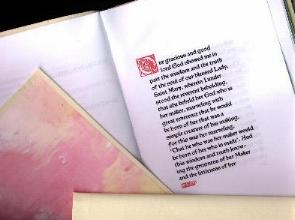
 To see inside this book, where God's
words are in red, Julian's in black, her editor's in grey, click here.
To see inside this book, where God's
words are in red, Julian's in black, her editor's in grey, click here.
Julian
of Norwich. Showing of Love. Translated, Julia Bolton Holloway. Collegeville: Liturgical Press;
London; Darton, Longman and Todd, 2003. Amazon
ISBN 0-8146-5169-0/ ISBN 023252503X. xxxiv + 133 pp.
Index.
 To
view sample copies, actual size, click here.
To
view sample copies, actual size, click here.

'Colections' by an English Nun in Exile:
Bibliothèque Mazarine 1202. Ed. Julia Bolton
Holloway, Hermit of the Holy Family. Analecta Cartusiana
119:26. Eds. James Hogg, Alain Girard, Daniel Le Blévec.
Salzburg: Institut für Anglistik und Amerikanistik
Universität Salzburg, 2006.
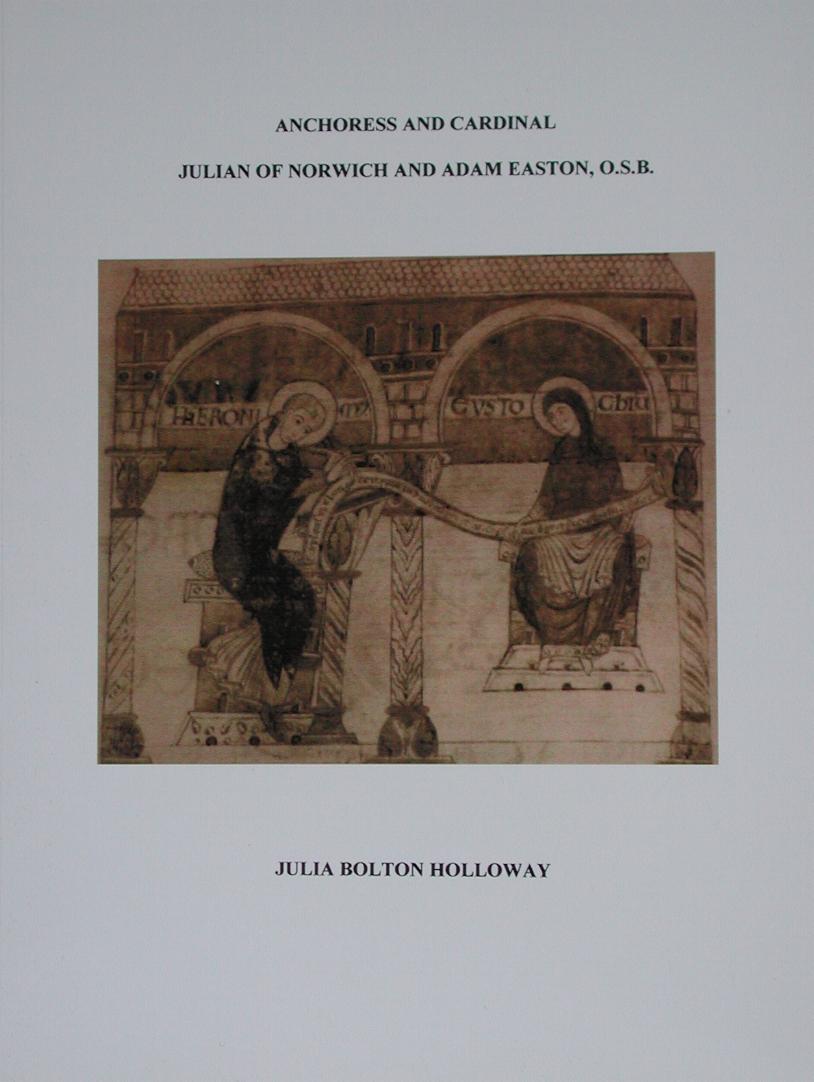
Anchoress and Cardinal:
Julian of Norwich and Adam Easton OSB. Analecta Cartusiana
35:20 Spiritualität Heute und Gestern. Salzburg:
Institut für Anglistik und Amerikanistik Universität
Salzburg, 2008. ISBN 978-3-902649-01-0. ix + 399 pp.
Index. Plates.
Teresa Morris. Julian of Norwich: A
Comprehensive Bibliography and Handbook.
Preface, Julia Bolton Holloway. Lewiston: Edwin
Mellen Press, 2010. x + 310 pp. ISBN-13:
978-0-7734-3678-7; ISBN-10: 0-7734-3678-2. Maps.
Index.

Fr
Brendan Pelphrey. Lo, How I Love Thee:
Divine Love in Julian of Norwich. Ed.
Julia Bolton Holloway. Amazon,
2013. ISBN 978-1470198299

Julian
among the Books: Julian of Norwich's Theological
Library. Newcastle upon Tyne: Cambridge
Scholars Publishing, 2016. xxi + 328 pp. VII
Plates, 59 Figures. ISBN (10): 1-4438-8894-X, ISBN (13)
978-1-4438-8894-3.

Mary's
Dowry; An Anthology of Pilgrim and
Contemplative Writings/ La Dote di Maria:Antologie di
Testi di Pellegrine e Contemplativi.
Traduzione di Gabriella Del
Lungo Camiciotto. Testo a fronte,
inglese/italiano. Analecta Cartusiana 35:21
Spiritualität Heute und Gestern. Salzburg:
Institut für Anglistik und Amerikanistik
Universität Salzburg, 2017. ISBN
978-3-903185-07-4. ix + 484 pp.
  |
To donate to the restoration
by Roma of Florence's formerly abandoned English
Cemetery and to its Library click on our Aureo Anello Associazione:'s
PayPal button: THANKYOU! |

