FLORIN WEBSITE © JULIA BOLTON
HOLLOWAY, AUREO ANELLO
ASSOCIAZIONE, 1997-2022: ACADEMIA
BESSARION || MEDIEVAL: BRUNETTO LATINO, DANTE ALIGHIERI, SWEET NEW STYLE: BRUNETTO LATINO, DANTE ALIGHIERI,
& GEOFFREY CHAUCER || VICTORIAN:
WHITE
SILENCE: FLORENCE'S 'ENGLISH' CEMETERY || ELIZABETH BARRETT BROWNING
|| WALTER SAVAGE LANDOR || FRANCES TROLLOPE || ABOLITION OF SLAVERY ||
FLORENCE IN SEPIA ||
CITY
AND BOOK CONFERENCE
PROCEEDINGS I, II, III,
IV, V, VI,
VII || MEDIATHECA 'FIORETTA
MAZZEI' || EDITRICE
AUREO
ANELLO CATALOGUE || UMILTA
WEBSITE || LINGUE/LANGUAGES:
ITALIANO, ENGLISH || VITA
New: Dante vivo || White Silence Cloister
Website, Sciptorium Website 1997-2007 © Julia Bolton Holloway
French text from unique
manuscript, Paris, Bibliothèque Nationale, fr. 2168, ed.
Mario Roques, Paris: Honoré Champion, 1977. Illuminations from Brunetto Latino, Li
Livres dou Tresor, St Petersburg Manuscript,
Courtesy of M.Moleiro.
Contact them to purchase the exquisite manuscript
facsimile. Per la versione in italiano,
Aucassin
e Nicoleta I plead for an Early Music performance
group to supply the music in mp3 for this multimedia
webpage.
C'EST D'AUCASIN ET DE NICOLETE
♫
A MEDIEVAL CHANT-FABLE
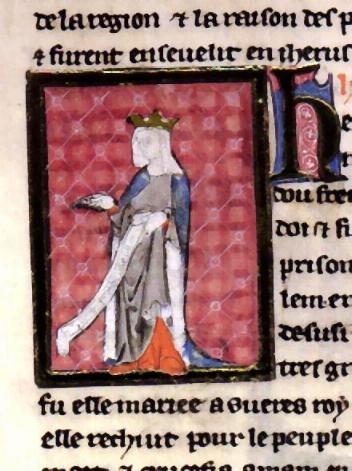
Queen Hester, Brunetto Latino, Li Livres dou Tresor, St Petersburg Manuscript, fol. 18v
This text is
found in only one manuscript, Paris, Bibliothèque Nationale,
français 2168, at folios 70 recto to 80 verso in two columns
of 37 lines, beginning at the second column. It gives both
words and music, but no illumination.

Paris, Bibliothèque Nationale, français 2168, fol. 70
Its dialect is Picard, its setting in Provence and in Tunisia. Charles of Anjou, St Louis' money-grubbing, war-mongering brother, became Count of Provence and then King of Sicily, seeking even to crusade to become the Emperor of Constantinople, bleeding Sicily white with taxes, until all Europe united against him, causing the Sicilian Vespers and his containment. Amongst his circle were such literary figures as Adam de la Halle and Brunetto Latino. Their style, in opposition to that of St Louis's circle, was bourgeois rather than courtly, cosmopolitan rather than monocultural, comic rather than pious. The manuscript is thirteenth century.
It mocks at the seriousness and hypocrisy of the Arthurian romance, blending together, in the same way as will Cervantes later in his Don Quixote, the pastoral and the epic. William Empson and Mikhail Bakhtin could have used it as an example in their studies of the Pastoral and of the 'Two Worlds'. Other works in this mocking genre include Apuleius' Golden Ass, Alexander Pope's Rape of the Lock and Alexander Pushkin's Eugene Onegin. Its hero is an anti-hero, almost a Hamlet, that self-mockery of the sonnet form, of the helpless lover, though here with a lady 'kind and fair', portrayed in an argument of 'Make love, not war'. It plays games with reversals of conventions, the adynata, including those of gender, turning these inside out, the woman being the capable partner, the man afraid to fight, the woman being Saracen by birth, the man having the Saracen name (Aucassin=Al Kassim), both being improbably blond, the king lying in childbirth while the queen fights his war - with apples and cheeses, such as are typically reflected in the drolleries of manuscript marginalia and in monastic misericordias. Though medieval, it is cognisant of Alexandrian pastoral romances that preceded it (reflected in both saints' legends and in romances in the Middle Ages), while foreshadowing those in Ariosto and Tasso. It is clearly meant to be presented in lively performance, with alternating melodic song and narration, interspersed also with dramatic dialogue, these last reminding one of Terence's Comedies and their dialogues between fathers and their love-lorn sons, this being a performance text. The alternation of poetry and prose, known as 'Maenippian satire', had already been consummately effected in Boethius' Consolation of Philosophy, again a work playing with gender role reversals, and would be reflected in the similar Sir Gawain and the Green Knight. Indeed the form of Aucassin and Nicolete has a similar 'bob-and-wheel' as does Sir Gawain.This chant-fable ends with a happy marriage, unlike the broken discord of Camelot between Arthur and Guinevere, or the premonition of Boethius' brutal execution, though Charles of Anjou carried out similar brutal punishments on his subjects in his dungeons, cutting out their right eye, cutting off their right hand and foot. Indeed the author of the piece gives himself out as similarly imprisoned, a captive, as was Boethius and as are, self-referentially, his hero and heroine at various points in the poem, and he makes use, though with genders reversed and heterosexualized, of the story of imprisoned King Richard I and his minstrel Blondel's quest for him through song, where Nicolete quests Aucassin.
The manuscript is not illuminated. Instead, manuscript illuminations are given here from a contemporary Picardian manuscript, Li Livres dou Tresor, written by Brunetto Latino, Dante Alighieri's teacher, first for King Charles of Anjou (though later versions he wrote against his cruel, war-mongering patron). This particular manuscript, one out of many, is now in St Petersburg National Library in Russia. These reproductions are made from the fine manuscript facsimile of it published by M. Moleiro of Spain (http://www.beato-de-liebana.com). A similar manuscript from the same workshop is in the Laurentian Library in Florence.
It is hoped that
this web essay will be of use to manuscript scholars and to
undergraduate students, the latter of whom could even
perform the text. When doing so you will find that with
feminine rhymes, like 'Biaucaire, repaire', where in sung
and in medieval French the final e is pronounced,
the musical notation adds one extra note to those
transcribed below.
P.S.
Professor John Levy has made some corrections to the
transcription and suggests parallels between this tale and
Turkish oral anti-romances. I yearn to have a musicologist on
the order of Manfred Bukhofzer supply us with a performance of
the music in MP3 files.

Female and male centaurs
jousting, Brunetto Latino, Li Livres dou Tresor,
St Petersburg Manuscript, fol. 77
| THE SONG-STORY
OF AUCASSIN AND NICOLETE I. 'Tis of Aucassin
and Nicolete.
|
C'EST D'AUCASIN ET
DE NICOLETE
[Folio 70, Column B,
I] |

Knights at Charlemagne's
Coronation as Emperor by Pope, Brunetto
Latino, Li Livres dou
Tresor, St Petersburg Manuscript, fol. 24
| II. Now
they speak and they relate and they tell.
♫
|
[II]O
r
dient et content et fablent
|

III. Now
it is sung.  ucassin was of
Biaucaire ucassin was of
Biaucaire  And abode in castle fair. None can move him to forget Dainty-fashioned Nicolete, Whom his sire to him denies; And his mother sternly cries: `Out on you! what will you, fool! Nicolete is blithe and fair Castaway from Carthage she! Bought of paynim company! If with a woman you will mate Take a wife of great estate!' `Mother, I cannot do else! Nicolete is debonair; Her lithe form, her face, her fairness, Do the heart of me enkindle, Fairly mine her love may be,
|
[III] Or
se cante.  ucassins fu de
biaucaire ucassins fu de
biaucaire  D'un castel del bel repaire D e nicole le bien faite N uis hom ne l'en puet retraire Q ue ses peres ne l'i laisse E t sa mere le manace D i va! faus, que vex tu faire? N icolete est cointe et gaie J etee fu de Cartage A catee fu d'un Saisne P uis qa'a moullié te vix traire [71.A] P ren femme de haut parage M ere, je n'en puis el faire N icolete est de boin aire S es gens cors et son viaire S a biautés le cuer m'esclaire B ien est drois que s'amor aie  Que trop est douce |
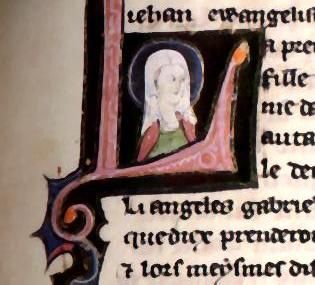
| ♫
IV. Now
speak they and relate and tell.
|
[IV] Or dient et content et flablent.
|
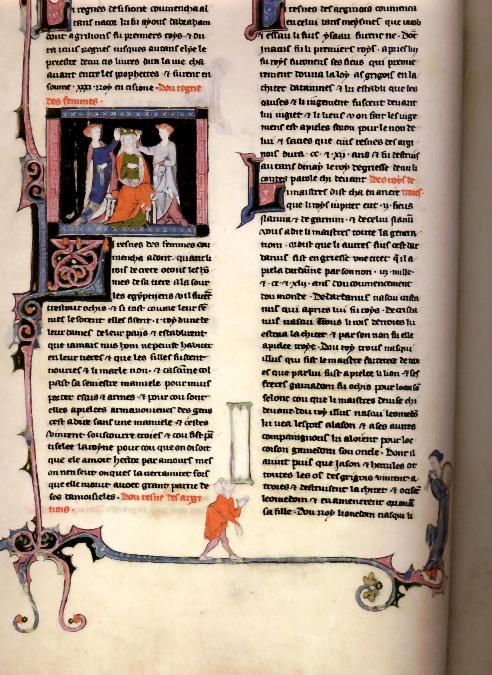
Coronation of the Queen of
the Amazons, Brunetto Latino, Li Livres dou Tresor,
fol. 13v.
v
V. Now
it is sung.  icolete is now a
prisoner icolete is now a
prisoner In a vaulted chamber set, That was wrought by cunning rare, Painted marvellously fair. At the marble window-bay, There she leaned, that luckless maid. Of pale gold was her hair, Exquisite her eyebrows were, Bright her face, curved delicately; Lovelier did you never see. O'er the woodland gazed she out, Saw the rose bloom all about, Heard the bird call to its mate; Then she wept her orphan fate: `Woe is me! poor captive maid! Why am I in prison laid? Aucassin, liege lording dear, Now I am thy loving friend, Nor by you am I abhorred: For your sake I am in ward, In this painted chamber held, Where full evil days I spend. But, O Son of Mary Virgin!, I will not stay here long,
|
Or se cante.   icole est in
prison mise icole est in
prison mise En une canbre vautie K i faite est par grant devisse, P anturee a miramie. A la fenestre marbrine L a s'apoia la mescine: E le avoit blonde la crigne E t bien faite la sorcille, L a face clere et traitice; A inc plus bele ne veïstos. E sgarda par le gaudine E t vit la rose espanie E t les oisax qui se crient, D ont se clama orphenine: A i mi! lasse moi, caitive! P or coi sui en prison misse? A ucassins, demoisiax sire, J a sui jou li vostre amie E t vos ne me haés mie; P or vos sui en prison misse E n ceste canbre vautie [71v.A] U je trai molt male vie; M ais, par Diu le fil Marie L ongement n'i serai mie,  S e iel puis fare. |

| VI. Then
speak they and relate and tell.
♫
|
Or dient et content et fablent.
|

| VII. Now
it is sung. ucassin has turned and
passed. Sorrowful and sore down-cast, All for his bright-favoured maid, None can counsel him nor cheer. To the palace he went home: There the outer steps he climbs, To a chamber enters in, And begins to weep therein, And ado most doleful make And lament his fair love's sake. `Nicolete, your pretty bearing! Your sweet speech and pretty joying, Pretty jesting, pretty toying, Pretty kissing, pretty coying! For you I am in such tene, And so ill bested, I ween Never hence alive to wend,
|
[VII] Or
se cante ucasins s'en est
tornés  M olt dolans et abosmés: D e s'amie o le vis cler N us ne le puet conforter, N e nul bon consel doner. V ers le palais est alés; I l en monta les degrés, E n une canbre est entrés, S i comença a plorer E t grant dol a demener E t s'amie a regreter. N icolete, biax esters, B iax venir et biax alers, B iax borders et biax jouers, B iax baisiers, biax acolers, P or vos sui si adolés E t si malement menés Q ue je n'en cuit vis aler,  S uer douce amie. |
| VIII. Now
speak they and relate and tell.
♫
|
Or dient et content et fablent.
|
| IX. Now
it is sung: ucassin heard of
the kiss Which shall on return be his. Had one given him of pure gold Marks a hundred thousand told, Not so blithe of heart he were. Rich array he bade them bear: They made ready for his wear. He put on a hauberk lined, Helmet on his head did bind, Girt on his sword with hilt pure gold, Mounted on his charger bold; Spear and buckler then he took; At his two feet cast a look: They trod in the stirrups trim. Wondrous proud he carried him. His dear love he thought upon, And his good horse spurred anon, Who right eagerly went on. Through the gate he rode straightway,
|
[IX] Or
se cante ucassins ot du baisier
 Qu'il ara au repairier: P or cent mile mars d'or mier N e le fesist on si lié. G arnemens demanda ciers, O n li a aparelliés: I l vest en auberc dublier E t laça l'iaume en son cief, Ç ainst l'espee au poin d'or mier, S i monta sor son destrier E t prent l'escu et l'espiel; R egarda andex ses piés, B ien li sissent es estriers; A mervelle se tint ciers. D e s'amie il sovient, S 'esperona le destrier; I l li cort molt volentiers: T ot droit a le porte en vient a la bataille. |
| X. Now
they speak and relate and tell.
♫
|
[X] Or dient et content [72v.B]
|
| XI. Now
it is sung. ow Count Garin, when
he saw Aucassin will ne'er withdraw From bright-favoured Nicolete, In a prison had him set, In a dark cell under ground, With grey marble walled around. Now when Aucassin came there, Sad he was, so was he ne'er! Loud lamenting he fell on Thus as you shall hear anon: `Nicolete, O love lily! Sweet love-friend, so bright of blee! Sweet as cluster of the vine, Sweet as mede in maselyn! Saw I this some yesterday: On a bed a pilgrim lay, (Who of Limousin was bred,) Sick with fever of the head. Very sore was he in pain, With most grievous sickness ta'en. By his bedside thou didst fare, And thy long train liftedst there, And thy dainty ermine frock, And thy snowy linen smock, Till thy white limbs he might see. Straight the pilgrim healed was he, Whole as he was ne'er before. From his bed he rose once more, And to his own land did flit, Safe and sound, whole every whyit. Sweet love-friend, white lily blowing! Fair thy coming, fair thy going, Fair thy jesting, fair thy toying, Fair thy speaking, fair thy joying Sweet thy kiss and sweet thy coying! None could hate thee, Nicolete! 'Tis for thy sake I am set In this dark cell under ground, Where I make most doleful sound. Now to die behoveth me,
|
[XI] Or
se cante. [73v.A]  ant or voit li quens
garins ant or voit li quens
garins  D e son enfant aucassin Q u'il ne pora departir D e nicolete au cler vis, E n une prison l'a mis E n un celier sosterin Q ui fu fas de marbre bis. Q uant or i vint aucassins, D olans fu, ainc ne fu si; A dementer si se prist S i con vos porrés oïr: N icolete, flors de lus, P lus es douce que roisins N e que soupe en maserin. L 'autr' ier vi un pelerin, N es estoit de Limosin, M alades de l'esvertin, S i gisoit ens en un lit, M out par estoit entrepris, D e grant mal amaladis; T u passas devant son lit, S i soulevas ton traïn E t ton peliçon ermin, L a cemisse de blanc lin, T ant que ta ganbete vit: G aris fu li pelerins E t tos sains, ainc ne fu si; S i se leva de son lit, S i rala en son païs S ains et saus et tos garis. D oce amie, flors de lis, B iax alers et biax venirs, [73v.B] B iax jouers et biax bordirs, B iax parlers et biax delis, D ox baisiers et dox sentirs, N us ne vous poroit haïr. P or vos sui en prison mis E n ce clier sousterin U je fac mout male fin; O r m'i convenra morir  P or vos, amie. |
| XII. Now
they speak and they relate and they tell.
♫
|
[XII] Or dient et content et fabloient.
|
| XIII. Now
it is sung: icolete the bright of
brow On a pillar leanest thou, All Aucassin's wail dost hear For his love that is so dear, Then thou spakest, shrill and clear, "Gentle knight withouten fear Little good befalleth thee, Little help of sigh or tear, Ne'er shalt thou have joy of me. Never shalt thou win me; still Am I held in evil will Of thy father and thy kin, Therefore must I cross the sea, And another land must win." Then she cut her curls of gold, Cast them in the dungeon hold, Aucassin doth clasp them there, Kissed the curls that were so fair, Them doth in his bosom bear, Then he wept, even as of old,
|
[XIII] Or
se
cante. icolete o le vis cler
 S' apoia a un piler, [74.B] S 'oï aucassin plourer E t s'amie regreter; O r parla, dist son penser: A cassins, gentix et ber, F rans damoisiax honorés, Q ue vos vaut li dementer, L i plaindres ne li plurers, Q uant ja de moi ne gorés? C ar vostre peres me het E t trestos vos parentés. P or vous passerai le mer, S 'irai en autre regné. D e ses caviax a caupés, L a dedans les a rüés. A ucassins les prist, li ber, S i les a molt honerés E t baisiés et acolés; E n sen sain les a boutés; S i recomence a plorer,  T out por s'amie. |
| XIV. Now
they speak and they relate and they tell.
♫
|
[XIV] Or
dient et content et fabloient.
|
XV. Now
it is sung.  rave the warder was
indeed, rave the warder was
indeed, Gallant, gentle, good of rede. He began to sing straightway A right good and pleasant lay. `Maiden of the noble heart, Winsome fair of form you are, Golden tresses winsome fair, Laughing face and eyes of vair. By thy looks I see full plain With thy love thou'st spoke again, Who for thee is in death's way. Now thou hearest that I saw: Of yon treacherous men beware, Who on all sides hunt thee there! 'Neath their cloaks their drawn swords be; Loudly do they threaten thee; Soon will they some mischief do thee,
|
[XV] Or
se cante  i gaite fu mout
vaillans, [74.B] i gaite fu mout
vaillans, [74.B]  Preus et cortois et saçans; I l a commencié un cant K i biax fu et avenans. M escinete o le cuer franc, C ors as gent et avenant. L e poil blont et reluisant, V airs les ex, ciere riant; B ien le voi a ton sanblant, P arlé as a ton amant Q ui por toit se va morant. J el te di et tu l'entens: G arde toi des souduians K i par ci te vont querant, S ous les capes le nus brans; F orment te vont maneçant, T ost te feront messeant,  S' or ne t'i gardes. |
| XVI. Now
they speak and they relate and they tell.
♫
" |
[XVI] Or
dient et content et fabloient.
|
| XVII. Now
it is sung: ow bright-favoured
Nicolete, Foot upon the moat-top set; And her lamentation made, Crying loud for Jesus' aid. `Father, King of Majesty! Now I know not where to fly! Should I in the greenwood fare, Soon the wolf will eat me there, And the lion and wild boar, - Creatures which are there galore. Should I wait the daylight clear, So my foes may find me here, Straightway will the fire be lit, And my body be burned in it. But-O God of Majesty!- Rather would I, verily, That the wolf my body tore, And the lion and wild boar, Than I to the town should fare!
|
[XVII] Or se cante. icolete o le vis cler
 Fu montee le fossé, S i se prent a dementer E t Jhesum a reclamer: P ere, rois de maïsté, O r ne sai quel part aler: [75.B] S e je vois u gaut ramé, J a me mengeront li lé, L i lion et li sengler, D ont il i a a plenté; E t se j'atent le jor cler, Q ue on me puist ci trover, L i fus sera alumés D ont mes cors iert enbrasés; M ais, par Diu de maïsté, E ncor aim jou mis assés Q ue me mengucent li lé, L i lion et li sengler, Q ue je voisse en la cité  J e n'irai mie. |
| XVIII. Now
they speak and they relate and they tell.
♫
|
[XVIII] Or
dient et content et fabloient.
|
| XIX. Now
it is sung. icolete,
bright-favoured maid, To the herds her farewell bade, And her journey straight addressed Right amid the green forest, Down a path of olden day; Till she reached an open way Where seven roads fork, that go out Through the region round about. Then the thought within her grew. She will try her lover true, If he love her as he said:- She took many a lily head, With the bushy kermes-oak shoot, And of leafy boughs to boot, And a bower so fair made she,- Daintier did I never see! By the truth of Heaven she sware, Should Aucassin come by there, And not rest a little space, For her love's sake, in that place, He should ne'er her lover be,
|
[XIX] Or
se cante. icolete o le cler vis
 D es pastoriaus se parti, S i acoilli son cemin T res par mi le gaut foilli [75v.B] T out un viés sentier anti, T ant qu'a une voie vint U aforkent set cemin Q ui s'en vont par le païs. A porpenser or se prist Q u'esprovera son ami S 'i l'aime si com il dist. E le prist des flors de lis E t de l'erbe du garris E t de le foille autresi, U ne bele loge en fist, A inques tant gente ne vi. J ure Diu qui ne menti S e par la vient aucasins E t il por l'amor de li N e s'i repose un petit, J a ne sera ses amis,  N' ele s'amie. |
| XX. Now
they speak and they relate and they tell.
♫
|
[XX] Or dient et content et fabloient.
|
| XXI. Now
it is sung. ow the herd-boys
gathered in; There was John and Fruelin, Martin came, and Esmaret, Robin eke, and Aubriet. Quoth the one, `Good fellows all, Aucassin God's help befall! Truth, a pretty lad, i'fay! And the dainty-fashioned may, Who of pale gold had her hair, Bright her face, and eyes of vair; Who gave us this pretty penny, Which shall buy as cates a many, Wallets eke, and hunting-knife, Cornemuse and merry fife, Cudgel stick and pipes moreover,
|
[XXI] Or
se cante.  r s'asanlent
pastouret, r s'asanlent
pastouret,  E smerés et martinés, F rüelins et johanés, R obeçons et aubriés. L i uns dist: Bel conpaignet, D ix aït aucasinet, V oire a foi! le bel vallet; [76.B] E t le mescine au corset Q ui avoit le poil blondet, C ler le vis et l'oeul vairet, K i nos dona denerés D ont acatrons gastelés, G aïnes et coutelés, F laüsteles et cornés, M açueles et pipés,  D ix le garisse! |
| XXII. Now
they speak and they relate and they tell.
♫
|
[XXII] Or
dient et content et fabloient
|
| XXIII. Here
one singeth. ucassin heard told to
him His love's words, the lithe of limb: Deep they entered into him. From the herds he parted quick, Made into the greenswood thick. Nimbly paced his noble steed, Bore him fairly at full speed. Then three words he spake, and said, `Nicolete, O lithe-limbed maid, For your sake I thread the glade! Stag nor boar I now pursue, But the trail I hunt for you. Your lithe body and bright eyes, Your sweet laugh and soft replies, Sore to death have wounded me. But, - Heaven's puissant will so be!- I will look upon you yet,
|
[XXIII]
Or se cante. ucassins oï les
mos  D e s'amie o le gent cors, D es pastoriax se part tost, S i entra el parfont bos; L i destriers li anble tost; [76v.B] B ien l'en porte les galos. O r parla, s'a dit trois mos: N icolete o le gent cors, P or vos sui venus en bos; J e ne cac ne cerf ne porc, M ais por vos siu les esclos. V o vair oiel et vos gens cors, V os biax ris et vos dox mos O nt men cuer navré a mort. S e Diu plaist le pere fort, J e vous reverai encor,  S uer douce amie. |
| XXVI. Now
they speak and they relate and they tell.
♫
|
[XXIV] Or dient et content et fabloient.
|
| XXV. Now
it is sung. "  ittle star, I see you
plain, ittle star, I see you
plain, That the moon draws to her train! Nicolete is with you there, My love, of the golden hair. God, methinks, wants her in heaven, To become the lamp of even . . . . . . . . . . . . . . . . How so great my fall might be, Would that I were there with thee! Closely would I kiss and cling! Were I son to crowned king, Thou shouldst well become me yet,
|
[XXV] Or
se cante.  stoilete, je te voi, stoilete, je te voi, Que la lune trait a soi; N icolete est aveuc toi, M 'amïete o le blont poil. J e quid Dix le veut avoir P or la lu . . . e de s . . . . . . . . . . . . . . . . . . . . . . . . . . . . . . . . . [77v.B] Q ue que fust du recaoir Q ue fuisse lassus o toi: J e te baiseroie estroit. S e j'estoie fix a roi, S 'afferriés vos bien a moi,  S uer douce amie.
|
| XXVI. Now
they speak and they relate and they tell.
♫
|
[XXVI] Or
dient
et content et fabloient.
|
| XXVII. Now it is sung. ucassin the fair, the
blond, Gentle knight and lover fond, Rode from out the thick forest; In his arms his love was pressed, On the saddle-bow before; And he kissed her o'er and o'er, Eyes and brows and lips and chin. Then to him did she begin: `Aucassin, fair lover sweet, To what country shall we flee?' `Sweet my love, what should I know? Little care I where we go, In the greenwood or away, So I am with you alway!' Hill and vale they fleeted by, Town and fortress fenced high, Till they came at dawn of day Where the sea before them lay; There they lighted on the sand,
|
[XXVII] Or
se cante. ucassins li biax, li
blons,  Li gentix, li amorous, E st issus del gaut parfont, E ntre ses bras ses amors D evant lui sor son arçon; L es ex li baise et le front E t le bouce et le menton. E le l'a mis a raison: A ucassins, biax amis dox, E n tuel tere en irons nous? D ouce amie, que sai jou? M oi ne caut u nous aillons, E n forest u en destor, M ais que je soie aveuc vous. P assant les vaus et les mons E t les viles et les bors; A la mer vinrent au jor, S i descendent u sablon  Les le rivage. |
| XXVIII. Now
they speak and they relate and they tell.
♫
|
[XXVIII] Or
dient et content et fabloient.
|
XXIX. Now
it is sung.  traight into the
chamber went traight into the
chamber went Aucassin, the kind, the gentle; Right to the bed he made On which the king was laid; There before his face he stayed And so said (I pray you hear!) `Shrew you, fool! What are you doing?' Said the king, `I am in child-bed. When my month is fully up, And I am recovered quite, I shall go to mass forthright, As did my late ancestor, And to speed my mighty war Gainst my foemen in the field;
|
[XXIX] Or
se
cante. n le canbre entre
aucassins,  Li cortois et li gentis; I l est venues dusque au lit, A lec u li rois se gist; P ar devant lui s'arestit, S i parla; oés que dist: D i va! fau, que fais tu ci? D ist li rois: Je gis d'un fil; Q uant mes mois sera conplis E t je sarai bien garis, D ont irai le messe oïr, S i com mes ancestre fist, [78v.A] E t me grant guerre esbaudir E ncontre mes anemis  N el lairai mie. |
| XXX: Now
they speak and they relate and they tell.
♫
|
[XXX] Or dient et conten et fabloient.
|
| XXXI. Now
it is sung. ucassin drew rein to
see, Elbow propped on saddle-tree, And began to watch the fray Of that field in full array. They had brought to battle there, Store of cheeses fresh and fair, Wild crab-apples roasted through, And great meadow mushrooms too. He who troubles best the fords, Is proclaimed their lord of lords. Aucassin, the noble knight, Began to watch them at their fight,
|
[XXXI] Or
se
cante. ucassins est
arestés,  Sor son arçon acoucés, [78v.B] S i coumence a regarder C e plenier estor canpel: I l avoient aportés D es fromages fres assés E t puns de bos waumonés E t grans canpegneus canpés; C il qui mix torble les gués E st li plus sire clamés. A ucassins, li prex, li ber, L es coumence a regarder,  S' en prist a rire. |
| XXXII. Now
they speak and they relate and they tell.
♫
|
[XXXII] Or
dient et content et flabent.
|

| XXXIII:
Now it is sung. "  ing of Torelore, my
lord!' ing of Torelore, my
lord!' (Spake fair Nicolete this word,) `Fool I seem in your folk's sight! When my dear love clasps me tight, And he finds me soft and sweet, Then am I in school so meet, Ball, carole, and roundelay, Viol, rebeck, and harp-play, All of merriment and mirth
|
[XXXIII] Or
se cante. [79.A]  ire rois de
Torelore, ire rois de
Torelore,  Ce dist la bele nichole, V ostre gens me tient por fole: Q uant mes dox amis m'acole E t il me sent grasse et mole, D ont sui jou a tele escole, B aus ne tresce ne carole, H arpe, gigle ne viole, M e deduis de la nimpole  N'i vauroit mie. |

Paris, Bibliothèque Nationale, français
2168, fol. 70
v
| XXXIV.
Now they speak and they relate and they tell.
♫
|
[XXXIV] Or
dient et content et flaboient.
|
XXXV. Now
it is sung.  hus did Aucassin
repair hus did Aucassin
repair To his city of Beaucaire. All the realm and region o'er Rule in quietness he bore. Vowed he by Heaven's majesty, More past measure mourned he Nicolete, the bright of hue, Than his kinsmen every one, Though they all were dead and gone, `Bright of favour, sweet love friend! Now I know not where to go. Never did God make that country, Over land or over sea, Whither, did I think to view you,
|
[XXXV] Or
se
cante. ucassins s'en est
alés  A biaucaire sa cité L e païs e le regné T int trestout en quiteé. J ure Diu de maïsté Q u'il li poise plus assés D e nicholete au vis cler Q ue de tot sen parenté S 'il estoit a fin alés. D ouce amie o le vis cler, O r ne vous ai u quester; A inc Diu ne fist ce regné N e par terre ne par mer, S e t'i quidoie trover,  ne t'i quesisce. |
| XXXVI.
Now they speak and they relate and they tell.
♫
|
[XXXVI] Or
dient et content et fabloien.
|
| XXXVII. Now
it is sung. icolete the wise, the
brave, Won to land from off the wave, Saw the houses and the walls, And the palaces and the halls, Then she wept her piteous fate: `Woe is me, my high estate! Born king's daughter of Carthage, Of the Sultan's lineage. I am held by a savage horde. Aucassin, my gentle lord, Honourable, wise and freem Your sweet love constraineth me, Loudly calls and urges sore. Grant me holy Heaven, once more You, my love, in my arms to lace, Feel your kisses on my face, On my lips and forehead poured,
|
[XXXVII] Or
se cante. ichole li preus li
sage  Est arivee a rivage, V oit les murs et les astages E t les palais et les sales; D ont si s'est clamee lasse: T ant mar fui de haut parage, N e fille au roi de Cartage, N e cousine l'amuaffle! C i me mainnent gent sauvage. A ucassin gentix et sages F rans damoisiax honorables, V os douces amors me hastent E t semonent et travaillent. C e doinst Dix l'esperitables C 'oncor vous tiengne en me brace, E t que vos baissiés me face Et me bouce et mon visage  D amoisiax sire. |
| XXXVIII. Now
they speak and they relate and they tell.
♫
|
[XXXVIII] Or dient et content et fabloient.
|
| XXXIX: Now
it is sung. ucassin was at Beaucaire 'Neath the tower a morning fair. On a stair he sat without, With his brave lords round about; Saw the leaves and flowers spring, Heard the song-birds carolling; Of his love he thought anew, Nicolete the maiden true, Whom he loved so long a day; Then his tears and sighs had way. When, behold, before the stair, Nicolete herself stood there, Lifted viol, lifted bow, Then she told her story so: `Listen, lordings brave, to me, You who low or lofty be! Like you to hear a stave, All of Aucassin the brave, And of Nicolete the true? Long they loved and long did rue, 'Till into the deep forest After her he went in quest. From the tower of Torelore Them one day the pagan bore, And of him I know no more. But the true-hearted Nicolete Is in Carthage castle yet; To her sire so dear is she, Who is king of that country. Desire they to her give A felon king to be her lord. Nicolete wants no pagan, For she loves a slender lord, Aucassin his name. By God she vows that never Will she ever take a baron, Except her love once more
|
[XXXIX]Or se cante. biaucaire sous la tor  Estoit aucassins un jor, L a se sist sor un perron, E ntor lui si franc baron; V oit les herbes et les flors S 'oit canter les oisellons, M enbre li de ses amors, [80.A] D e nicholete le prox Q u'il ot amee tans jors; D ont jete souspirs et plors. E s vous nichole au peron, T rait vïele, trait arçon; O r parla, dist sa raison. E scoutés moi, franc baron, C 'il d'aval et cil d'amont; P lairoit vos oïr un son D 'aucassin, un franc baron, D e nicholete la prox? T ant durerent lor amors Q u'il le quist u gaut parfont; A Torelore u dongon L es prissent paiien un jor. D 'aucassin rien ne savons, M ais nicolete la prous E st a Cartage el donjon, C ar ses pere l'ainme mout Q ui sire est de cel roion. D oner il volent baron U n roi de paiiens felon: N icolete n'en a soing, C ar ele aime un dansellon Q ui aucassins avoit non; B ien jure Diu et son non, J a ne prendera baron, S 'ele n'a son ameor  Que tant desire. |
| XL. Now
they speak and they relate and they tell.
♫
|
[XL] Or dient et content et fabloient.
|
XLI. Now
it is sung.  ow when Aucassin did
hear ow when Aucassin did
hear Of his own bright-favoured maid, That she had arrived on shore, Glad he was as nev'er before. Forth with that fair dame he made, Nor until the hostel stayed. Quickly to the room they win, Where sat Nicolete within. When she saw her love once more, Glad she was as ne'er before. Up she sprang upon her feet, And went forward him to meet. Soon as Aucassin beheld, Both his arms to her he held, Gently took her to his breast, All her eyes and face caressed. The night they lay side by side; And the next day by morning Aucassin married her; Of Beaucaire he made her Dame. After lived they many days, And in pleasure went their ways. Now has Aucassin his bliss, And likewise Nicolete. Ends our song and story so,
|
[XLI] Or
se cante. uant or entent
aucassins  De s'amie o le cler vis Q u'ele est venue el païs, O r fu liés, ain ne fu si. A veuc la dame s'est mis, D usqu'a l'ostel ne prist fin; E n le cambre se sont mist, L a u nicholete sist. Q uant ele voit son ami, O r fu lie, ainc ne fu si; C ontre lui en piés sali. Q uant or le voit aucassins, A ndex ses bras li tendi, [80v.B] D oucement le recoulli, L es eus li baisse et le vis. L a nuit le laissent ensi, T resqu'au demain par matin Q ue lespousa aucassins: D ame de biaucaire en fist; P uis vesquirent les mains dis E t menerent lor delis. O r a sa joie aucasins E t nicholete autresi: N o cantefable prent fin,  N' en sai plus dire. |
Brunetto Latino, Li
Livres dou Tresor, St Petersburg Manuscript, Female
and male centaurs jousting, fol. 77
FLORIN WEBSITE © JULIA BOLTON
HOLLOWAY, AUREO ANELLO
ASSOCIAZIONE, 1997-2022: ACADEMIA
BESSARION || MEDIEVAL: BRUNETTO LATINO, DANTE ALIGHIERI, SWEET NEW STYLE: BRUNETTO LATINO, DANTE ALIGHIERI,
& GEOFFREY CHAUCER || VICTORIAN:
WHITE
SILENCE: FLORENCE'S 'ENGLISH' CEMETERY || ELIZABETH BARRETT BROWNING
|| WALTER SAVAGE LANDOR ||
FRANCES TROLLOPE || ABOLITION OF SLAVERY ||
FLORENCE IN SEPIA ||
CITY
AND BOOK CONFERENCE PROCEEDINGS I, II,
III, IV,
V, VI,
VII || MEDIATHECA 'FIORETTA
MAZZEI' || EDITRICE
AUREO
ANELLO CATALOGUE || UMILTA WEBSITE || LINGUE/LANGUAGES: ITALIANO, ENGLISH || VITA
New: Dante vivo || White Silence
Sciptorium Website 1997-2019 © Julia Bolton Holloway Illuminations from Brunetto Latino, Li Livres dou Tresor, St Petersburg Manuscript, Courtesy of M.Moleiro. Contact them to purchase the exquisite manuscript facsimile.

 |
If you have used and enjoyed this page please
consider donating to the research and restoration of
Florence's formerly abandoned English Cemetery by the Roma and its Library through our Aureo Anello Associazione's account with PayPal: Thank you! |
 ho would hear good
verse
ho would hear good
verse 


 ow the Count
Bougars of Valence made war on Count Garin of
Beaucaire, so great and so wonderful and so
deadly, that not a single day dawned, but he was
at the gates and the walls and the barriers of
the town, with a hundred knights, and with ten
thousand soldiers on foot and on horseback; and
he burned his land, and laid waste to his
country, and killed his men. Count Garin of
Beaucaire was old and feeble, and had out-lived
his time. He had no heir, neither son nor
daughter, save only one boy. The latter was such
as I shall tell you. Aucassin was the young
lord's name. He was fair and slim, tall and well
fashioned in legs and feet and body and arms.
His hair was golden and in little curls; and his
eyes were blue-grey and laughing; and his face
was bright and oval; and his nose high and
well-set; and so compact was he of good
qualities, that there was none bad in him, but
good only. But he was so overcome by Love, who
conquers all, that he would not be a knight, nor
take arms, nor go to the tourney, nor do
anything of all that he ought to have done. His
father and his mother said to him: `Son, now
take your arms, and mount your horse, and fight
for your land, and help your people! If they see
you among them, they will fight better for their
lives and their goods, and for your land and
ours!' `Father,' said Aucassin, `what do you
speak of now? God will never give me ought I ask
of Him, if I will be a knight, or mount horse,
or go to war or to battle, where I may strike a
knight or be struck, unless you give me
Nicolete, my sweet friend, whom I love so much!'
`Son', said the father, `that could not be! Let
Nicolete alone! For she is a captive maid, who
was brought from a foreign land; and the
Viscount of this town bought her from Saracens,
and brought her to this town, and has reared her
and baptized her, and made her his god-daughter;
and one of these days he will give her for
husband a young bachelor, who will earn bread
for her honourably. Have nothing to do with
this, and you will have a wife, I will give you
the daughter of a King or a Count. There is not
so rich a man in France, but if you will, you
can have his daughter'. `Alas, father,' said
Aucassin, `where is there on earth such great
honour, but if Nicolete, my most sweet friend,
had it she would become it? Were she Empress of
Constantinople or of Germany, or Queen of France
or of England, it would be little enough for
her, so noble is she and gracious and debonair
and compact of all good qualities'.
ow the Count
Bougars of Valence made war on Count Garin of
Beaucaire, so great and so wonderful and so
deadly, that not a single day dawned, but he was
at the gates and the walls and the barriers of
the town, with a hundred knights, and with ten
thousand soldiers on foot and on horseback; and
he burned his land, and laid waste to his
country, and killed his men. Count Garin of
Beaucaire was old and feeble, and had out-lived
his time. He had no heir, neither son nor
daughter, save only one boy. The latter was such
as I shall tell you. Aucassin was the young
lord's name. He was fair and slim, tall and well
fashioned in legs and feet and body and arms.
His hair was golden and in little curls; and his
eyes were blue-grey and laughing; and his face
was bright and oval; and his nose high and
well-set; and so compact was he of good
qualities, that there was none bad in him, but
good only. But he was so overcome by Love, who
conquers all, that he would not be a knight, nor
take arms, nor go to the tourney, nor do
anything of all that he ought to have done. His
father and his mother said to him: `Son, now
take your arms, and mount your horse, and fight
for your land, and help your people! If they see
you among them, they will fight better for their
lives and their goods, and for your land and
ours!' `Father,' said Aucassin, `what do you
speak of now? God will never give me ought I ask
of Him, if I will be a knight, or mount horse,
or go to war or to battle, where I may strike a
knight or be struck, unless you give me
Nicolete, my sweet friend, whom I love so much!'
`Son', said the father, `that could not be! Let
Nicolete alone! For she is a captive maid, who
was brought from a foreign land; and the
Viscount of this town bought her from Saracens,
and brought her to this town, and has reared her
and baptized her, and made her his god-daughter;
and one of these days he will give her for
husband a young bachelor, who will earn bread
for her honourably. Have nothing to do with
this, and you will have a wife, I will give you
the daughter of a King or a Count. There is not
so rich a man in France, but if you will, you
can have his daughter'. `Alas, father,' said
Aucassin, `where is there on earth such great
honour, but if Nicolete, my most sweet friend,
had it she would become it? Were she Empress of
Constantinople or of Germany, or Queen of France
or of England, it would be little enough for
her, so noble is she and gracious and debonair
and compact of all good qualities'. que li quens
bougars de valence faisoit guere au conte garin
de biaucaire si grande et si mervelleuse et si
mortel qu'il ne fust uns seux jors ajornés qu'il
ne fust as portes et as murs et as bares de le
vile a cent cev[fol.70v,col.A]aliers et a dis
mille sergens a pié et a ceval, si li argoit sa
terre et gastoit son païs et ocioit ses homes.
Li quens garins de biaucaire estoit vix et
frales, si avoit son tans trespassé. Il n'avoit
nul oir, ne fil ne fille, fors un seul vallet:
cil estoit tex con je vos dirai. aucasins avoit
a non li damoisiax. Biax estoit et gens et grans
et bien tailliés de ganbes et de piés et de cors
et de bras; il avoit les caviax blons et menus
recercelés et les ex vairs et rians et le face
clere et traitice et le nes haut et bien assis.
Et si estoit enteciés de bones teces qu'en lui
n'en avoit nule mauvaise se bone non; mais si
estoit soupris d'Amor, qui tout vaint, q'il ne
voloit estre cevalers, ne les armes prendre,
n'aler au tornoi, ne fare point de quanque il
deust. Ses pere et se mere li disoient: Fix, car
pren tes armes, si monte el ceval, si deffent te
terre at aie tes homes: s'il te voient entr'ex,
si defenderont il mix lors cors et lor avoirs et
te tere et le miue. Pere, fait aucassins,
qu'en parlés vos ore? Ja Dix ne me doinst riens
que je li demant, quant ere cevaliers, ne monte
a ceval, ne que voise a estor ne a bataille, la
u je fiere cevalier ni autres mi, se vos ne me
donés nicholete me douce amie que je tant
aim. -Fix, fait li peres, ce [70v.B]
ne poroit estre. nicolete laise ester, que se
est une caitive qui fu amenee d'estrange terre,
si l'acata li visquens de ceste vile as
Sarasins, si l'amena en ceste vile, si l'a levee
et bautisie et faite sa fillole, si li donra un
de ces jors un baceler qui du pain li gaaignera
par honor: de ce n'as tu que faire. Et se tu
fenme vix avoir, je te donrai le file a un roi u
a un conte: il n'a si rice home en France, se tu
vix sa fille avoir, que tu ne l'aies. -Avoi!
peres, fait aucassins, ou est ore si haute
honers en terre, se nicolete me tresdouce amie
l'avoit, qu'ele ne fust bien enploiie en li?
S'ele estoit enpereris de Colstentinoble u
d'Alemaigne, u roigne de France u d'Engleterre,
si aroit il assés peu en li, tant est france et
cortoise et de bon aire et entecie de toutes
bones teces.
que li quens
bougars de valence faisoit guere au conte garin
de biaucaire si grande et si mervelleuse et si
mortel qu'il ne fust uns seux jors ajornés qu'il
ne fust as portes et as murs et as bares de le
vile a cent cev[fol.70v,col.A]aliers et a dis
mille sergens a pié et a ceval, si li argoit sa
terre et gastoit son païs et ocioit ses homes.
Li quens garins de biaucaire estoit vix et
frales, si avoit son tans trespassé. Il n'avoit
nul oir, ne fil ne fille, fors un seul vallet:
cil estoit tex con je vos dirai. aucasins avoit
a non li damoisiax. Biax estoit et gens et grans
et bien tailliés de ganbes et de piés et de cors
et de bras; il avoit les caviax blons et menus
recercelés et les ex vairs et rians et le face
clere et traitice et le nes haut et bien assis.
Et si estoit enteciés de bones teces qu'en lui
n'en avoit nule mauvaise se bone non; mais si
estoit soupris d'Amor, qui tout vaint, q'il ne
voloit estre cevalers, ne les armes prendre,
n'aler au tornoi, ne fare point de quanque il
deust. Ses pere et se mere li disoient: Fix, car
pren tes armes, si monte el ceval, si deffent te
terre at aie tes homes: s'il te voient entr'ex,
si defenderont il mix lors cors et lor avoirs et
te tere et le miue. Pere, fait aucassins,
qu'en parlés vos ore? Ja Dix ne me doinst riens
que je li demant, quant ere cevaliers, ne monte
a ceval, ne que voise a estor ne a bataille, la
u je fiere cevalier ni autres mi, se vos ne me
donés nicholete me douce amie que je tant
aim. -Fix, fait li peres, ce [70v.B]
ne poroit estre. nicolete laise ester, que se
est une caitive qui fu amenee d'estrange terre,
si l'acata li visquens de ceste vile as
Sarasins, si l'amena en ceste vile, si l'a levee
et bautisie et faite sa fillole, si li donra un
de ces jors un baceler qui du pain li gaaignera
par honor: de ce n'as tu que faire. Et se tu
fenme vix avoir, je te donrai le file a un roi u
a un conte: il n'a si rice home en France, se tu
vix sa fille avoir, que tu ne l'aies. -Avoi!
peres, fait aucassins, ou est ore si haute
honers en terre, se nicolete me tresdouce amie
l'avoit, qu'ele ne fust bien enploiie en li?
S'ele estoit enpereris de Colstentinoble u
d'Alemaigne, u roigne de France u d'Engleterre,
si aroit il assés peu en li, tant est france et
cortoise et de bon aire et entecie de toutes
bones teces.  hen the Count Garin
of Beaucaire saw that he should not be able to
turn Aucassin his son from his love for Nicolete,
he went his way to the Viscount of the town, who
was his vassal, and addressed him: `Sir Viscount!
Now get rid of Nicolete your god-daughter!
Accursed be the land from which she was brought to
this country! For through her I lose Aucassin;
since he will not be a knight, nor do anything of
all that he ought to do. And know well that if I
can get hold of her I will burn her in a fire; and
you too may have the utmost fear for yourself!'
`Sir,' said the Viscount, `It grieves me that he
goes to her, or that he comes to her, or that he
speaks to her. I had bought her with my money, and
had reared her, and baptized her, and made her my
god- daughter, and I would have given her a young
bachelor, who would have earned bread for her
honourably. With this would Aucassin your son have
nothing to do. But since it is your will and your
good pleasure, I will send her to such a land and
to such a country that he shall nevermore see her
with his eyes.' `Now have a care to yourself!'
said Count Garin', `Great trouble might come of it
to you'. They parted. And the Viscount was a very
rich man, and had a rich palace overlooking a
garden. In a chamber of this he had Nicolete
placed, on an upper story, and an old woman to
keep her company and society; and he had bread put
there, and flesh, and wine, and whatever they had
need of. Then he had the door sealed up, so that
there was no way to go in there, nor to go out,
except that there was a window overlooking the
garden, small enough, through which there came to
them a little fresh air.
hen the Count Garin
of Beaucaire saw that he should not be able to
turn Aucassin his son from his love for Nicolete,
he went his way to the Viscount of the town, who
was his vassal, and addressed him: `Sir Viscount!
Now get rid of Nicolete your god-daughter!
Accursed be the land from which she was brought to
this country! For through her I lose Aucassin;
since he will not be a knight, nor do anything of
all that he ought to do. And know well that if I
can get hold of her I will burn her in a fire; and
you too may have the utmost fear for yourself!'
`Sir,' said the Viscount, `It grieves me that he
goes to her, or that he comes to her, or that he
speaks to her. I had bought her with my money, and
had reared her, and baptized her, and made her my
god- daughter, and I would have given her a young
bachelor, who would have earned bread for her
honourably. With this would Aucassin your son have
nothing to do. But since it is your will and your
good pleasure, I will send her to such a land and
to such a country that he shall nevermore see her
with his eyes.' `Now have a care to yourself!'
said Count Garin', `Great trouble might come of it
to you'. They parted. And the Viscount was a very
rich man, and had a rich palace overlooking a
garden. In a chamber of this he had Nicolete
placed, on an upper story, and an old woman to
keep her company and society; and he had bread put
there, and flesh, and wine, and whatever they had
need of. Then he had the door sealed up, so that
there was no way to go in there, nor to go out,
except that there was a window overlooking the
garden, small enough, through which there came to
them a little fresh air. uant li guens garins
de biaucaire vit qu'il ne poroit aucassin son fil
retraire des amors nicolete, it trait au visconte
de le vle qui ses hon estoit, si l'apela: Sire
quens, car ostés nicolete vostre filole! Que la
tere soit maleoite dont ele fu amenee en cest
païs! C'or par li pert jou aucassin, qu'il ne veut
estre cevaliers, ne faire point de quanque faire
doie; et saciés bien que, se je le puis avoir, que
je l'arderai en un fu, et vous meismes porés avoir
de vos tote peor. - Sire, fait li visquens,
ce poise moi qu'il va ne qu'il i vient ne qu'il i
parole. Je l'avoie acatee de mes deniers, si
l'avoie levee et bautisie et faite ma filole, si
li donasse un baceler qui du pain li gaegnast par
honor: de ce n'eust aucassins vos fix que faire.
Mais puis que vostre volentés est et vos bons, je
l'envoierai en tel tere et en tel païs que ja mais
ne le verra de ses ex. - Ce gardés vous!
fait li quens Garins: grans maus vos en porroit
venir. [71.B] Il se departent. Et li visquens
estoit molt rices hom, si avoit un rice palais par
devers un gardin. En une canbre la fist metre
nicolete en un haut estage et une vielle aveuc li
por conpagnie et por soisté tenir, et s'i fist
metre pain et car et vin et quanque mestiers lor
fu; puis si fist l'uis seeler c'on n'i peust de
nule part entrer ne iscir, fors tant qu'il i avoit
une fenestre par devers le gardin assés petite
dont il lor venoit un peu d'essor.
uant li guens garins
de biaucaire vit qu'il ne poroit aucassin son fil
retraire des amors nicolete, it trait au visconte
de le vle qui ses hon estoit, si l'apela: Sire
quens, car ostés nicolete vostre filole! Que la
tere soit maleoite dont ele fu amenee en cest
païs! C'or par li pert jou aucassin, qu'il ne veut
estre cevaliers, ne faire point de quanque faire
doie; et saciés bien que, se je le puis avoir, que
je l'arderai en un fu, et vous meismes porés avoir
de vos tote peor. - Sire, fait li visquens,
ce poise moi qu'il va ne qu'il i vient ne qu'il i
parole. Je l'avoie acatee de mes deniers, si
l'avoie levee et bautisie et faite ma filole, si
li donasse un baceler qui du pain li gaegnast par
honor: de ce n'eust aucassins vos fix que faire.
Mais puis que vostre volentés est et vos bons, je
l'envoierai en tel tere et en tel païs que ja mais
ne le verra de ses ex. - Ce gardés vous!
fait li quens Garins: grans maus vos en porroit
venir. [71.B] Il se departent. Et li visquens
estoit molt rices hom, si avoit un rice palais par
devers un gardin. En une canbre la fist metre
nicolete en un haut estage et une vielle aveuc li
por conpagnie et por soisté tenir, et s'i fist
metre pain et car et vin et quanque mestiers lor
fu; puis si fist l'uis seeler c'on n'i peust de
nule part entrer ne iscir, fors tant qu'il i avoit
une fenestre par devers le gardin assés petite
dont il lor venoit un peu d'essor.  hilst Aucassin was
in the chamber, and was bewailing Nicolete his
friend, Count Bougart of Valence, who had his war
to carry on, did not forget it, but had summoned
his men on foot and on horse, and advanced to
assault the castle. And the cry arose and the
noise; and the knights and the soldiers arm
themselves, and rush to the gate and to the walls
to defend the castle; and the townsfolk go up to
the towers of the walls, and throw quarrels and
sharpened stakes. While the attack was great and
plenary, the Count Garin of Beaucaire came into
the chamber where Aucassin was making moan and
bewailing Nicolete his most sweet friend, whom he
loved so much. `Ah, son!' he said, `Caitif you are
and miserable! For you see assault made on your
castle, altogether the best and the strongest! And
know that if you lose it you are disinherited! So,
now take arms, and mount horse, and fight for your
land, and help your men! Strike never a man nor
they you, but if they see you among them, they
will fight better for their goods and their lives,
and your land and mine. And you are so tall and so
strong, that you are well able to do it, and do it
you ought.' `Father,' said Aucassin, `what do you
speak of now? Never God give me anything I ask of
him, if I be a knight and mount horse or go to
onset, where I may strike knight or they me,
unless you give me Nicolete, my sweet friend, whom
I love so much.' `Son', said the father, `that
cannot be! Rather I would endure to be utterly
dispossessed, and to lose all that I have, than
that you should ever have to woman or to wife!' He
turned away. And when Aucassin saw him going away,
he called him back. `Father,' said Aucassin, `come
here! I will make a fair convenant with you!' `And
what is that, fair son'. `I will take arms and go
to the onset by such covenant, - that if God bring
me back safe and sound, you will let me see
Nicolete, my sweet friend, long enough to have
spoken two words or three to her, and to have
kissed one single time'. `I consent to it!', said
the father. He grants it him, and Aucassin was
glad.
hilst Aucassin was
in the chamber, and was bewailing Nicolete his
friend, Count Bougart of Valence, who had his war
to carry on, did not forget it, but had summoned
his men on foot and on horse, and advanced to
assault the castle. And the cry arose and the
noise; and the knights and the soldiers arm
themselves, and rush to the gate and to the walls
to defend the castle; and the townsfolk go up to
the towers of the walls, and throw quarrels and
sharpened stakes. While the attack was great and
plenary, the Count Garin of Beaucaire came into
the chamber where Aucassin was making moan and
bewailing Nicolete his most sweet friend, whom he
loved so much. `Ah, son!' he said, `Caitif you are
and miserable! For you see assault made on your
castle, altogether the best and the strongest! And
know that if you lose it you are disinherited! So,
now take arms, and mount horse, and fight for your
land, and help your men! Strike never a man nor
they you, but if they see you among them, they
will fight better for their goods and their lives,
and your land and mine. And you are so tall and so
strong, that you are well able to do it, and do it
you ought.' `Father,' said Aucassin, `what do you
speak of now? Never God give me anything I ask of
him, if I be a knight and mount horse or go to
onset, where I may strike knight or they me,
unless you give me Nicolete, my sweet friend, whom
I love so much.' `Son', said the father, `that
cannot be! Rather I would endure to be utterly
dispossessed, and to lose all that I have, than
that you should ever have to woman or to wife!' He
turned away. And when Aucassin saw him going away,
he called him back. `Father,' said Aucassin, `come
here! I will make a fair convenant with you!' `And
what is that, fair son'. `I will take arms and go
to the onset by such covenant, - that if God bring
me back safe and sound, you will let me see
Nicolete, my sweet friend, long enough to have
spoken two words or three to her, and to have
kissed one single time'. `I consent to it!', said
the father. He grants it him, and Aucassin was
glad.  ntreusque aucassins estoit en le canbre
et il regretoit nicolete s'amie, li quens bougars
de val[72.B]ence, qui sa guerre avoit a furnir, ne
s'oublia mie, ains ot mandé ses homes a pié et a
ceval, si traist au castel por asalir. Et li cris
lieve et la noise, et li cevalier et li serjant
s'arment et querent as portes et as murs por le
castel desfendre, et li borgois montent as aleoirs
des murs, si jetent quariax et peus aguisiés.
Entroeusque li asaus estoit grans et pleniers, et
li quens garins de biaucaire vint en la canbre u
aucassins faisoit deul et regretoit nicolete sa
tresdouce amie que tant amoit. Ha! fix, fait il,
con par es caitis et maleurox, que tu vois c'on
asaut ton castel tot le mellor et le plus fort; et
saces, se tu le pers, que tu es desiretés. Fix,
car pren les armes et monte u ceval et defen te
tere et aiues tes homes et va a l'estor: ja n'i
fieres tu home ni autres ti, s'il te voient
entr'ax, si desfonderont il mix lor avoir et lor
cors et te tere et le miue; et tu ies si grans et
si fors que bien le pués faire, et farre le
dois. - Pere, fait aucassins, qu'en parlés
vous ore? Ja Dix ne me doinst riens que je li
demant, quant ere cevaliers, ne monte el ceval, ne
voise en estor, le u je fiere cevalier ne autres
mi, se vos ne me [72v.A] donés nicolete me douce
amie que je tant aim. - Fix, dist le pere,
ce ne puet estre: ançois sosferoie jo que je
feusse tous desiretés et que je perdisse quanques
g'ai que tu ja l'euses a mollier ni a espousse. Il
s'en torne; et quant aucassins l'en voit aler, il
le rapela: Peres, fait aucassins, venés avant: je
vous ferai bons couvens. - Et quex,
biax fix? - Je prendrai les armes,
s'irai a l'estor, par tex covens que se Dix me
ramaine sain et sauf, que vos me lairés nicolete
me douce amie tant veir que j'aie deus paroles u
trois a li parlees et que je l'aie une seule fois
baisie. -Je l'otroi, fait li peres. Il le creante
et aucassin fu lié.
ntreusque aucassins estoit en le canbre
et il regretoit nicolete s'amie, li quens bougars
de val[72.B]ence, qui sa guerre avoit a furnir, ne
s'oublia mie, ains ot mandé ses homes a pié et a
ceval, si traist au castel por asalir. Et li cris
lieve et la noise, et li cevalier et li serjant
s'arment et querent as portes et as murs por le
castel desfendre, et li borgois montent as aleoirs
des murs, si jetent quariax et peus aguisiés.
Entroeusque li asaus estoit grans et pleniers, et
li quens garins de biaucaire vint en la canbre u
aucassins faisoit deul et regretoit nicolete sa
tresdouce amie que tant amoit. Ha! fix, fait il,
con par es caitis et maleurox, que tu vois c'on
asaut ton castel tot le mellor et le plus fort; et
saces, se tu le pers, que tu es desiretés. Fix,
car pren les armes et monte u ceval et defen te
tere et aiues tes homes et va a l'estor: ja n'i
fieres tu home ni autres ti, s'il te voient
entr'ax, si desfonderont il mix lor avoir et lor
cors et te tere et le miue; et tu ies si grans et
si fors que bien le pués faire, et farre le
dois. - Pere, fait aucassins, qu'en parlés
vous ore? Ja Dix ne me doinst riens que je li
demant, quant ere cevaliers, ne monte el ceval, ne
voise en estor, le u je fiere cevalier ne autres
mi, se vos ne me [72v.A] donés nicolete me douce
amie que je tant aim. - Fix, dist le pere,
ce ne puet estre: ançois sosferoie jo que je
feusse tous desiretés et que je perdisse quanques
g'ai que tu ja l'euses a mollier ni a espousse. Il
s'en torne; et quant aucassins l'en voit aler, il
le rapela: Peres, fait aucassins, venés avant: je
vous ferai bons couvens. - Et quex,
biax fix? - Je prendrai les armes,
s'irai a l'estor, par tex covens que se Dix me
ramaine sain et sauf, que vos me lairés nicolete
me douce amie tant veir que j'aie deus paroles u
trois a li parlees et que je l'aie une seule fois
baisie. -Je l'otroi, fait li peres. Il le creante
et aucassin fu lié.  r lairons
d'aucassin, si dirons de nicolete.
r lairons
d'aucassin, si dirons de nicolete.