TO HEW HEREMYTE
A PYSTYL OF SOLYTARY LYFE NOWADAYES
RICHARD METHLEY, O.CART, EDITED BY JAMES HOGG

Mount Grace Priory
Preface
♫ My interest in Richard Methley and Mount Grace Charterhouse had been aroused even before I entered the Charterhouse of Sélignac in the autumn of 1961; but my first enthusiasm for him, kindled by reading the late dom David Knowles' sympathetic account in volume II of the magisterial The Religious Orders in England was somewhat dampened by the isolated references I came across in The Book of Margery Kempe, indicating a rather exaggerated emtionalism and a tendency to 'excesses'. In any event I was forced to lay him aside through the restrictions of my novitiate, but when in the autumn of 1965 the Carthusian authorities dispatched me to an ill-fated exile at the Charterhouse of Farneta (Lucca), I was allowed, by what proved subsequently to be a misunderstanding among my superiors, to devote some of my time to research on Carthusian history and spirituality, with the result that I began to study the works of Methley and his Mount Grace colleague, dom John Norton, with some care. Two English Benedictine monks, dom Phillip Jebb and dom Dominic Gaisford, placed at my disposal some preliminary transcripts that proved useful in the early stages of my researches, and, in 1967, I was unexpectedly approached by Dr Romana Guarnieri, the distinguished editor of the Archivio Italiano per la Storia della Pietà, to prepare an edition of Methley's Latin glossed translations of The Cloud of Unknowing and The Mirror of Simple Souls. After I had commenced work on the project, the Rev Edmund Colledge OSA, now professor at the Pontifical Institute of Mediaeval Studies at Toronto in Canada, discovered that a Jesuit friend, the Rev James Walsh, had, unknown, to him and Dr Guarnieri, already transcribed the Latin translations from the Pembroke College Cambridge MS. Understandably, my commission was annulled and the edition of James Walsh and Edmund Colledge was announced for the next number of the Archivio. To date strikes, followed by financial difficulties, have prevented the publication of what will undoubtedly be a major contribution, not only to the study of Methley, but of late medieval English spirituality in general.
As a first offering of my own researches, I am presenting an edition of Methley's to hew hereyte - a pystyl of solitary lyfe now a dayes, - a text that has been available to scholars since 1956. Unfortunately the 1956 transcription contains quite a number of obvious blunders, both as regards the Latin and the English, besides the fact that it offers a half-hearted modernised text, useless for critical purposes.
Writings by late medieval English Carthusians are few in number, and Campbell's statement that ' . . . the greater portion of the works written by the English Carthusians in the sixteenth century were destroyed during the dissolution of the monasteries . . . ' may tend to give an impression of a greater literary activity then, in fact, the Carthusians were capable of, though we do know that some of Methley's works have perished. Thus, apart from the extant original writings in the London Public Record Office Collection SP 1/239, the Experimentum Veritatis (fols. 1-24v), Dormitorium Dilecti Dilecti (25-48), and Refectorium Salutis (49-70v), there is a reference in the Experimentum Veritatis to an apology for the solitary life that cannot be traced. The Refectorium Salutis contains allusions to three further treatises that have also disappeared, whilst in the Dormitorium Dilecti Dilecti he refers to a work entitled Cellarium, compiled in 1484.
Seen together with his translations in the Pembroke College, Cambridge, MS 221, Methley was obviously a prolific writer on spiritual topics, and surely found superiors more sympathetic to his aims that I was destined to break against in the late 1960's. However, as Campbell observes of such Carthusian works as have survived from the pre-Reformation period,
. . .
those that are extant are singularly spiritual,
summoning the individual to a life of faith and active
and meditative prayer. In this 'silent' preaching the
Carthusians were carrying out the command of their
great twelfth-century Prior of the Grande Chartreuse,
Guigo I, who urged that 'books should be industriously
written'. Since their vow of silence forbids preaching
the word of God with their mouths, 'we must', he
wrote, 'do so with our hands'.
. . . We do not know the date of Methley's letter to Hugh the Hermit, but, though simple, it shows a marked wisdom, discretion, and yet a touch of firmness in dealing with the difficulties of the eremitical life. It is pleasing to find that his teaching stands in the same tradition as that which his more famous Yorkshire neighbour, St Aelred of Rievaulx, gave to his sister in the twelfth century.

Mount Grace Priory
Text
folio 266
♫ to hew heremyte
Here begynneth a pystyl of solytary lyfe now a dayes
Capitulum j.
 od almyghty al wytty al lovely in whome
is al goodnes the wel of mercy & grace: the
gloryous trynyte one god & persones thre: that is
for to say, the fader & the sonne & the holy
gost: He blys vs with his gracyous goodnes & bryng
vs vnto his blys in hevyn. Dere broder in christ Iesu
thy desyre is good & holy that thou wold be
infourmed after thy state that is an herimyt: How thou
shuldest pleas god to his worship & profight to
thy selfe. God for his mykyl mercy mekenes &
grace: gyfe vs bothe grace me to say wel: & the to
do therafter to his worship and our mede Amen.
od almyghty al wytty al lovely in whome
is al goodnes the wel of mercy & grace: the
gloryous trynyte one god & persones thre: that is
for to say, the fader & the sonne & the holy
gost: He blys vs with his gracyous goodnes & bryng
vs vnto his blys in hevyn. Dere broder in christ Iesu
thy desyre is good & holy that thou wold be
infourmed after thy state that is an herimyt: How thou
shuldest pleas god to his worship & profight to
thy selfe. God for his mykyl mercy mekenes &
grace: gyfe vs bothe grace me to say wel: & the to
do therafter to his worship and our mede Amen.Capitulum ij.
 ripe me de
inimicis meis domine ad te confugi, doce me facere
voluntatem tuam, quia deus meus es tu. That is to say in
englisshe thus Lord delyver me fro myn enemys to the I
haue fled. Tech me for to do thy wyl for thou art my
god. These wordys are perteynyng to al christen pepyl
that askys to be delyuerd fro ther enemyse bodely
& gostly the which do fle fro the love of the
world: but specyally they perteyne to the that hast
fled to god in the wyldernes fro mannys felyship: that
thou may the better lerne to do his wil for he is thy
god & thou art to love hym specyally. Therfor how
thou shalt aske hym to be delyuerd fro thyn enemys I
shal by his grace tel the.
ripe me de
inimicis meis domine ad te confugi, doce me facere
voluntatem tuam, quia deus meus es tu. That is to say in
englisshe thus Lord delyver me fro myn enemys to the I
haue fled. Tech me for to do thy wyl for thou art my
god. These wordys are perteynyng to al christen pepyl
that askys to be delyuerd fro ther enemyse bodely
& gostly the which do fle fro the love of the
world: but specyally they perteyne to the that hast
fled to god in the wyldernes fro mannys felyship: that
thou may the better lerne to do his wil for he is thy
god & thou art to love hym specyally. Therfor how
thou shalt aske hym to be delyuerd fro thyn enemys I
shal by his grace tel the.Capitulum iij.
 hou hast pryncypally thre enemys - the
world thy flesshe & the evil spyryt. Thou mayst
fle fro the world to god. But thy flesshe & thy
enemye wyl go with the in to the wyldernes. Thou hast
mervel why I say in to the wyldernes whan thou
dwellyst in a fayer chapel of our lady blessyd
worshipped & thanked mu[s]t she be. Aske no more
felyshyp for to talke with al but her I pray the:
& then I sey that thou dwellyst wel in the
wyldernes and sythen yt ys so that thou hast fled fro
al women: yf thou may not fle fro thyn owne flesshe,
have no woman in thy mynde so ofte as her, & then
wel I wot thou shalt overcome thy thre enemys by thes
thre vertues that ys to say, agaynst thyn enemy gostly
obedyence, agayn thy flesshe clene chastyte; agaynst
the world, that thou turne not to yt agayn bot kep
pouerte with a good wyl. And then may thou wel say to
god almyghty. Lord delyuer me fro myn enemyes for I
haue fled to the teche me to do thy wyl, for thou art
my god Eripe
me de inimicis meis, domine ad te confugi doce me
facere voluntatem tuam quia deus meus es tu.
hou hast pryncypally thre enemys - the
world thy flesshe & the evil spyryt. Thou mayst
fle fro the world to god. But thy flesshe & thy
enemye wyl go with the in to the wyldernes. Thou hast
mervel why I say in to the wyldernes whan thou
dwellyst in a fayer chapel of our lady blessyd
worshipped & thanked mu[s]t she be. Aske no more
felyshyp for to talke with al but her I pray the:
& then I sey that thou dwellyst wel in the
wyldernes and sythen yt ys so that thou hast fled fro
al women: yf thou may not fle fro thyn owne flesshe,
have no woman in thy mynde so ofte as her, & then
wel I wot thou shalt overcome thy thre enemys by thes
thre vertues that ys to say, agaynst thyn enemy gostly
obedyence, agayn thy flesshe clene chastyte; agaynst
the world, that thou turne not to yt agayn bot kep
pouerte with a good wyl. And then may thou wel say to
god almyghty. Lord delyuer me fro myn enemyes for I
haue fled to the teche me to do thy wyl, for thou art
my god Eripe
me de inimicis meis, domine ad te confugi doce me
facere voluntatem tuam quia deus meus es tu.Capitulum iiij.
 vt
how shalt thou kepe wel obedyence chastyte &
poverty. Be obedyent to god almyghty after hys lawe:
& as thou promysed before the byshop whan thou
toke the to an heremyte lyfe & also now be
obedyent to thy curete that ys thy gostly fader after
god & hath charge of thy soule. Remember the then
euery mornyng and evenyng what thou art bounden to,
and thanke god that hath called the therto & aske
hym mercy of al that thou hast not wel kept & say
to hym thus Eripe me de inimicis meis domine ad te confugi
doce me facere voluntatem tuam quia deus meus es tu And aske hyn grace
for to do bettyr in tyme for to come.
vt
how shalt thou kepe wel obedyence chastyte &
poverty. Be obedyent to god almyghty after hys lawe:
& as thou promysed before the byshop whan thou
toke the to an heremyte lyfe & also now be
obedyent to thy curete that ys thy gostly fader after
god & hath charge of thy soule. Remember the then
euery mornyng and evenyng what thou art bounden to,
and thanke god that hath called the therto & aske
hym mercy of al that thou hast not wel kept & say
to hym thus Eripe me de inimicis meis domine ad te confugi
doce me facere voluntatem tuam quia deus meus es tu And aske hyn grace
for to do bettyr in tyme for to come. Capitulum vtum
 lso
clene chastyte must thou nedys kepe. I know none
other in the but thou doste kepe yt. But yet I shal
tel as I trow wyl do /f. 266v/ the good, by goddys
grace, and thou kepe clene chastyte by goddys grace
in body & in soule trewly to pleas god and our
lady with al, ther ys no vertue that so sone shal
bryng the to the trew felyng of the loue of god in
erthe. But how shalt thou kepe yt by grace
perfightly. Fle al womens felyshyp & ryse vp in
thy thought in thy hert & in thy worde to god in
hevyn & say thus Iesu Iesu Iesu Eripe me de inimicis meis domine. Ad te
confugi doce me facere voluntatem tuam quia deus meus es
tu
lso
clene chastyte must thou nedys kepe. I know none
other in the but thou doste kepe yt. But yet I shal
tel as I trow wyl do /f. 266v/ the good, by goddys
grace, and thou kepe clene chastyte by goddys grace
in body & in soule trewly to pleas god and our
lady with al, ther ys no vertue that so sone shal
bryng the to the trew felyng of the loue of god in
erthe. But how shalt thou kepe yt by grace
perfightly. Fle al womens felyshyp & ryse vp in
thy thought in thy hert & in thy worde to god in
hevyn & say thus Iesu Iesu Iesu Eripe me de inimicis meis domine. Ad te
confugi doce me facere voluntatem tuam quia deus meus es
tu Capitulum vj.
 nd I
let the wyt ther is no maner of way that is leful to the
to haue the lust of thy flesshe. And thynke on wel that
I say no maner of way: nowther lyttyl nor mekyl nowther
one way nowther other. And therfor a remedy I shal nowe
tel the & I pray the kepe yt wele. Thy thought may
not be clene alway. But yf yt be in hevyn with god &
our lady or with some other good seynt or Aungel And thy
thought be there with love, drede & reuerence &
mekenes: than dwellys thou ther as seynt paule sayth Nostra
conuersacio in celis est Our lyvynge ys in hevyn. And I pray the love wel
our blessyd lady & let her be thy leman swete: and
say to her thus Tota
pulchra es amica mea & macula non est in te.
Al fayer thou art o leman myne & ther s not one spot
in the, And to her pray & by her sende thy prayers
to god and say thus Eripe me de inimicis meis domine ad te
confugi doce me et
cetera
nd I
let the wyt ther is no maner of way that is leful to the
to haue the lust of thy flesshe. And thynke on wel that
I say no maner of way: nowther lyttyl nor mekyl nowther
one way nowther other. And therfor a remedy I shal nowe
tel the & I pray the kepe yt wele. Thy thought may
not be clene alway. But yf yt be in hevyn with god &
our lady or with some other good seynt or Aungel And thy
thought be there with love, drede & reuerence &
mekenes: than dwellys thou ther as seynt paule sayth Nostra
conuersacio in celis est Our lyvynge ys in hevyn. And I pray the love wel
our blessyd lady & let her be thy leman swete: and
say to her thus Tota
pulchra es amica mea & macula non est in te.
Al fayer thou art o leman myne & ther s not one spot
in the, And to her pray & by her sende thy prayers
to god and say thus Eripe me de inimicis meis domine ad te
confugi doce me et
cetera Capitulum vij.
gaynst ryches of the world ys wylful
pouerte a good remedy. And yt ys callyd wylful pouerte
for yt must be with a good wyl, and yt wold by ful of a
good wyl, yf thou kepe yt perfightly. But how shall thou
come to this good wel. By the love of god. For scripture
saith thus, Si
dederit homo omnem substanciam domus sue pro
dileccione quasi non despiciet eam. If a man
shuld haue gyven al the ryches of his howse for the loue
of god: as yt were no3t he shal despyse yt And I say
& thou feld onys in thy hert the love of god, thou
woldest despyse al the world. Not despysyng the
creatures of god: But thynkyng in comparyson of the love
of god: al the world ys but vanyte. And therfore whan
thou art temptyed to haue goodys of the world: at the
first begynnyng of thy thought tary no longer but say to
god thus in englisshe or in latyn as thou hast most
deuocyon Eripe me
de inimicis meis domine et cetera. And I shall
teche the to vnderstand wel this verse O domine O lord
eripe
delyver thou me,
me de inimicis meis
of myn enemys confugi
I have fled al togedyr ad te
to the Doce me
teche me, facere
voluntatam tuam to do thy wyl quia deus meus es tu
for why thou art my god.Capitulum viiij.
 ther thre thynges ther is nedeful for the
to kepe wele, one ys thy syght, an other thy sel, the
third ys thy sylens that ys to say hold thy tonge wel.
Thy syght must be nedys kepyd wel fro vanytes & than
thynke to come to hevyns blys, for the /f. 267/ prophete
Ieremy saith thus. Oculus
meus depredatus est animam meam. Myne eye hath
deprayd my soul Thatys to say myn eye hath refte my
soule a pray: as theves do the which lue in the weys
syde to rob men & wayten ther pray when ony come by.
So whan thou shuldest thynke on godnes that is for to
say on god & hevynly or helthful thynges for thy
soule: thyn eye wil rauysshe thy mynde here & there
but yf thou kepe yt wel, & then as ofte as thou
synnest thereby, so ofte robbys thou thy soule as a
robber in the way. And as great as the synne ys: so
great a vertue takest thou fro thy soule & so great
a stroke gyves thou thy soule And wete thou wel that
ther ys no synne lytel: but in comparyson of a greater
yt ys no lytel thng to offend god almyghty. And have no
dowte thou shalt haue great stryfe with thy selfe or
thou canst ouer come thy sight. But aske god mercy
helthe & grace & say to hym thus Eripe me de inimicis
meis et cetera.
ther thre thynges ther is nedeful for the
to kepe wele, one ys thy syght, an other thy sel, the
third ys thy sylens that ys to say hold thy tonge wel.
Thy syght must be nedys kepyd wel fro vanytes & than
thynke to come to hevyns blys, for the /f. 267/ prophete
Ieremy saith thus. Oculus
meus depredatus est animam meam. Myne eye hath
deprayd my soul Thatys to say myn eye hath refte my
soule a pray: as theves do the which lue in the weys
syde to rob men & wayten ther pray when ony come by.
So whan thou shuldest thynke on godnes that is for to
say on god & hevynly or helthful thynges for thy
soule: thyn eye wil rauysshe thy mynde here & there
but yf thou kepe yt wel, & then as ofte as thou
synnest thereby, so ofte robbys thou thy soule as a
robber in the way. And as great as the synne ys: so
great a vertue takest thou fro thy soule & so great
a stroke gyves thou thy soule And wete thou wel that
ther ys no synne lytel: but in comparyson of a greater
yt ys no lytel thng to offend god almyghty. And have no
dowte thou shalt haue great stryfe with thy selfe or
thou canst ouer come thy sight. But aske god mercy
helthe & grace & say to hym thus Eripe me de inimicis
meis et cetera. Capitulum ixum
hy
Selle ys the second thyng that I sayd, and what cal
I thy selle trowest thou but the place or the chapel
of owr blessed lady where thou dwellyst. And wote
thou wel, thou has great cause to kepe yt wel, for
thou that not rynne here & there to seke thy
lyvyng. God hath prouyded for the, and therfor kepe
thy selle, & yt wyl kepe the fro synne. Be no
home rynner for to see mervels no gangrel fro towne
to towne, no land leper wavyng in the wynde lyke a
laverooke. But kepe thy sel & yt wyl kepe the.
But now thou sayst peraduenture thou mayst not kepe
yt for thou art sent for to gentils in the contre
whome thou dare not displeas. I answer & say
thus. Tel them that thou hast forsakyn the world
& therfor but in the tyme of very great nede as
in the tyme of dethe or such other great nede; thou
mayst not let thy deuocion. And when thou shalt help
them loke thou do yt trewly for the love of god
& take no thyng but for thy cost. And when thou
syttest by thy one in the wyldernes & art yrke
or wery. Say this to our lady as saynt Godryke sayd
that holy hermyte: Sancta maria virgo mater Iesu christi
nazareni protege et adiuua tuum hugonem suscipe et
adduce cito tecum in tuum regnum vel in dei regnum.
He said adiuua
tuum godricum, but thou [may say] tuum hugonem,
for thy name ys hewe. This is thus to say in
englyshe Saynt mary mayden & moder of Iesu
christ of Nazareth holde & helpe thy hewe &
lede soaue with the in thy kingdom or say in to the
kingdom of god bothe ys good. And I councel the love
wel saynt hew of our order of the chartyr monkes.
But now thou sayst I trowe thou must come forthe to
here messe that ys ful wel semyng but yf thou had
masses song withyn thy chapel. But when thou hast
hard masse: then fle home but if thou haue a ful
good cuase as thou sayst in this verse Ad te confugi,
to the lord I haue fled holy bothe body & soule
as thou [art] my al. For & thou fle with thy
body & not with thy hert fro the world, then art
thou a fals ypocryte as scripture sayth/ f. 267v/ Simulatores callidi
prouocant iram dei that is thus in
englisshe Fals wyly dyssemblers prouoke the yre of
god therfore in thy nede agaynst such temptacyons
say this verse Eripe
me de inimicis meis et cetera.Capitulum x m.
 he third thyng ys thy sylence. And
wete thou wele: yt wyl do the great good and then
thynk thus in thy hert makyng no vowe but yf thou
lyst Good lord by thy grace I thynke this day to
kepe wel my tong to thy worshyp & my wele And
specually on fastyng dayes I councel the kepe thy
sylence & speke with no creature & thou
mayst eschew yt. I have knowen some holy persons
that wold so kepe ther sylence as on fryday on
wednesday or great sayintes evyns. And the prophet
Dauyd sayth thus Obmutui & humiliatus sum & silui a
bonis. I have hold my tongue & I
have bene mekyd and I haue kepyd me styl fro good
speche. Note wel what he sayth. Fro good thynges or
fro good speche I haue kept me styl. And why For
fere that among good speche happon some yl. For wote
thou wel thou canst not speke mekyl good speche but
some wylbe voyd or yl And on the day of dome euery
man must gyf a counte of euery ydel worde that he
spekyth And therfore eschew speche. And when thou
felyst the temptyd to speke say this verse Eripe me domine
et cetera.
he third thyng ys thy sylence. And
wete thou wele: yt wyl do the great good and then
thynk thus in thy hert makyng no vowe but yf thou
lyst Good lord by thy grace I thynke this day to
kepe wel my tong to thy worshyp & my wele And
specually on fastyng dayes I councel the kepe thy
sylence & speke with no creature & thou
mayst eschew yt. I have knowen some holy persons
that wold so kepe ther sylence as on fryday on
wednesday or great sayintes evyns. And the prophet
Dauyd sayth thus Obmutui & humiliatus sum & silui a
bonis. I have hold my tongue & I
have bene mekyd and I haue kepyd me styl fro good
speche. Note wel what he sayth. Fro good thynges or
fro good speche I haue kept me styl. And why For
fere that among good speche happon some yl. For wote
thou wel thou canst not speke mekyl good speche but
some wylbe voyd or yl And on the day of dome euery
man must gyf a counte of euery ydel worde that he
spekyth And therfore eschew speche. And when thou
felyst the temptyd to speke say this verse Eripe me domine
et cetera.Capitulum xj.
 ow thou mayst aske me how thou shalt
be occupied day & nyght. I say with thy dewty
that thou art bounden to And then with more that
thou puttest to yt by grace & thy deuocyon. Fyve
thinges ther be accordyng for the that yys to say
Good prayer, medytacyon that is callyd holy
thynkyng, redyng of holy englisshe bokes,
Contemplacyon that thou mayst come to by grace and
great deuocyon, that ys for to day to forget al
manner of thynges but god & for great love of
hymn: be rapt in contemplacyon, and good dedys with
thy hand. And I pray the do thyn owne chores thy
selfe & thou may and when thou art temptyd to
haue worke men where no myster ys say the sayd verse
Eripe me
et cetera.
ow thou mayst aske me how thou shalt
be occupied day & nyght. I say with thy dewty
that thou art bounden to And then with more that
thou puttest to yt by grace & thy deuocyon. Fyve
thinges ther be accordyng for the that yys to say
Good prayer, medytacyon that is callyd holy
thynkyng, redyng of holy englisshe bokes,
Contemplacyon that thou mayst come to by grace and
great deuocyon, that ys for to day to forget al
manner of thynges but god & for great love of
hymn: be rapt in contemplacyon, and good dedys with
thy hand. And I pray the do thyn owne chores thy
selfe & thou may and when thou art temptyd to
haue worke men where no myster ys say the sayd verse
Eripe me
et cetera.Capitulum xij
 hat I say now I pray the gyf good
hede. Scripture sayth thus. Non enim habet amaritudinem
conuersacio illorum nec tedium conuictus illius:
sed leticiam & gaudium. Vnderstonde yt
thus. The conuersacyon that ys to say the holy
lyvyng of a good man hath no bytternes in hert nor
yrksomenes to lyfe with god but gladnes & ioy.
So if thou wilt lyfe alway in ioy: kepe thy thought
alway on god with love & drede & other
vertues. And in the mornyng & evenyng vse long
prayers or other spiritual exercyses as ys
medytacyon as I sayd before & other lyke &
betwene morne & evyn many prayers or spiritual
exercyses but shortly & ofte & werke betwixt
them & in the tyme of thy werke let not they
mynd go fro god. And in the begynnyng thou shalt
fele some penaunce or payne, but ever after thou
shalt lyfe lyke a throstel cok or a nyghtyng gale
for ioy and thanke god & pray for me & as
ofte as thou haste myster sayd the said verse Eripe me et
cetera. Deo
gracias Amen quoth Ricardus methley de Monte gracie
ordinis carthusiensis fratri Hugoni deuoto
heremite.
hat I say now I pray the gyf good
hede. Scripture sayth thus. Non enim habet amaritudinem
conuersacio illorum nec tedium conuictus illius:
sed leticiam & gaudium. Vnderstonde yt
thus. The conuersacyon that ys to say the holy
lyvyng of a good man hath no bytternes in hert nor
yrksomenes to lyfe with god but gladnes & ioy.
So if thou wilt lyfe alway in ioy: kepe thy thought
alway on god with love & drede & other
vertues. And in the mornyng & evenyng vse long
prayers or other spiritual exercyses as ys
medytacyon as I sayd before & other lyke &
betwene morne & evyn many prayers or spiritual
exercyses but shortly & ofte & werke betwixt
them & in the tyme of thy werke let not they
mynd go fro god. And in the begynnyng thou shalt
fele some penaunce or payne, but ever after thou
shalt lyfe lyke a throstel cok or a nyghtyng gale
for ioy and thanke god & pray for me & as
ofte as thou haste myster sayd the said verse Eripe me et
cetera. Deo
gracias Amen quoth Ricardus methley de Monte gracie
ordinis carthusiensis fratri Hugoni deuoto
heremite.

 To see an example of a page inside
with parallel text in Middle English and Modern English,
variants and explanatory notes, click
To see an example of a page inside
with parallel text in Middle English and Modern English,
variants and explanatory notes, click  To
see inside this book, where God's words are in red,
Julian's in black, her editor's in grey,
click
To
see inside this book, where God's words are in red,
Julian's in black, her editor's in grey,
click 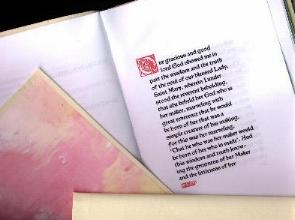 To view sample copies,
actual size, click here.
To view sample copies,
actual size, click here.


