
SYON'S ORCHARD
ST CATHERINE OF SIENA IN
ENGLISH
IN PROGRESS
The Translator's Prologue
 eligious Mother and devout Sisters called and chosen
busily to labour at the house of Syon, in the blessed vineyard
of our holy Saviour, his perfect Rule which he himself
dictated to be kept continually until your lives' end under
the governance of our blessed Lady, his service to read and to
sing as her special servants and daughters, and she your most
sovereign lady and chief abbess of her holy convent. I sinful
creature, unworthy to bear any name, to the worship of that
holy Saviour and at the reverence of his glorious mother, to
your spiritual recreation with help of your prayers, compelled
by charity for spiritual affection, purpose to write to you
after my simple feeling, the revelations of our Lord to his
chosen maid, Catherine of Siena. This Book of Revelations as
for your spiritual comfort to you I call a fruitful orchard.
This orchard by God's grace my will is to divide into seven
parts, and each part into five chapters, as you may see and
read in the following calendar.
eligious Mother and devout Sisters called and chosen
busily to labour at the house of Syon, in the blessed vineyard
of our holy Saviour, his perfect Rule which he himself
dictated to be kept continually until your lives' end under
the governance of our blessed Lady, his service to read and to
sing as her special servants and daughters, and she your most
sovereign lady and chief abbess of her holy convent. I sinful
creature, unworthy to bear any name, to the worship of that
holy Saviour and at the reverence of his glorious mother, to
your spiritual recreation with help of your prayers, compelled
by charity for spiritual affection, purpose to write to you
after my simple feeling, the revelations of our Lord to his
chosen maid, Catherine of Siena. This Book of Revelations as
for your spiritual comfort to you I call a fruitful orchard.
This orchard by God's grace my will is to divide into seven
parts, and each part into five chapters, as you may see and
read in the following calendar.
In this orchard, when you will be comforted, you may walk and see both fruit and herbs. And though some fruit or some herbs seem to some sharp, hard or bitter, yet for purging of the soul they are very helpful and profitable, when they are discreetly taken and received by counsel. Therefore, religious sisters, in this spiritual orchard at planned reasonable times, I would that you play and walk about where you will with your mind and reason, in what alley you like and namely there where you taste best, as you are disposed. You may choose if you will of thirty-five paths where you may walk, that is to say thirty-five chapters, at one time in one, at another in another. But first my counsel is clearly to try and search the whole orchard, and taste of such fruit and herbs reasonably after your affection, and what you like best, afterwards chew it well and eat of it for the health of your soul.
And now, Sisters, I cease writing this prologue, and in a kind of calendar here I will show you now the ordering of this orchard in time to come by God's grace, as he will of his mercy to grant me bodily health and length of life to plant it and set it with such fruit and herbs as our Lord showed to the aforesaid maid in her contemplation when her soul was ravished from all bodily feeling, as her secretaries witnessed and all her disciples. And forasmuch as I said before, this book shall be divided into seven parts, and each part into five chapters. Here, therefore, I begin the Calendar and I commend me to your prayers.
Calendar
First Part
The chapters of the first part
Chapter 1
The first chapter of this first
part speaks of how the soul of this maid is oned to God; and
how, when that soul was lifted up in contemplation, she made
four petitions to our Lord. Also how the desire of this soul
increased, while the need of the world was showed to her by
our Lord. Also how the works of a man in the world do not
suffice to punish his sin in purgatory, nor to be rewarded in
bliss without continual affection of charity. Also how desire
and contrition of a man's heart make satisfaction for his sin,
and for the punishment of his sin, when he labours for his own
soul and for all other men's souls; and how sometimes it makes
satisfaction for the sin, and not for the punishment.
Chapter 2
The second chapter is how each
virtue and fault is by some manner done to one's neightbouR;
also how virtues are wrought in us by some way through our
neighbour. Also why there is so much difference in virtues
which are in creatures. Also how virtues are proved and
strengthened by their contraries.
Chapter 3
The third chapter treats of the
virtue of discretion; and first how a soul shall not put his
affection, nor effectual working, in penance principally, but
in virtues. And how discretion comes from meekness; and how
discretion yields to each creature who belongs to him. Also
our Lord God shows here a similitude how charity, meekness and
discretion be oned together; to which likeness a soul conforms
as much as she may. Also how a bodily penance and other bodily
exercise should be taken for an instrument to come to virtues,
and not for principal affection. Also of the light of
discretion, that is to say: in diverse ways and workings. Also
here he shows a repetition of some words said earlier: and how
God promises his refreshment and comfort, and to Holy Church
reformation through suffereing in penance and tribulation.
Chapter 4
The fourth chapter is how the
working of the soul of this maid by the answer of our Lord
both increased and failed in the bitterness of her soul; and
how she made her prayer for his holy Church and for his
people. Also how God moaned for his Christian people, and
specially of his priests. Also here he touches somewhat of the
sacrament of his holy body, and of the benefit of his
incarnation.
Chapter 5
Also how sin is more grievously
punished after Christ's passion than before; and how God
promises to do mercy to the world and to holy Church through
prayers and enduring penance and discomfort. Also how this
soul knowing so much of the goodness of God prayed not only
for Christian people and for holy Church, but prayed also for
all the world. How God made his complaint of his rational
creatures, and especially for their own self love which reigns
in them, where he comforts this soul to prayers and to tears.
Also how no man may escape the hands of God, but that he must
abide either his righteousness or his mercy. How this soul, on
a time when she sweat water for a holy spiritual burning heat
in time of prayer, desired that her sweating should have been
blood rather than water; and how she reproached herself that
she had not sweat blood; and in this reproaching she made a
special prayer for her spiritual father. Also how a man may
not please God unless he bear tribulation with patience.
Second Part
The chapters of the second part
Chapter 1
The first chapter of the second part make
mention of a bridge, and how God made a bridge of his son when
the way of going to heaven was broken by Adam's disobedience,
by which all true Christian may may pass over; how God induces
and stirs this soul to behold the greatness of this bridge,
that is to say, how it reaches from earth to heaven. Also how
we all are labourers, and are sent from God to labour in the
vineyard of holy Church; and how each man and woman has a
vineyard of their own; and how we which be the twigs or the
branches be oned in the true vine of the Son of God; also by
what way God bears the branches which are oned to the foresaid
vine, and that is to say, these servants; also how the
vineyard of each man is oned with the vineyard of his
neighbour, insomuch that no man may set, or till, or
distrie
his own vineyard unless he set,
till or distrie his neighbour's
vineyard. Also how this foresaid soul, when she had given
praise to God, prayed him to show her those who were going by
that bridge, and those who were not going by that bridge.
Chapter 2
Also how that blessed bridge,
God's son, has three stairs, by which are meant the three
states of a soul; and how this bridge, when it is raised up at
the top, yet is not separated from the earth. Also how this
word shall be understood: Si ergo exaltatus fuero a terra,
omnia trahum ad me [ ]. Also how this bridge is
walled with stones meaning real and true virtues, and upon
this bridge there is a shop or a place where meat shall be
given to travellers; and who goes by that bridge goes to life
and who goes under by the river goes to perdition and to the
depths; how men go that will travel by these two ways, whether
he goes by that one or the other; and of the joy that a soul
has that goes to the bridge.
Chapter 3
The third chapter makes mention
still of this same bridge, God's son, and tells how when our
Lord was ascended up into heaven on the day of the Ascension
he was not parted from the earth. Also how this soul as she
wondered about the mercy of God, she numbered in her soul the
multitude of the gifts of God and the graces which came to
mankind of that same divine mercy. Also of the unworthiness of
those which went by the river under the foresaid bridge. And
how God cleans that soul which goes under the tree of death,
which has roots principally in the four vices.
Chapter 4
Also how the fruit of this tree
is as different as is the diversity of sins; and here he shows
first of fleshly sin. Also how the fruit of some trees is
avarice; and of the evil that comes of that sin; and how
unrighteousness is the fruit of some men's trees which have
the state of domination. Also through his unrighteousness and
through other defaults a man comes into false judging. Also of
the unworthiness into which a man falls through these
defaults. Here also God speaks upon that word which Christ
said: Ego mittam paraclitum. Christ said 'I shall send
the holy Spirit, which shall reproach the word of
unrighteousness and of false judging. And here he said that
one of these reproaches is continual.
Chapter 5
The fifth chapter is of the
second undernaming, or blaming, where unrighteousness and
false judgment are reproved, both in general and in
particular. Also of four principle torments of them who are
damned, which all other torments follow; and in special and
singularly of the foul sight of the fiend. Also of the third
reproof and blaming that shall be at Doomsday, how they who
are damned may not desire any goodness; and of the joy of them
that are blessed. Also that after the general Judgment, the
pain of them that shall be damned shall be increased.
Third Part
The chapters of the third part
Chapter 1
Also of the profit of
temptation; and how each soul in his last end of this life
sees and tastes or feels his place, before he departs from the
body; that is to say: he shall know the pain or joy which he
shall have hereafter. How the fiend catches ever soul under
colour of some goodness; and how those who are stopped by the
river and those who do not go by the bridge are deceived into
believing that there they will avoid punishment, they fall
into torments. Here is also put a vision, which this soul had,
and was a vision of a tree. Also how the world for sin brought
forth thorns and briars, yet there are some that are not
annoyed by them, although no man may come to everlasting life
without some pain suffered thereto. Also the evil that comes
of the blindness of the spiritual eye or sight. Also how good
deeds that are not in the state of grace avail not for
everlasting life.
Chapter 2
The second chapter tells how the
precepts must not be kept but that a man should of perfection
keep the counsels, and how in each estate which a man choses,
so that he has a holy and a good will, that state is pleasing
to God. Also how worldly men with all their goods may not be
fulfilled; and of the pain they deserve by their wicked will,
as well in this life as after. How a servile dread is not
enough for everlasting life; and how with exercise of this
dread a man may come to the love of virtues.
Chapter 3
Also how this soul fell into a
mourning for the blindness of them who were drowned in the
foresaid river. And three stairs were figured in the foresaid
bridge, that is to say: in God's son, meaning the three
strengths in the soul; and how these three virtues of the soul
if are not joined together, there may be no perseverance,
without which perseverance no man may come to the goal of
perfection. Also in this chapter is an exposition of the word
of Christ where he dais: Siqui siti, et cetera. That
is to say, 'Who so thirst, come to me and drink'. Also how
each reasonable creature generally may govern themselves, so
that he may pass out from the sea of this world, and go by the
foresaid holy bridge. Also here is a repetition of some words
said before.
Chapter 4
The fourth chapter tells when
our Lord would show to his devout soul that the three stairs
of the bridge are figured by the three states of the soul,
then he told her to lift herself up above herself to behold
this truthfulness. Also how this devout soul, beholding in the
mirror of God, saw diverse creatures go in diverse ways. Also
how the dread of slavery without love of virtues is not
sufficient to everlasting life; and how the law of dread and
the law of love be oned together. Also how a man who has the
dread of bondage, or a slave state which is the state of
imperfection (by which state is understood to be the first
stair of the aforesaid holy bridge) he may come to the second
stair, which is the state of perfection. Also of the
imperfection of those who love and serve God for their own
profit, and love, or for their comfort. Also that God shows
himself sometimes to a soul which loves him.
Chapter 5
Also why Christ did not say: Ego
manifestabo. 'I shall show my Father', but he said: 'I
shall show myself'. What manner of governance a soul shall
keep that he may come up to the second stair of the holy
bridge. How he who loves God imperfectly, loves mperfectly his
neighbour; and of the tokens of his imperfect love.
Fourth Part
The chapters of the fourth part
Chapter 1
The first chapter of the fourth
part speaks of prayer, and first in what manner a soul shall
givern himself, that he may come to pure and free love. But
first God shows here doctrine of the holy sacrament of
Christ's body on the altar, that is to say, the holy sacrament
of Christ's body; and how a soul shall come from vocal prayer
to mental prayer. And here is showed a vision which this
devout soul had once. Also of a deceit that creatures have
sometimes, who love God and serve him for their own comfort
and their deligth. Also of te deceit that they have, who set
all their affection in vomfort and spiritual visions; and how
such who delight in them in such comforts and visions may be
deceived, and receive a wicked spirit under likeness of a good
spirit; and of tokens how it may be known when it comes from
God, and when of the enemy.
Chapter 2
Also of those who will not help
or comfort their neighbour in their need because they will not
be interrupted nor leave their won comfort and peace and rest.
Also of the deceit which God's servants have, and love God
with such imperfect love as said before. How a soul who knows
herself wisely in truthfulness keeps herself from all these
aforesaid deceits. Also by what manner a soul comes from
imperfect love, and comes to a perfect, friendly and loving
love.
Chapter 3
The third chapter of this part
is of tokens whereby it is known that a soul is come to the
perfect love. Also how imperfect men will only follow me, the
father, but perfect men follow the son. Also God showed a
vision which this devout maid had, in which vision is showed
diverse baptism, and of all other fair and profitable things.
How a soul, when it is come to the mouth, soon it takes the
door of the mouth, and when the proper will of man is dead, it
is a true token that it is come there. Also of the workings of
the soul after the time that it is ascended to the third holy
stair. Also of the fourth state that is not separated from the
third, and of the workings of the soul which has come to this
state; and how God never goes away from the aforesaid peerfect
men by feeling of grace, because of the union between them.
Also how worldly men give glory and worship to God, whether
they will or not. Also how the fiends give worship to God
against their will.
Chapter 4
Also how a perfect soul that
passes from this world sees fully the glory and praise of the
name of God in each creature, and how in the soul is ended the
pain of desire, and not desire. Also, how Saint Paul, after
the time that he was taken to see the glory of them who are in
bliss, desired to be unbound and loosened from the body, and
do they who come to the third and furthest aforesaid stair.
Whcih causes a soul to desire to be loosed from the body; and
though it is not as he desires, it is not against the will of
God, but rather it gives worship to God in that pain and in
each other pain for the worship of God. How they who are come
to the aforesaid stair of union are lightened in the eye of
the intellect by grace with a light above nature. And how it
is better to go to have counsel for the soul's help to a meek
man with a holy consicence than to a proud lettered man. Also
here is a profitable repetition of many things, which are
said: and how God induces the devout soul to pray for every
creature, and for all the Holy Church.
Chapter 5
The fifth chapter of this part
is much of the state of holy tears; and how this holy soul
desired to know of the states and the fruits of holy tears.
Also of the difference of the aforesaid tears; and how there
are five kinds of tears. Also a short repetition of the
matter; and how the wicked spirit flees away from those who
come to the fifth kind of tears. Also how they who desire to
have tears from their eyes and may not have them, such have
tears of fear. And why God withdraws bodily tears. How the
four states of the five states of tears give different tears.
And how God will be served with things that have no end, and
not only with things that end. Also of the fruits of tears of
worldly men: and how such worldly weepers are buffeted with
four winds. Also of the fruit of the second and the third
state of tears; and of the fruit of the fourth and the fifth
state of tears. Also how this devout soul, when she gave
thanks to God for the declaration of the aforesaid states of
tears, made three petitions to God.
Also how the light of reason is necessary to a soul that would
serve God in truthfulness, and truly; and of a general light.
Fifth Part
The chapters of the fifth part
Chapter 1
Also those who desire more to
suffer bodily pain than to mortify or destroy their own will;
which is one perfect light, or a light of perfection more than
the general light, and it is the second light of perfection.
Also of the third and most perfect light of reason; and of the
works that a soul does when it comes to that state. Also there
is showed a fair vision which this soul had, in which vision
is showed fully of the kind of coming of perfect purity of the
soul. Also by what way they receive the promise of sureness of
everlasting life in this life, such as live in the third
light, which is most perfect light. Also how our neighbour
shall be reproved that he falls not into a false judging.
Also, if a man prays for a person, and God shows in the soul
of the one praying that that soul is full darkness for whom he
prays, yet this shall not be considered wrong. Also how bodily
penance shall not be taken for a principal foundation, nor for
a principal desire, but desire and love of virtue shall be
taken for a principal base. And of a short repetition of words
said already, with an addition of reproving our neighbour.
Chapter 2
The second chapter is of tokens
to know when visitations or spiritual visions come from God or
from the fiend. Also how God is the fulfiller of holy desires
of his servants, and how it greatly pleases God when a man
asks with perseverance and knocks at the gate of his
truthfulness. How this devout soul humbled herself and gave
thanks to God; and how she prays for all the world, and
specially for Holy Church, and also specially for her
spiritual disciples and for her two spiritual fathers, and
after this, she asks to hear the deeds of the ministers of
holy Church. Also how God sees the business of this soul about
prayer, and answers some of her petitions.
Chapter 3
Also here God speaks of the
dignity of priests, and of the sacrament of his holy body; and
of them who receive that sacrament worthily and unworthily.
Also how all the bodily senses or feeling are deceived in the
aforesaid sacrament, but not the feelings of the soul; there
with the feelings or senses of the soul that holy sacrament
shall be seen, tasted and felt. And here is a vision which
this devout soul had of this same matter, Also of the
excellence in which a soul stands, who receives this sacrament
in grace. How the words that are said of the excellence of the
sacrament are said that the dignity of priests should be
better known. And how God asks more purity and cleanness of
body and soul in them than in other of his creatures. Also how
the sacraments shall neither be sold nor bought. And those who
receive the sacraments shall help the ministers with their
temporal goods, which goods the ministers shall dispose and
ordain into three parts.
Chapter 4
The fourth chapter speaks in the
beginning of the dignity of priests, and how the virtue of
sacraments is not lessened nor diminished through the sins of
those who minister, nor through the sins of the receiver. And
how God does not want the laity to correct the ministers. Also
how God stops the persecution that is done to holy Church or
to the ministers as if it were done to himself. And how that
sin is more grievous than any other sin. Here also God speaks
against those who persecute holy Church, and of the ministers
of holy Church in several ways. And a short repetition of what
is said earlier of holy Church and of the ministers. Of the
excellence and virtues and of the holy works of virtues and
holy ministers; and how they have the condition of the Son.
And of the correction to her subject. A repetition of words
beforesaid. And of reverence that shall be done to priests,
whether they are good or bad. And of the deeds and wicked life
of evil priests and evil ministers. And how unrighteousness
reigns in bad ministers, and in those who do not correc their
subjects. Of many other defaults of the aforesaid ministers,
and specially of going to taverns and of their vain plays, and
of keeping their concubines. Also how the sin against natura
reigns in some of the aforesaid ministers; and of a fair
vision which this soul had of this matter. Also how subjects
who are in the aforesaid faults do not amend them; and of
faults of religious persons who do not correct the aforesaid
faults. Also how the sin of lechery reigns in evil ministers
of holy Church; also that avarice reigns in wicked ministers
in lending in usury; and especially in buying and selling
benefices and prelacies, and of much evil that has come in
holy Church because of this covetousness. Also how pride
reigns in the aforesaid ministers, by which pride the feeling
of God is lost, and when that feeling is absent then they fall
into this fault; that is to say, such men pretend to
consecrate, and do not. Also of many other faults which come
of pride and of man's self love.
Chapter 5
Of the difference of the death
of rightful men and of the death of great sinful men; and
first of the death of rightful men. Of the death of great
sinners, and of their pains at the end, or point of death. And
a repetition of much that is said already. And how God forbids
that priests should not be touched by the hands of secular
men. And how God stirs this soul to pray and to weep in
compassion of such misliving priests. And how this devout soul
gives thanks to God and praise, and prays specially for all
holy Church.
Sixth Part
The chapters of the sixth part
Chapter 1
The first chapter of the sixth
part treats much of the providence of God; and first of his
providence generally, that is to say, how God provides man to
be man and formed of nought to his image and likeness; and how
God provides man to his salvation with the incarnation of his
Son, when the gate of Paradise was shut through the sin of
Adam. And how he provides himself, giving himself continually
to us into meat on the altar. Also how God provides to give
hope in his creatures; and how he who most perfectly hopes,
most tastes the providence of God. And how God in the Old
Testament provided the law and the prophets and afterward he
sent his word by the apostles, martyrs and other holy men. And
how nothing falls to creatures, but that all is the providence
of God. Also how whatever God sufferes to do to us, it is only
for our good and for our soul's health, and they are blind and
deceived that believe the contrary.
Chapter 2
The second chapter is how God
provides in some special cases to the soul that falls. Here
God shows his providence against his creatures in other
diverse ways, and makes his complaint of untruth of his
creatures. And he expounds a figure of the Old Testament, and
shows a profitble doctrine. How God provides for us, that we
have tribulations for the health of our soul and of the misery
of those who trust to themselves and not in the providence of
God. And of the excellent grace of those who trust in the
pèrovidence of God. How God has provided for souls, giving
them the sacraments for their health; and how he provides for
his servants who are very hungry and desiorous, when he
ordains them to be fed with his Son's body Jesus Christ, where
he tells that often times he provides Christ's body by a
wonderful manner to a soul that was very hungry.
Chapter 3
The third chapter is of the
providence of God against those that are abiding in deadly
sin; of the providence which God uses and ordains for those
that are in imperfect love, and for those that are in perfect
love and charity. And a short repretition of the aforesaid
words. And how God speaks afterwards of the word which Christ
said to Peter: Mitte rethe ad dexteram partem navis &
invenietis, that is to say: 'Cast the net on the right
side of the ship, and you shall find'. And how some men cast
their net more perfectly than others, so they catch more fish
than others. And of the excellence of such perfect men.
Chapter 4
The fourth chapter is of the
providence of God in general, that he uses in his creatures in
this life and that other. Also of providence of God for his
poor servants, helping them with temporal goods. And of evils
that come in keeping and desiring temporal goods inordinately.
Of the excellence of them who are poor in spirit.
Chapter 5
The fifth chapter is how Christ
taught us of his poverty, not only by word but by example.
Also of the providence of God for those who take up his
poverty. And a short repetition of the aforesaid divine
providence. And how this soul when she gave worship and thanks
to God, she prayed that he would speak to her of the virtue of
obedience.
Seventh Part
The chapters of the seventh part
Chapter 1
The first chapter of this
seventh part and all the chapters of this part speak of the
virtue of obedience. And first, how obedience is has, and what
is that thing which casts obedience away from us. And what is
the token of obedience that a man has it, or not. And who is
the fellow of obedience, and of whom it is nourished. How
obedience has a key whereby heaven is opened, and how the key
must have a thong and be born on the belt. Here also he speaks
of the misery of them who are not obedient, and of the
excellent grace of them who are obedient.
Chapter 2
The second chapter is of them
who set so much love to obedience that it is not enough to
them to obey to the general obedience as to the commandments
of God, unless they take and bind to themselves some special
obedience. Also how a man comes, and what way, from the
general obedience to the speical; and of the excellence of
religion. Also of the excellence of them who are under
obedience and are obedient, and of the misery of them who are
disobedient, which are in monastic orders. How those who are
very obedient receive a hundredfold for one, and everlasting
life. And what is understood by that one, and what by that
hundred.
Chapter 3
The third chapter is of the
perversity, misery and labours of he who is disobedient; and
of the miserable fruits which come of disobedience. Of the
imperfections of those who are slow or unwilling in religiion,
although they keep themselves from deadly sin; and of the
remedy how they should come out of that unwillingness. Of the
excellence of obedience, and of the goods that obedience gives
to him who takes it in truthfulness.
Chapter 4
The fourth chapter is of the
distinction of two ways of obedience, that is to say, of
obedience of religious people, and of obedience that is due to
a certain person out of religion for God. How God rewards not
after the travail of obedience, nor after the length of the
time, but after the magnitude of charity. Also of the
readiness and quickness of them who are very obedient. And of
the miracles which God shows of this virtue. And of discretion
in obedience, and of the works and reward of them who are very
obedient.
Chapter 5
The fifth chapter of this last
part is a repetition of the whole book; and how this devout
soul, giving worship and thanks to God, made a prayer for all
holy Church and for all the world. And here is commended the
virtue of faith, and so is fulfilled the end of this book.
PROLOGUE
So, Sisters, I have showed you what bushes and trees I have found and gathered to plant and to set in your spiritual orchard. The alleys of your orchard are very long and broad, within which are many paths for walking, which shall lead you truly to what fruit you want to eat, in which part they have been set or planted. But, Sisters, you should know that in gathering delectable fruit I found many bitter weeds. Bitter and sour they are to taste, but profitable to know. Such weeds I intend to set amongst good fruit, not for eating, but for your knowing.
Taste them and know them, that you may beware of any spiritual enemy when they offer you such weeds. Savour them not for complete eating, for they work dangerously and often to dying, but by grace sooner it shall be remedied.
But, Sisters, though my herbs are gathered, yet I must have time for setting and plantings sometimes among my time of playing. I was never a great worker, bodily nor spiritually. I was never very strong to work with spade nor shovel. Therefore now, devout Sisters, help me with prayers, for I lack cunning, alongside my great feebleness. Strengthen me with your pity. And recommend me in your spiritual exercise to our blessed Lady. And greet her in my name with devout Aves, recalling to mind her five joys, and sometimes her five sorrows which she had on earth. With this work I charge you not but as your charity stirs you to. With that virtue help me forth, for hastily I go to labour, in purpose to perform the spiritual orchard as it pleases Almighty God to lighten my soul with true feeling and clear sight. Which Jesus Christ for his motehr's love grant only to his worship, and to your spiritual learning, and comfortable recreation. Amen.
Here begins the Book of Divine Doctrine, that is to say, of God's teaching, given by the person of God the Father to the intellect of the glorious virgin, Saint Catherine of Siena, of the Order of Saint Dominic, which was written as she dictated it in her mother tongue, when she was in contemplation rapt in spirit, and she actually hearing and in the same time telling before many what our Lord God spoke in her.
First Part
And here follows the first
chapter of this book, which is how the soul of this maiden was
oned to God, and how she made four petitions to our Lord in
that time of contemplation, and of the answer of God; and of
much other doctrine.
Chapter 1
A soul that is raised up with heavenly and ghostly desires and affections to the worship of God and to the health of man's soul, and with a great desire languishes, virtuously inhabited by a space of a long time, very busily works in spiritual exercise, and meekly abides in her inward beholding to know herself, to that intent only that she might better know in herself the godness of God; for as she well feels by grace that after that knowing the love that loves is knit and joined with a love to that that is loved, and forces and busies her to love and follow that knowing, and with continual excercise inhabits her with truthfulness. And forasmuch as a soul in no way tastes nor savours so much, also it is in no way so much lightened with knowing of that truthfulness as it is by the means of a meek, continual and devout prayer founded and grounded in the knowing of God and of itself. Therefore such a prayer ones such a soul to God, following the steps of Christ in his Passion. And so by desire, affection, and union of love, the soul makes herself another than she was before.
This seems well of Christ's words when he said: Siquis diligit me, sermonem meum servabit. That is to say: 'Who loves me shall keep my word'. Also he says elsewhere: Qui diliget me diligetur a patre meo, et ego diligam eum et manifestabo illi meipsum, et erit unum mecum et ego cum illo. That is to say: 'He who loves me shall be loved of my father, and I shall love him, and I shall show myself to him, and he shall be one with me and I with him'. and in many places of scripture we find similar words to the same purpose, by which we may openly know that a soul is altered and he makes himself other than he was before in truthfulness of love and desire.
And that we may see this more clearly I am reminded that I have read of a holy maid, servant of God, Catherine of Siena, who when she gave herself busily and attentively to prayer with enhancing of her mind to God to behold heavenly things in the ways of contemplation, then holy God did not hide his love that may not be measured which he has to his servants with the gift of intellect by the spiritual eye. But specially among other words our Lord God spoke to her and said: Open your eye of the intellect, or of spiritual udnerstanding, and see in me, and you shall see the dignity and the fairness or beauty of my reasonable creature, and the fairness which I have given to the soul, making it of nought to my image and likeness. Seen them who are arrayed with the precious clothing of spiritual weddings; that is to say, virtuously arrayed with charity and with many diverse virtues; continually you are joined to me by love. Therefore, if you should ask me who they are, I should answer you again: Those who are another I; as though he had said: Those who have my likeness. For such who have lost and mortified wilfully their own self will, and are conformed to my will, and in all things with my will they are clothed and preciously arrayed. Therefore it is true that such a soul ones itself to God through desire and affection of love. Also this soul still moreover willing to know the holy truthfulness of knowing and to follow it by exercise, considered first as for herself with a high desire that a soul may by no way of doctrine, nor of example, nor of prayer, benefit his neighbour but it benefit first itself; that is to say, in purchasing and in having in possession the perfection of virtures in itself. Therefore in that holy desire of true knowing meekly she asked four petitions of the eternal Father in heaven. The first petition was for herself; the second, for the reformation of holy Church; the third, in general for the health of all the world, and specially for the peace of Christian people which with great presumption and great persecution is rebel to holy Church; the fourth petition was that the providence of God should purvey for each dark case, or doubt, or need, in general and in special.
How the desire of this soul increased when she knew the need that is in the world
This desire was to her very great and remained continuously; which desire increased in her the more fervently when the great wretchedness of this world was shown to her by Almighty God, the maker of all the world, and when she also saw such great trouble in the world, and so much offence done to God in the world. Also in this time of this holy desire she understood by a writing that she had of her spiritual father, in which writing he showed her the great pain and the sharpness of intolerable sorrow ordained for sin and for the offence to God, and of the cause of the loss of souls, and for the persecution that is done to holy Church. Which words kindled in a fire of desire, with a loathing and a bittereness for the offence done to God, and then she with a gladness and joy of a trusted hope meekly attended the goodness of God, which mercifully would purvey for all the evils and perils.
And forasmuch that in receiving of the holy sacrament a soul more sweetly and more fervently cleaves to God and better knows his truthfulness, because that then is a soul in God, and God in the soul, right as fish abide in the sea, and the sea in the fish: therefore upon the next morning following she had a full fervent and burning desire to hear Mass; which day was on a feast of our Lady, God's mother. And when she heard Mass at a certain hour with a very great desire to have an inward knowing of herself and of her own imperfection, it seemed to her in a great shamefastnss that she was the principle cause of all the evils or diseases done in the world, and conceived in herself a sngular hate and displeasure of herself. And than with a desire of a holy righteousness to purify such filth of sin which she saw in the world and in her own soul, she lifted up her heart to the Father in heaven and said: Everlasting Father in Heaven, to you I make my complaint of myself, and to you I complain and accuse myself, to that intent that in this life you punish my sins. And forasmuch as I am the principle cause of the pains through my sins which my even-Christian should suffer, therefore meekly I beseech your high majesty that you put those pains on me.
How good or evil works in this world only suffice not to be punished in purgatory nor to be rewarded in bliss without continual desire of charity
Then the truthfulness of the Godhead took this
desire and fervently drew it to him, and did as it was in the
Old Testament. For then when the sacrifice was acceptable to
God, fire came down from heaven and drew such a sacrifice to
him. In the same way that holy truthfulness did to that soul,
for that truthfulness, Father of heaven, sent the fire of the
holy Spirit and took the sacrifice of her great desire, which
sacrifice she made of herself to God. And when our Lord had
received this sacrifice of her, he spoke to her and said:
Daughter, don't you know that all the pains that men suffer,
or any creature may suffer in this world, are not full worthy,
nor even worthy penance, nor sufficient to punish the least
sin? And the cause is because the offence that is done to me,
who am God and godness who has no end, asks blame without end.
Therefore I would that you know that not all the pains that
are given or sent of God in this world are for penance, but
for correction, to amend and correct the child when he
trespasses. And yet, furthermore, it is true that a man makes
or does satisfaction by a fervent desire of the soul, that is
to say, with true contrition and true horror of sin. For true
contrition
IN PROGRESS
Indices to
Umiltà Website's Essays on Julian:
Preface
Influences
on Julian
Her Self
Her
Contemporaries
Her Manuscript
Texts ♫
with recorded readings of them
About Her
Manuscript Texts
After Julian,
Her Editors
Julian in our
Day
Publications related to Julian:


Saint Bride and Her Book: Birgitta of Sweden's Revelations Translated from Latin and Middle English with Introduction, Notes and Interpretative Essay. Focus Library of Medieval Women. Series Editor, Jane Chance. xv + 164 pp. Revised, republished, Boydell and Brewer, 1997. Republished, Boydell and Brewer, 2000. ISBN 0-941051-18-8
 To see an example of a page inside with
parallel text in Middle English and Modern English, variants
and explanatory notes, click here. Index to this book at http://www.umilta.net/julsismelindex.html
To see an example of a page inside with
parallel text in Middle English and Modern English, variants
and explanatory notes, click here. Index to this book at http://www.umilta.net/julsismelindex.html
Julian of
Norwich. Showing of Love: Extant Texts and Translation. Edited.
Sister Anna Maria Reynolds, C.P. and Julia Bolton Holloway.
Florence: SISMEL Edizioni del Galluzzo (Click
on British flag, enter 'Julian of Norwich' in search
box), 2001. Biblioteche e Archivi
8. XIV + 848 pp. ISBN 88-8450-095-8.
 To see
inside this book, where God's words are in red, Julian's
in black, her editor's in grey, click here.
To see
inside this book, where God's words are in red, Julian's
in black, her editor's in grey, click here.
Julian of
Norwich. Showing of Love. Translated, Julia Bolton
Holloway. Collegeville:
Liturgical Press;
London; Darton, Longman and Todd, 2003. Amazon
ISBN 0-8146-5169-0/ ISBN 023252503X. xxxiv + 133 pp. Index.
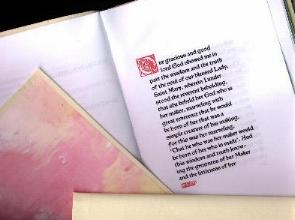 To view sample copies, actual
size, click here.
To view sample copies, actual
size, click here.

'Colections'
by an English Nun in Exile: Bibliothèque Mazarine 1202.
Ed. Julia Bolton Holloway, Hermit of the Holy Family. Analecta
Cartusiana 119:26. Eds. James Hogg, Alain Girard, Daniel Le
Blévec. Salzburg: Institut für Anglistik und Amerikanistik
Universität Salzburg, 2006.

Anchoress and Cardinal: Julian of
Norwich and Adam Easton OSB. Analecta Cartusiana 35:20 Spiritualität
Heute und Gestern. Salzburg: Institut für Anglistik und
Amerikanistik Universität Salzburg, 2008. ISBN
978-3-902649-01-0. ix + 399 pp. Index. Plates.
Teresa Morris. Julian of Norwich: A
Comprehensive Bibliography and Handbook. Preface,
Julia Bolton Holloway. Lewiston: Edwin Mellen Press, 2010.
x + 310 pp. ISBN-13: 978-0-7734-3678-7; ISBN-10:
0-7734-3678-2. Maps. Index.

Fr Brendan
Pelphrey. Lo, How I Love Thee: Divine Love in Julian
of Norwich. Ed. Julia Bolton Holloway. Amazon,
2013. ISBN 978-1470198299

Julian among
the Books: Julian of Norwich's Theological Library.
Newcastle upon Tyne: Cambridge
Scholars Publishing, 2016. xxi + 328 pp. VII Plates, 59
Figures. ISBN (10): 1-4438-8894-X, ISBN (13)
978-1-4438-8894-3.

Mary's Dowry; An Anthology of
Pilgrim and Contemplative Writings/ La Dote di
Maria:Antologie di
Testi di Pellegrine e Contemplativi.
Traduzione di Gabriella Del Lungo
Camiciotto. Testo a fronte, inglese/italiano. Analecta
Cartusiana 35:21 Spiritualität Heute und Gestern.
Salzburg: Institut für Anglistik und Amerikanistik
Universität Salzburg, 2017. ISBN 978-3-903185-07-4. ix
+ 484 pp.
  |
To donate to the restoration by Roma of Florence's
formerly abandoned English Cemetery and to its Library
click on our Aureo Anello Associazione:'s
PayPal button: THANKYOU! |
JULIAN OF NORWICH, HER
SHOWING OF LOVE AND ITS CONTEXTS ©1997-2024 JULIA BOLTON HOLLOWAY
|| JULIAN
OF NORWICH ||
SHOWING
OF LOVE || HER
TEXTS || HER
SELF || ABOUT
HER TEXTS || BEFORE
JULIAN || HER
CONTEMPORARIES || AFTER
JULIAN || JULIAN
IN OUR TIME || ST
BIRGITTA OF SWEDEN || BIBLE
AND WOMEN || EQUALLY
IN GOD'S IMAGE ||
MIRROR
OF SAINTS || BENEDICTINISM|| THE
CLOISTER || ITS
SCRIPTORIUM ||
AMHERST
MANUSCRIPT || PRAYER|| CATALOGUE
AND PORTFOLIO (HANDCRAFTS, BOOKS ) || BOOK
REVIEWS || BIBLIOGRAPHY ||

