JULIAN OF NORWICH, HER SHOWING OF LOVE
AND ITS CONTEXTS ©1997-2024
JULIA BOLTON HOLLOWAY
|| JULIAN OF NORWICH || SHOWING OF
LOVE || HER TEXTS || HER SELF || ABOUT
HER TEXTS || BEFORE JULIAN
|| HER CONTEMPORARIES || AFTER JULIAN || JULIAN IN OUR TIME || ST BIRGITTA OF SWEDEN
|| BIBLE AND WOMEN || EQUALLY IN GOD'S IMAGE || MIRROR OF SAINTS || BENEDICTINISM || THE CLOISTER || ITS SCRIPTORIUM || AMHERST MANUSCRIPT || PRAYER || CATALOGUE AND PORTFOLIO (HANDCRAFTS, BOOKS )
|| BOOK REVIEWS || BIBLIOGRAPHY
THE ROUND WORLD'S
IMAGINED CORNERS
 s a medievalist I have found myself often
challenged by non-medievalists' misconception of medieval people
as believing that the world was flat and square, and even that
one dropped off its edge. This seems to me
Renaissance/Enlightenment propaganda against the Middle Ages as
the 'dark ages of superstition and ignorance'. But it is
certainly not borne out in medieval texts or in medieval art. I
borrow from John Donne's Renaissance poetry the title for this
modern prose on medieval cosmology.
s a medievalist I have found myself often
challenged by non-medievalists' misconception of medieval people
as believing that the world was flat and square, and even that
one dropped off its edge. This seems to me
Renaissance/Enlightenment propaganda against the Middle Ages as
the 'dark ages of superstition and ignorance'. But it is
certainly not borne out in medieval texts or in medieval art. I
borrow from John Donne's Renaissance poetry the title for this
modern prose on medieval cosmology.
Great maps, as at Hereford, show the mappa
mundi as round. Medieval art can show God creating the
world as a globe. Medieval kings held orbs, signifying the
roundness of the world, the cross at its top for Jerusalem. One
particularly recalls the Coronation Portrait of Richard II in
Westminster Abbey.

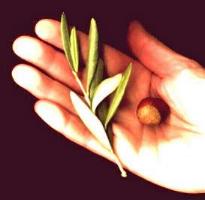
Julian holds all that is created as
like a round ball, the quantity of a hazel nut in the palm of
her hand. This apparent smallness, her text explains, because
she sees the Cosmos, the Creation, in the presence of the
Creator.
Generally medieval maps are of their
'known world', arranged in the T of Asia, Europe and Africa. But
an Icelandic map shows two sides of the globe, one, the T map,
the other the boundless ocean in between which Christopher
Columbus was to try to cross to reach India and China./1 Already in the
fourteenth century John de Mandeville describes yearning to
cross that vast ocean from Chinese shores in order that way to
return to Europe and as having his voyages checked against a mappa
mundi by the Pope in Rome./2 Medieval libraries (without which the
Renaissance could not have taken place) of classical texts
treasured in monasteries and cathedrals, included the texts of
Ptolemy. Further refinements were added to this knowledge by the
Arabs' study of Greek texts. But already Cicero's Somnium
Scipionis and Boethius' De consoltatione philosophiae,
based on Ptolemy and Pythagoras, had stressed that vision of
the earth as a round ball. Not to be actually seen until the
astronauts first viewed it from space in our lifetime.

Spain particularly is cognisant of the
globe. Egeria had been noted in a Spanish document dated from
the seventh century to have traversed the whole orb with her
pilgrimages made in the fourth century./3 While Jonas' life of
St Columbanus tells us:
Once Columban thought of going to the land of
the Wends, who are also called Slavs, in order to illuminate
their darkened minds with the light of the Gospel and to open
the way of truth to those who had always wandered in error.
When he proposed to make his vows, the angel of the Lord
appeared to him in a vision, and showed him in a little circle
the structure of the world, just as the circle of the universe
is usually, drawn with a pen in a book. "You perceive," the
angel said, "how much remains set apart of the whole world. Go
to the right or the left where you will, that you may enjoy
the fruits of your labors." Therefore Columban remained where
he was, until the way to Italy opened before him.4
The eleventh/twelfth century
Creation Tapestry at Gerona reflects what one also sees in the
Beatus Apocalypse manuscripts. A fourteenth-century Castilian
painting shows Christ, God the Son, with the T-map globe in his
left hand perched on God the Father's shoulders whose own arm is
looped through the circular cosmos and whose feet are upon an
ocean filled with fish. Spain's monarchs, Ferdinand and
Isabella, came to commission Columbus' Voyage that would bring
about America's official discovery. But Dante Alighieri had
already postulated, in the Purgatorio, the existence of
this 'nuova terra'. As had the Icelandic discovery before him of
Vinland.
Brunetto Latino, Dante Alighieri's
teacher, clearly presented the world as round, in his Tesoretto
when describing his meeting with Ptolemy.
[Folio 25 verso]
Ch'io credo pur tornare
La via ch'i m'era messo;
Ché ciò che m'è promesso
Di veder le sette arti
E altri molte parti,
Io le vo'pur vedere
E cercare e savere
. . .
[Folio 26]
COsì un dì di festa
Tornai a la foresta,
E tanto cavalcai
Che io mi ritrovai
Una diman per tempo
In sul monte d'elempo,
Di sopra in su la cima.
E qui lascio la rima
Per dire più chiaramente
Ciò ch'io vidi presente:
Ch'io
vidi tutto'l mondo,
Sì com'elgli è ritondo,
E tutta terra e mare,
E'l fuoco sopra l'aire;
Ciò sono quattro elementi,
Che sono sostenimenti
Di tutte creature
Secondo lor nature./5
Brunetto Latino continued that
education, but in French, in his Li Livres dou Tresor
whose manuscripts are to be found throughout Latin Christendom
and which often show in miniature and drawing the roundness of
the earth./6 All of
this became material for Dante Alighieri to use in his Commedia
in which he articulates in detail the cosmos, the round earth at
its centre and the carefully calculated movement of the seven
planets about it and even the Southern Cross./7 The only difference
between their cosmos and ours is their centring of it on the
earth, rather than upon the sun. Thus the mathematics they had
to use to compute the movements of the planets, which to them
looped about in subtle ways, had to be far more complex than
ours because based on that fallacy and needing to predict the
placements of these 'wandering stars'.
NOTES
1 See the maps from Joachim Lelewel, Géographie
du Moyen Age (Brussels, 1852), 3 vols., reproduced in
Julia Bolton Holloway, The Pilgrim and the Book: A Study
of Dante, Langland and Chaucer (Berne: Peter Lang,
1992), p. 153.
2 Mandeville's Travels, ed. M.C. Seymour
(London: Oxford University Press, 1968), p. 243. See also
the Early English Text Society editions of his work.
3 'Si tratta di uno scritto del VII secolo, una
lettera che un monaco galiziano, Valerio del Bierzo, indirizza
ai suoi confratelli, esortandoli a prendere come loro modello
le straordinarie doti spirituali di una pellegrina che
"intrepido corde immensum totius orbis arripuit iter" ("con
intrepido cuore, intraprese un viaggio interminabile
attraverso tutto il mondo") - dice Valerio, con evidente
amplificazione retorica: Pasquale Smiraglia, Accademia dei
Lincei, 'La Citta e il Libro II: Il manoscritto, la
miniatura', http://www.florin.ms/
beth.html For another intrepid woman globe-trotter see
Iceland's Guthrithyr, who visited both Vinland and Rome, http://www.umilta.net/egeria.html
4 Edited, Dana C. Munro, University of
Pennsylvania. Dept. of History: Translations and Reprints from
the Original Sources of European History (Philadelphia,
University of Pennsylvania Press [1897?-1907?]. Vol. II. No.
7; http://www.fordham.edu/halsall/basis/columban.html © Paul
Halsall June 1997, halsall@murray.fordham.edu
5 Brunetto Latini, Il Tesoretto (Firenze: Le Lettere,
2000), facsimile of Laurentian Library Strozziano 146.
6 Brunetto Latini, Li Livres dou
Tresor (Barcelona: M.Moleiro Editor, 2000), facsimile of
St Petersburg National Library Fr. F.V.III,N° 4, 2 vols.,
fols. 7, 28v, 31v, 30v, 38v.
7 Barbara Reynolds, for her
completion of Dorothy Sayers' translation of the Commedia, used M.A. Orr's study
of Dante's astronomy, carried out by a Victorian woman in an
astronomical observatory in India, which was in turn based
on that of his teacher, Brunetto Latino. M.A. Orr's work
reflects that of Mary Somerville, the brilliant, self-taught
mathematician and astronomer, who proved the existence of
the eighth and ninth planets, Neptune and Pluto, before
their discovery, from the erratic movements of the other
planets effected by their gravity.
JULIAN OF NORWICH, HER SHOWING OF LOVE
AND ITS CONTEXTS ©1997-2024
JULIA
BOLTON HOLLOWAY || JULIAN OF NORWICH
|| SHOWING
OF LOVE || HER TEXTS
|| HER SELF || ABOUT HER TEXTS || BEFORE JULIAN || HER CONTEMPORARIES || AFTER JULIAN || JULIAN IN OUR TIME || ST BIRGITTA OF SWEDEN
|| BIBLE AND WOMEN || EQUALLY IN GOD'S IMAGE || MIRROR OF SAINTS || BENEDICTINISM || THE CLOISTER || ITS SCRIPTORIUM || AMHERST MANUSCRIPT || PRAYER || CATALOGUE AND PORTFOLIO (HANDCRAFTS, BOOKS
) || BOOK REVIEWS || BIBLIOGRAPHY


