
HELENA, EGERIA, PAULA, EUSTOCHIUM, PEGA, BRIDGET, GUTHRITHYR, MARGARET, ISOLDA, BIRGITTA, CATHERINE, MARGERY, ROSE AND JULIA:
THE BIBLE AND WOMEN PILGRIMS
Fourteenth-Century Icelandic Manuscript, Jonsbok,
Arni Magnusson Institute, Reykjavik, Iceland
Helena
|| Egeria || Paula, Eustochium || Pega || Bridget ||
Guthrithyr || Margaret
|| Isolda || Birgitta,
Catherine || Margery || Rose, Julia
 n this presentation given first at St Hilda's
College, Oxford, Conference on Women and the Book, and then
on Iceland celebrating her Millennium of Christianity since
1000, in Christianity's Jubilee of 2000, you will go on
pilgrimage with me and with other women, who, guided by the
Bible, travelled to the Holy Places in Israel, to Nazareth, Bethelehem and Jerusalem, and to Sinai
in Egypt, modeling their journeys upon those Mary took. This
essay will discuss women, from the fourth through the
fifteenth centuries, such as Helena ,
Egeria , Paula
and her daughter, Eustochium, Bridget, Margaret, Pega,
Guthruthyr, Isolda, Birgitta and
her daughter, Catharine, and Margery,
women from Britain, Spain, Italy, Ireland, Iceland and
Sweden, who took those journeys.
n this presentation given first at St Hilda's
College, Oxford, Conference on Women and the Book, and then
on Iceland celebrating her Millennium of Christianity since
1000, in Christianity's Jubilee of 2000, you will go on
pilgrimage with me and with other women, who, guided by the
Bible, travelled to the Holy Places in Israel, to Nazareth, Bethelehem and Jerusalem, and to Sinai
in Egypt, modeling their journeys upon those Mary took. This
essay will discuss women, from the fourth through the
fifteenth centuries, such as Helena ,
Egeria , Paula
and her daughter, Eustochium, Bridget, Margaret, Pega,
Guthruthyr, Isolda, Birgitta and
her daughter, Catharine, and Margery,
women from Britain, Spain, Italy, Ireland, Iceland and
Sweden, who took those journeys.
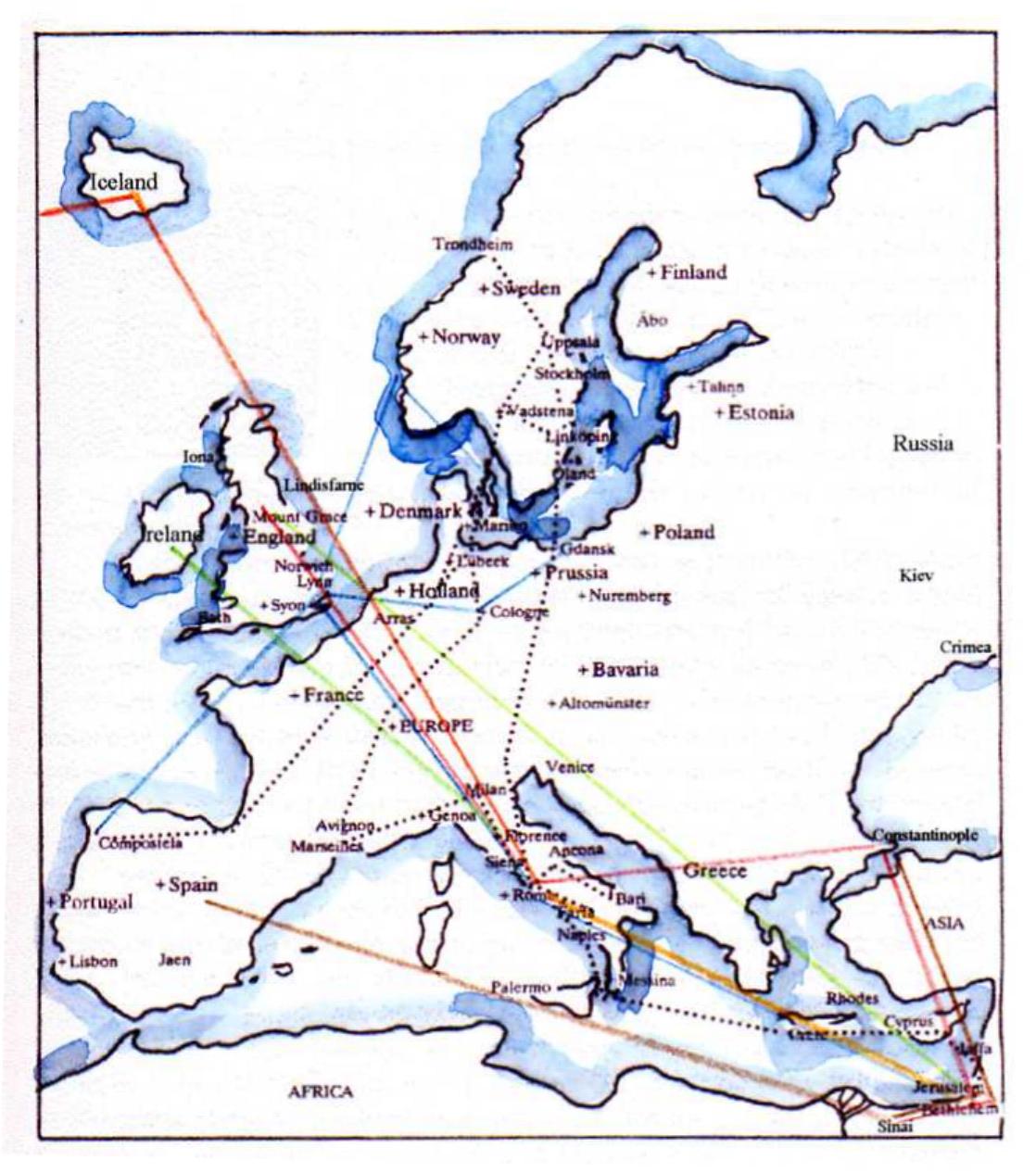
Egeria 381-384 (Spain, by sea, Sinai, by land, Jerusalem, by
sea, Constantinople)
Saints Paula and Eustochium 385, Jerome's colleagues (Rome, by
sea, Egypt, by land, Sinai, Jerusalem, Bethlehem)
Pega + 719, Guthlac's sister (Crowland, nr Cambridge, by land,
Rome)
St Bridget 876, St Andrea's sister (Ireland, by land, Fiesole
in Italy)
Guthrithyr 1000 (Iceland, by sea, Greenland, Vinland, Iceland,
Rome, Iceland)
Margaret of Jerusalem 1155- (Jerusalem, by land, Beverley,
Jerusalem, Turkey, Compostela, Rome, Normandy)
St Birgitta 1303-1373 (Finstad, near Uppsala, by land,
Trondheim, Compostela, Arras, Alvastra, Rome, Naples, by sea,
Jerusalem, Bethlehem, Rome)
Margery Kempe 1373-1430 (Lynn, by land, Bologna, Venice, by
sea, Jerusalem, by land, Bethlehem, by sea, Venice, by land,
Assisi, Rome, Norwich, Bristol, Compostela, Bristol,
Leicester, York, Lambeth, Lynn, Norwich, by sea, Bergen,
Gdansk, by land, Aachen, Syon, Lynn)
Chaucer's fictional Wife of Bath, Canterbury Tales,
General Prologue 565-466 (Bath, Rome, Bologna, Bath,
Compostela, Cologne, Bath, Canterbury)


 et me begin with the
Empress Helena (†330), mother of the Emperor Constantine
(†337). The official account of her life speaks of her as an
Eastern princess, but in Celtic Britain the legends persist
that she was a Christian British slave from York. She became
Constantius' concubine and, A.D. 274, Constantine's mother.
She was repudiated by the Emperor Constantius in 292, next
treated with honour by Constantine when he was proclaimed
Emperor, at York, in 302. Christianity was adopted by the
Empire in 312. It could well be that his mother, like African
Augustine's, had much to do with Constantine's conversion to
Christianity. Helena, now decreed Empress, visited the Holy
Places, such as Bethlehem, Jerusalem and Sinai , in A.D. 327-328, determined
where their churches would be built, and she and her son
officially established for Christendom the cult of the
Cross. However it is likely that the present Mount Sinai is
not the true Sinai of Exodus but a mountain Helena decreed
by fiat as Mount Sinai and that declaration is taken on
faith by pilgrims to this day. Eusebius of Caesaria
(260-339), their contemporary, wrote the account of
Constantine and Helena's pilgrimages and building programmes
in the Holy Places. Eusebius emphasizes Constantine as
undertaking the excavations on Golgotha and building the
Church of the Holy Sepulchre in 335.(1) Later legend will
have this archeology and architecture be Helena's.(2)
Eusebius affirms Helena's actions in this area in connection
with the Bethlehem cave and basilica and with that on the
Mount of Olives.(3) He touchingly describes how she wished,
quoting Psalm 132.7, to 'worship
at the place whereon his feet have stood.' He
also describes how
et me begin with the
Empress Helena (†330), mother of the Emperor Constantine
(†337). The official account of her life speaks of her as an
Eastern princess, but in Celtic Britain the legends persist
that she was a Christian British slave from York. She became
Constantius' concubine and, A.D. 274, Constantine's mother.
She was repudiated by the Emperor Constantius in 292, next
treated with honour by Constantine when he was proclaimed
Emperor, at York, in 302. Christianity was adopted by the
Empire in 312. It could well be that his mother, like African
Augustine's, had much to do with Constantine's conversion to
Christianity. Helena, now decreed Empress, visited the Holy
Places, such as Bethlehem, Jerusalem and Sinai , in A.D. 327-328, determined
where their churches would be built, and she and her son
officially established for Christendom the cult of the
Cross. However it is likely that the present Mount Sinai is
not the true Sinai of Exodus but a mountain Helena decreed
by fiat as Mount Sinai and that declaration is taken on
faith by pilgrims to this day. Eusebius of Caesaria
(260-339), their contemporary, wrote the account of
Constantine and Helena's pilgrimages and building programmes
in the Holy Places. Eusebius emphasizes Constantine as
undertaking the excavations on Golgotha and building the
Church of the Holy Sepulchre in 335.(1) Later legend will
have this archeology and architecture be Helena's.(2)
Eusebius affirms Helena's actions in this area in connection
with the Bethlehem cave and basilica and with that on the
Mount of Olives.(3) He touchingly describes how she wished,
quoting Psalm 132.7, to 'worship
at the place whereon his feet have stood.' He
also describes how
While, however, her character derived luster from such deeds as I have described, she was far from neglecting personal piety toward God. She might be seen continually frequenting his Church, while at the same time she adorned the houses of prayer with splendid offerings, not overlooking the churches of the smallest cities. In short, this admirable woman was to be seen, in simple and modest attire, mingling with the crowd of worshipers, and testifying her devotion to God by a uniform course of pious conduct.
 See also http://www.roman-emperors.org/helena.htm§
Evelyn
Waugh on St Helena http://www.cin.org/saints/helena.html§
 ome sixty
years later, in A.D. 381-384, a Spanish nun, Egeria, is to
be found at Mount Sinai , from there
traveling to Jerusalem and Constantinople, in the footsteps
of the prophets, of Christ, - and of the Empress Helena.
Then, a year after Egeria's departure from the Holy Places,
Jerome, accompanied by Paula and her daughter Eustochium,
took up residence in Bethlehem ,
in A.D. 385.
ome sixty
years later, in A.D. 381-384, a Spanish nun, Egeria, is to
be found at Mount Sinai , from there
traveling to Jerusalem and Constantinople, in the footsteps
of the prophets, of Christ, - and of the Empress Helena.
Then, a year after Egeria's departure from the Holy Places,
Jerome, accompanied by Paula and her daughter Eustochium,
took up residence in Bethlehem ,
in A.D. 385.
Let me begin with Egeria - where her
surviving, mutilated manuscript has us begin - in view of Mount Sinai.(4) Being interested not only in
Egeria and Paula but also in women who came after them and who
imitated them, such as Saint Birgitta of Sweden and Margery
Kempe of Norfolk (and as well, in Dante'
s use of Mount Sinai for Mount Purgatorio), I too took their
pilgrimages to Israel and Sinai and at two o'clock in the
morning with a group of Franciscan-led pilgrims climbed Mount
Sinai. This is what Egeria and I and you would have seen from
the summit at dawn.



Egeria's account of her pilgrimages made Bible in hand throughout the Holy Places comes down to us in several forms. One is in the letters she wrote and sent back to Spain to her fellow nuns. That text survives, in mutilated form, from a manuscript likely copied out in Monte Cassino in the eleventh century. Another version is in a seventh-century letter written in her praise and in which the Galician monk Valerius urges his fellow monks to emulate her. Another is in a compilation made at Monte Cassino by Peter the Deacon in the twelfth century. Because Valerius' seventh-century text clearly had access to the now fragmentary version we possess of the manuscript written by Egeria in the fourth century, let me give an excerpt.
Egeria's own account tells us of the prospect of Sinai and its valley and about the mountain's ascent by stone steps:
The text next has us journey with Egeria from Sinai to other Holy Places.(12)
The manuscript which we have of Egeria's pilgrimage to the Holy Places is incomplete, lacking its beginning, its ending and several pages within its body. It is one copied out likely in Monte Cassino in the eleventh century, later coming to Arezzo.(13) The manuscript, when intact, had been used by other writers, compiling accounts of the Holy Places. One such compiler is Peter the Deacon, a monk of Monte Cassino, who in 1137 dedicated his text to his Abbot Guibald. Peter the Deacon used both Bede's work on the Holy Places and Egeria's.(14) It is possible in Peter the Deacon's text, using Valerius' seventh-century letter concerning Egeria, to identify those sections which once were in Egeria's text.
It is from the text of Peter the Deacon that Egeria's descriptions of the region about Galilee can best be found. She speaks of St. Peter's House being made into a church at Capharnaum and of the adjacent synagogue, both of which pilgrims can see today. She also speaks of nearby Tabgha with its stone steps going down into the lake where Jesus had stood - and where pilgrims step down into the waters to this day - and of the stone on which Christ placed the bread of the miracle of the loaves and fishes, now made, she says, into an altar. Nearby, she notes, is the Mount of the Beatitudes.(15) In the surviving manuscript text she visits such places as Elijah's brook of Cherith and Jacob's Well, while also going farther afield to see the shrines of Holy Thecla(16) and of Holy Euphemia.(17) She next goes on to Constantinople, then gives her 'loving ladies' a full account of the Jerusalem liturgy.(18)
Egeria's account of Mount Sinai is a major focal point in her work. Her other most important section is the discussion of the liturgy carried out in Jerusalem. She particularly praises the Jerusalem liturgy's use of suitably juxtaposed lessons from the Old and New Testaments in tandem with the Gospel readings. With Cyril of Jerusalem' s Catechetical Lectures first delivered in Constantine's basilica for the Holy Sepulchre in A.D. 348 and with Egeria's Pilgrimage of 381-84, we can come to an understanding of the liturgy as carried out by the Primitive Church, in particular that of Jerusalem, founded by Christ and James, versus that by Peter and Paul in Rome.(19) What Egeria has to say about the Jerusalem liturgy lies more in the domain of the East rather than the West, but she is transmitting that valuable information to her fellow nuns on the shores of the Atlantic. The Church is thus indebted to women such as Helena, Egeria, Paula and Eustochium for peacefully forging again the links between Jerusalem and Rome, between the East and the West, despite the tensions underlying them.
Egeria begins her account of the Jerusalem liturgy first by telling of an ordinary week's activities in the Church of the Holy Sepulchre.
Then the manuscript, which has also lost several pages within its text, tantalizingly breaks off. Now we do have an abbreviated version of these lectures, not one for every day in Lent or even in the Easter Octave, but only five, and likely written not by Cyril but by his successor John. These give us a more complete description of the Jerusalem Eucharist.(21)
Egeria accurately observed Christian religious practices on different continents, Africa and Asia, than her own of Europe and left a most important record of them. She was willing to pay heed to the Greek of the liturgy used in Jerusalem, though she was writing her account in Latin. She noted that the great basilicas in Jerusalem and Bethlehem were built by Constantine and adorned by Helena.(22) She portrays to us as well as to her intended audience of fourth-century nuns in distant Spain a figure in a landscape who, Bible in hand, participates fully in that sacred geography, responding to it with knowledge and joy.
See also
http://www.florin.ms/beth.html
http://www.fh-augsburg.de/~harsch/Chronologia/Lspost04/Egeria/ege_f.html§
http://www.gmu.edu/departments/fld/CLASSICS/egeria.html§
http://www.thelatinlibrary.com/egeria1.html§
http://go.owu.edu/~o5medww/egeria/§
 or is Egeria the only European woman to visit
the Holy Places in Africa and Asia during this period and
to write letters describing her experiences. Let us also
look at the Roman matron and widow Paula and her virgin
daughter Eustochium.(23) Paula and Eustochium wrote an
important, joint, and most joy-filled letter to their
friend in Rome, Marcella, published as Jerome's Epistola
XLVI/46, in which they described their pilgrimage in A.D.
385 to the Holy Places, to Africa, to Israel, before
settling down for the rest of their lives with Jerome in
Bethlehem, financially supporting him and assisting his
labours with translating the Bible from Hebrew and Greek into Latin, the
Vulgate text to which Egeria did not have access. We often
see paintings of scarlet-clad
Cardinal Jerome in his study at his labours, but
his womenfolk are forgotten and omitted from those
canvesses, except in three, One in the Santissima
Annunziata in Florence,
or is Egeria the only European woman to visit
the Holy Places in Africa and Asia during this period and
to write letters describing her experiences. Let us also
look at the Roman matron and widow Paula and her virgin
daughter Eustochium.(23) Paula and Eustochium wrote an
important, joint, and most joy-filled letter to their
friend in Rome, Marcella, published as Jerome's Epistola
XLVI/46, in which they described their pilgrimage in A.D.
385 to the Holy Places, to Africa, to Israel, before
settling down for the rest of their lives with Jerome in
Bethlehem, financially supporting him and assisting his
labours with translating the Bible from Hebrew and Greek into Latin, the
Vulgate text to which Egeria did not have access. We often
see paintings of scarlet-clad
Cardinal Jerome in his study at his labours, but
his womenfolk are forgotten and omitted from those
canvesses, except in three, One in the Santissima
Annunziata in Florence,

one now in the National Gallery in London, but which was at San Girolamo in Fiesole, which shows the widowed Paula, at her side her most beautiful virgin daughter, Eustochium, and another by Francisco Zurburan and Workshop now in the National Gallery in Washington , and originally painted for the Hieronymite Order founded by Alfonso of Jaen's brother, and to which belonged the famous Sor Juana de la Cruz in Mexico City.
Paula movingly contrasts the wealth of Rome and the poverty of Bethlehem:(24)
Paula's pilgrimage, like Egeria's, is a mapping out in time and space, using the Bible to understand the lands of the Bible. But Paula adds to Egeria's knowledge of the Bible in its Old Latin translation and her curiosity about Greek and comparative liturgy, her own knowledge not only of classical Latin but also of Greek and the Hebrew she is avidly studying. Helena, Egeria and Paula all use time and space, the book of the Bible and geography of the Holy Land as their Internet upon which to weave a web of links to sanctity, retrieving what is hallowed and hallowing.
Twenty years later, Jerome was to write another letter, his Epistola CVIII/108, praising Paula, and in it recapitulating the description of the pilgrimage that she had made. We learn much about Paula in Jerome's voluminous writings. He tells of her luxurious Roman life, her wealth, and her very great status. She, who had once always dressed in silks, and who had been used to being carried about Rome by her eunuch slaves so that her feet might never touch the ground, who was descended from Agamemnon, and whose husband was descended from Aeneas, had joined Marcella's group of high-born, wealthy Roman ladies, who together attempted to follow a life of monastic severity. Jerome became their teacher, expounding the Scriptures to them. But he quarrelled with Church officials in Rome most bitterly and found it expedient to return to Bethlehem. Paula and her daughter, Eustochium, joined him there, Paula leaving behind the rest of her children weeping on the quay. In the Holy Land Paula studied Hebrew so that she might sing the psalms, the chief early Christian devotional practice, in their original language and assist him in his translation work. She lived for twenty years in Bethlehem, dying there in A.D. 404.(25) Paula and Eustochium's letter to Marcella pleads with their old friend that she leave Rome, called in the letter a 'Babylon,' and come to Jerusalem and its Holy Places. Kelly, p. 141, remarks that this letter is 'written in the name of Paula and her daughter but manifestly by Jerome himself, to Marcella,' then goes on to say, 'It is an idyllic piece, relating spiritual serenity and contentment . . . and stands in striking contrast to the querulous, vituperative note' of Jerome's typical writings. We find other male scholars making the same statements of Heloise's letters, that they are Abelard's, yet that they are in a totally different style than his.
The letter in question is Epistola XLVI.(26) It describes Paula's pilgrimages to all these Holy Places in such a way as to have Marcella participate in their sacred journeying, mentally, and vicariously, in her imagination. Paula and Eustochium begin their letter by stating that, although the Crucifixion may have made Jerusalem an accursed place, there is ample scriptural justification for Christians to return to that holy city. Paula relies not only on the Scriptures and upon her growing knowledge of Hebrew but also upon Cicero for her arguments, describing both St. Paul speaking of his need to return to Jerusalem and Cicero speaking of his need to learn one's Greek not only in Sicily but in Athens, one's Latin not in Lilybaeum but in Rome. She adds, in a capstone to her argument, that Jerusalem is 'our Athens.' She then quotes Virgil's First Eclogue on the great distance of the British Isles from Rome in noting that Christian Gauls and Britons all make haste to come, not to Rome, but to far Jerusalem. Jerome is also fond of this phrase, but states it the opposite way: ' Et de Hierosolymis et de Britannia aequaliter patet aula coelestis: regnum enim dei intra nos est,' Epistola LVIII. Chaucer may have had it in mind with his Wife of Bath, who so often speaks of Jerome. Jerome writes the letter after Paula's death in 404, giving Paula's vita to her virgin daughter, Eustochium.(27) In contrast to Paula's letter to Marcella, Jerome's account of the pilgrimage Paula made is almost barren of references to classical authors. He does, however, mention the ' fables of the poets', de fabulis Poetarum , in giving the tale of Andromeda chained to a rock, as happening at Joppa, which he notes was also the harbor of the fugitive Jonah. He had earlier cited some lines of the Aeneid concerning the Greek Isles. But, unlike Paula, he does not show off his classical learning. He is here being more Christian than Ciceronian. (We recall his dream in which he is chided, or chides himself, by being told, 'Thou art not a Christian. Thou art a Ciceronian.' (28) But it is full of descriptions of her great piety and of her deep emotional participation in the past drama of the present places which she visits. He feminizes her. He is writing in her praise as had Valerius in that of Egeria. The letter waxes most sentimental about her parting from her family members, describing her as torn between the love of her children and her love for God.
Jerome in
Epistola CVIII/108 notes Paula's deep, affective piety at
the Cross and the Sepulchre in Jerusalem, and at the cave
and church in Bethlehem, which she had not particularly
stressed herself.(29) He amplifies her previous words to
Marcella and speaks of her as prostrating herself before the
Cross, almost seeing upon it the hanging body of the Lord,
as she prays, and as kissing the stones, the one which the
angel had rolled away and the one in the Holy Sepulchre on
which the Lord had lain. Then he describes her entering into
the cave of the Nativity , weeping and as if seeing
the Virgin wrapping the Child in swaddling clothes and
placing him in the manger between the ox and the ass written
of in the Prophets, the Magi adoring him, the star shining
above, the Mother nursing the Child, the shepherds coming by
night and seeing the Word which was made flesh as John wrote
in the beginning of his Gospel:
 n principio erat verbum et verbum caro
factum est.'
n principio erat verbum et verbum caro
factum est.'
One should note that Jerome, Paula and Eustochium lived in the adjacent cave, which one can still see today, reached by a passage from that of the Nativity, beneath the sanctuary in the Empress Helena's Bethlehem basilica.
Jerome's account in Epistola CVIII/108 ends by saying, and unconsciously echoing Valerius concerning Egeria:
Letters of Jerome and Paula in English http://www.ccel.org/fathers/NPNF2-06/index.html§
Jo Ann
McNamara, 'Cornelia's Daughters http://www.umilta.net/cornelia.html
Prof.
Claudio Moreschini, 'Jerome's Circle http://www.florin.ms/aleph2.html§
Bridget and Margaret, Birgitta and Margery
IV. Guthlac and Pega, from the Fens to Rome
 ccording to the Historia Croylandensis (of
which the Historia Ingulfi is the first section), St
Pega, sister to St Guthlac willed
Guthlac's Psalter and a scourge given to the saint by Saint
Bartholomew to Abbot Kenulph of Crowland. Finding her
brother's body incorrupt, she placed it in a monument which
King Æthelbald had decorated. According to Ordericus, she
then went on a pilgrimage to Rome and died there in 719.
According to the fourteenth-century Historia Ingulfi
, on her arrival in Rome, all the church bells rang to
signify her sanctity. Felix said that Guthlac's relics were
associated with miracles, and Ordericus recounts the same
thing about Pega's relics. He also says that at his time
they were kept in a church in Rome that bore her name.
ccording to the Historia Croylandensis (of
which the Historia Ingulfi is the first section), St
Pega, sister to St Guthlac willed
Guthlac's Psalter and a scourge given to the saint by Saint
Bartholomew to Abbot Kenulph of Crowland. Finding her
brother's body incorrupt, she placed it in a monument which
King Æthelbald had decorated. According to Ordericus, she
then went on a pilgrimage to Rome and died there in 719.
According to the fourteenth-century Historia Ingulfi
, on her arrival in Rome, all the church bells rang to
signify her sanctity. Felix said that Guthlac's relics were
associated with miracles, and Ordericus recounts the same
thing about Pega's relics. He also says that at his time
they were kept in a church in Rome that bore her name.
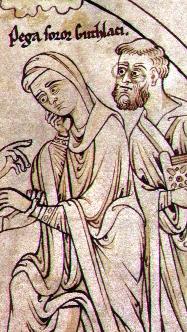
Guthlac's Sister, Pega, and Guthlac. Detail of
Harleian Guthlac Roll Y.6 Image. By Permission of the British
Library. Reproduction Prohibited.
V. Bridget, Andrew and Donatus from Ireland in Tuscany
 hy
would a town in Tuscany, near Fiesole, be called 'Santa
Brigida'? A brother and sister from Ireland, named Andrew
and Bridget journeyed there together in the ninth century.
St Bridget, named after the great St Bridget of Ireland,
lived in a cave in the valley around which is now built the
church and town with her name. Her brother lived in another
cave on the mountainside. Another Irish pilgrim arrived in
Fiesole, and on his arrival in its town square was promptly
elected its bishop. He is St Donatus. In 829, he called St
Andrew to be his diocesan Archdeacon. St Andrew finally died
at great old age in 876 at the church of San Martino a
Mensola, near Bertrand Berenson's Villa I Tatti, just after
founding the little church of St Martin in Florence by the
house where Dante would be born. Hermits continued to
inhabit that cave in Sasso, on the mountainside beyond
Fiesole.
hy
would a town in Tuscany, near Fiesole, be called 'Santa
Brigida'? A brother and sister from Ireland, named Andrew
and Bridget journeyed there together in the ninth century.
St Bridget, named after the great St Bridget of Ireland,
lived in a cave in the valley around which is now built the
church and town with her name. Her brother lived in another
cave on the mountainside. Another Irish pilgrim arrived in
Fiesole, and on his arrival in its town square was promptly
elected its bishop. He is St Donatus. In 829, he called St
Andrew to be his diocesan Archdeacon. St Andrew finally died
at great old age in 876 at the church of San Martino a
Mensola, near Bertrand Berenson's Villa I Tatti, just after
founding the little church of St Martin in Florence by the
house where Dante would be born. Hermits continued to
inhabit that cave in Sasso, on the mountainside beyond
Fiesole.
On 2 July 1484, on the rock of the Irish hermitage, the Virgin Mary appeared to two young shepherdesses of the Ricoveri family, telling them to tell the Florentines to study the Gospel, the Word of her Son. When the children were not believed she cured their dying father, appearing also to the grown-ups, repeating the previous message and ordering that a church be built there in her honour. And this was done, pilgrims to this day journeying there. In this later apparition of the Madonna, Gospel in hand, there is a vestige, a memory, of men and women pilgrims from Ireland, journeying, Gospel in hand, living in caves amongst the mountains. When Vikings came to Iceland they found Irish pilgrims had preceded them from the evidence of Gospel books, bells and croziers left there by them.
See also
Màire Herbert http://www.florin.ms/aleph3.html#cork§
VI. Guthrithyr of Iceland, Greenland, and Wineland
Fourteenth-Century Icelandic Manuscript, Jonsbok, Arni Magnusson Institute, Reykjavik, Iceland
Ari the Learned's Book of the Icelanders, the Book of Settlements, the Saga of Erik the Red and the Saga of the Greenlanders tell us of Eric the Red discovering Greenland, 985-986, before Christianity came to Iceland's Vikings; the Sagas then tell of his son, Leifur Eirísson, journeying first to the Hebrides, then Norway, where he became Christian through King Olafur Tryggvason, St Olav, who ruled Norway 995-1000. King Olav next sent him to Greenland to convert that land to Christianity, sending two others to Iceland for the same purpose and who succeeded in persuading the Althing to that conversion, A.D. 1000.
Leifur was driven off course and came to a country he called Wineland, Newfoundland, on the American Continent. He had brought a priest with him from Norway and, finally returning to Greenland, succeeded in converting Erik the Red's wife, Thjodhildur, who immediately built a church there.
Next, attempts were made to settle Wineland. Thorfinnur Karlsefni led a large expedition from Iceland in the early eleventh century and, during their first autumn there, his wife Guthrithyr gave birth to their son, Snorri, the first European born in America. They stayed in Wineland for three years but met resistance from the native peoples, called by them 'Skraelingjar', and so returned to Greenland, then Iceland.
The Saga of Erik
the Red says 'Guthrithyr was a very exceptional woman', and
the Saga of the Greenlanders says that after Thorfinnur's
death, Guthrithyr next pilgrimaged to Rome, then returned to
live with her son on Iceland, becoming a nun and a recluse.
Several bishops are numbered amongst her descendants. (32)
VII. Margaret of Jerusalem, Thomas of Froidmont
 he
monk Thomas was born in Beverley, England. His parents both
dying in his childhood, he was raised and educated by his
sister Margaret, who was eleven years his senior. When he
was adolescent he entered the service of Thomas Becket of
Canterbury, going with him also to France, in their flight
from persecution in England. At this time, towards
1165-1166, Thomas entered the Abbey of Froidmont in the
Diocese of Beauvais, probably after the example of his
patron, who took the Cistercian habit at Pontigny. Thomas
gave himself ably, in the solitude of the cloister, to the
cultivation of poetry. Likewise other members of Thomas of
Canterbury's circle were writers, among them Nigil Wireker
and John of Salisbury.
he
monk Thomas was born in Beverley, England. His parents both
dying in his childhood, he was raised and educated by his
sister Margaret, who was eleven years his senior. When he
was adolescent he entered the service of Thomas Becket of
Canterbury, going with him also to France, in their flight
from persecution in England. At this time, towards
1165-1166, Thomas entered the Abbey of Froidmont in the
Diocese of Beauvais, probably after the example of his
patron, who took the Cistercian habit at Pontigny. Thomas
gave himself ably, in the solitude of the cloister, to the
cultivation of poetry. Likewise other members of Thomas of
Canterbury's circle were writers, among them Nigil Wireker
and John of Salisbury.
Thomas of Froidmont's sister, Margaret, after extraordinary adventures, came to find him in his monastery. Thomas, as is monastic practice, reserved publication until Margaret's death, giving the work as her Elegy. Manrique said he saw this poem in an old manuscript kept at Cîteux. He copied out interesting passages from it, letting us know of the astonishing life of Thomas' sister. In the Elegy, Margaret herself speaks in the first person narrating to us her adventures. One wonders who is the poet, the brother or the sister? She had early been involved in educating her orphan brother and is clearly literate in Latin, possessing and using a Psalter.
'When I was conceived', she says, 'my pious parents left England on pilgrimage to Jerusalem. I was carried there in my mother's womb. After several months of pilgrimage we arrived in Palestine, and I was born there, while my parents were in the process of fulfilling their vow'. (33) That was in 1155.
'One day when we were crossing fertile land, a wolf left his carnage and came at us. My father, seeing him advance on, full of concern for his child, took to using force and guile. We were all three feeble, myself being small, my mother and the ass carrying me; fear hastened our steps, my father was intrepid; he tore off a tree branch which he dragged behind him, as if playing. Whenever the wolf would come near, my father would shake his thyrsis and the animal slunk away without harming any of us.
'We walked', she continued, 'towards Lachis, believing we were safe. But we found ourselves amidst the enemy. I was subjected to a difficult sentence for the love of Christ, who wished me also reduced to pious servitude. But I did not give in to the torment. My inviolate faith always won the victory. I was forced to carry out humiliating tasks; I gathered stones, I chopped wood. If I refused to obey, I was beaten with rods. I endured the blows, the threats, the heat, the cold, in silence. My chains rusted from my tears. The work and the slender diet tired my limbs. The long days were boiling hot and rest was rare and brief. The day of the Virgin's Purification, which ended the term of my sorrows, was a day I'll not forget. Do you know who bought our freedom? A Tyrian, a pious, benevolent man, redeemed us. A son had just been born to him whom he had desired. His joy caused our liberty. The happy day of the Feast of the Virgin ended for me fifteen months of slavery'.
'I drew apart', she said, 'avoiding the towns and public places. In the fear of being captured, I walked always in hiding. I was garbed only in a sack that I had worn when captive: it was short and light, without colour or warmth; it scarcely covered my nudity; it was a burden at that time not having other clothing. All I had left was a Psalter; it was my one companion in the midst of this wilderness; it was all that I possessed. A loaf of bread sustained me for five days. Hunger then forced me to have recourse to roots of plants. For five days I ate nothing that humans would use to satisfy their hunger; I lived however I could. Alone, troubled, lost, I saw nothing except solitude. I had twelve streams to cross. What to do? Would the fear of dying make me risk the danger of dying? I saw no bridge anywhere. The fords that I tried filled me with terror. I could not turn back. I feared staying there and becoming a meal to the wild beasts. Fear eventually made me bold. I crossed the first river, then I crossed them all'.
'What shall I do?' said Margaret. 'I want to escape but cannot on either side; around me are sentinels, no door is open. I'm afraid of everything, the looks, the words, of those surrounding me. I don't understand any Turkish words. Not knowing what to do, seized with the greatest sorrow, I pronounce the name of St Mary. At this name the chief of the Infidels is amazed, this faithless man become benevolent and pious, and turns towards the others. "See", he says, "She invokes Mary". He orders me to return. This order displeases the others, but I am only a little scared. I leave and give you thanks, O Virgin Mary. It is through you I was delivered at Lachis, it is through you I am again freed here. Honour and glory be to Mary!'
This Elegy, in which one finds many leonine verses, a type of poetry much in vogue in the twelfth and thirteenth centuries, does not seem without merit, and its versification is often elegant.
The monk Thomas of Froidmont also composed a Life of St Thomas of Canterbury and another prose work, a Liber de modo bene vivendi ad sororem which he wrote for his sister Margaret, but which was thought to be by St Bernard of Clairvaux for his sister, or his cousin, and as such was much beloved by St Birgitta of Sweden, who carried out the same pilgrimages as had Margaret of Jerusalem, to Compostela, Rome, Jerusalem, and who owned a copy of it from Spain: now Uppsala University Library, C240,

Uppsala C240, open to ' {S oror mea'
and which is also in the Amherst Manuscript immediately preceding Julian of Norwich's Showing of Love , and there called the Golden Epistle. Thomas of Beverley died at Froidmont, at the beginning of the thirteenth century.
For further accounts of brothers and sisters see: Sister Jane Morrissey, Saint Scholastica, Saint Benedict, A Paradigm, A Paradox ; Alexandra Olsen, Saint Pega, Saint Guthlac, Hermits ; Rose Lloyds and George Harris, An English Rose .
Guthlac's Sister, Pega, and Guthlac. Detail of Harleian Guthlac Roll Y.6 Image. By Permission of the British Library. Reproduction Prohibited.

For the text,
translated from Latin into Middle English into Modern
English, of Thomas of Froidmont's advice on how to quest
perfection in a monastery given to his sister, Margaret of
Jerusalem, see the The
Amherst Manuscript Golden Epistle http://www.umilta.net/epistle.html
 n two books I have discussed how fictional
pilgrims like Tristan's Isolda and Chaucer's Wife of Bath,
inscribed by men, jokingly turn pilgrimage's solemn sanctity
inside out.(34) They present not the 'Dearly beloved as
strangers and pilgrims I beseech you, abstain from fleshly
lusts which war against the soul' of sacred scripture, but
the opposite, the embracing of lust.
n two books I have discussed how fictional
pilgrims like Tristan's Isolda and Chaucer's Wife of Bath,
inscribed by men, jokingly turn pilgrimage's solemn sanctity
inside out.(34) They present not the 'Dearly beloved as
strangers and pilgrims I beseech you, abstain from fleshly
lusts which war against the soul' of sacred scripture, but
the opposite, the embracing of lust.
But I find that in reality pilgrims, especially women pilgrims, were willing like Margaret of Jerusalem, to endure great hardships and to preserve their chastity. Anthony Luttrell has discussed the historical documentation concerning Isolda Parewastell from Bridgwater, Somerset, who went on pilgrimage to Jerusalem in 1365. (35)
When I was in
Jerusalem I was moved by ancient Russian ladies, garbed as
nuns, toiling up her streets, living in sacred space in
prayer. Isolda Parewastell, like them, spent not just days,
but several years, in Jerusalem. Then disaster struck. In
reprisal for the Christian Crusaders' most un-Christian Sack
of Alexandria Muslims were harsh to Christian pilgrims, among
them Isolda Parewastell. She returned home by way of Avignon
where on 15 January 1366 she presented a petition to Pope
Urban V claiming she had lived in the Holy Land for three
years, visiting the sacred places daily, had then been hung
upside down on a rack and beaten half-dead, escaping
miraculously, - likely in October 1355. In compensation for
her pains she asks in her papal petition for the right to
construct a chantry shrine to the Virgin in Bridgwater in the
Diocese of Wells and to endow it with a living for a priest to
pray for her soul and those of her ancestors. The Pope amended
her petition to allow her only to have a chantry altar in her
parish church, rather than to build a new structure, but he
did grant those who visited this altar the typical indulgence
of one year and forty days' cessation from punishment in
Purgatory, provided they had first penitently confessed their
sins and had been absolved of them.
IX. Birgitta and Catherine of Sweden
 geria's
and
Paula's
journeys
are
replicated
a thousand years later, in the fourteenth and fifteenth
centuries, in fiction by the Wife of Bath, in fact by Saint
Birgitta of Sweden (36) and Margery Kempe of England (37). In
their writings we can see some of the reverberations of that
relationship between Paula and Jerome, and we can also see
how Paula as a pilgrim became a model of other Christian
women, one of power and financial independence, in so doing
achieving much admiration, even from such a misogynist as
St. Jerome. Egeria's text, however, at this period was
forgotten.
geria's
and
Paula's
journeys
are
replicated
a thousand years later, in the fourteenth and fifteenth
centuries, in fiction by the Wife of Bath, in fact by Saint
Birgitta of Sweden (36) and Margery Kempe of England (37). In
their writings we can see some of the reverberations of that
relationship between Paula and Jerome, and we can also see
how Paula as a pilgrim became a model of other Christian
women, one of power and financial independence, in so doing
achieving much admiration, even from such a misogynist as
St. Jerome. Egeria's text, however, at this period was
forgotten.
Birgitta when she had been a young wife in Sweden had studied Latin with her sons under Nicholas of Linköping and as a widow theology under Magister Mathias, who in turn had studied under the great Jewish convert and scholar Nicholas of Lyra in Paris and who knew Hebrew. Much later, in Rome, the hermit Bishop Alfonso of Jaèn, whose brother had founded the Hieronymite Order - after the manner of Jerome's eremiticism - and which he had joined, assisted Birgitta with her continuing work on her massive Revelations , a visionary work modeled on the Apocalypse in which Birgitta recounted her visions and prophecies given her by Christ and the Virgin Mary.(38) Alfonso, as a Hieronymite, was familiar with the letters written by Saints Jerome and Paula from Bethlehem and knew that Paula had studied Hebrew in order to assist Jerome in his translation of the Bible and had written ecstatically of her pilgrimage made with her daughter Eustochium to the Holy Places. Even the painting of Saint Jerome, now in London's National Gallery, but from this Order's monastery of San Girolamo in Fiesole, is a double portrayal, representing as well the widowed Birgitta and her beautiful virgin daughter Catherine of Sweden in its depictions of Saints Paula and Eustochium.
Eventually Birgitta under the guidance of Bishop Alfonso and her household (with the exception of her favorite son Charles who had died in Naples, after being the lover of Queen Johanna of that kingdom), went to Bethlehem and Jerusalem in the last and seventieth year of her life, fulfilling her youthful wish and vow made to the Virgin years ago in Sweden. For Alfonso as Hieronomyte this pilgrimage certainly resonated with that made by Jerome's companions, the noble Roman lady Paula and her daughter Eustochium, since Catherine accompanied her mother Birgitta as had Eustochium accompanied her mother Paula.(39) Birgitta's visions at Bethelehem in the cave of the Nativity and at Jerusalem's Calvary are clearly modeled on the affective piety of those Jerome recounted that Paula had had a thousand years earlier in those sacred places.(40) Birgitta's account of this pilgrimage, edited by Alfonso, is given in Revelationes VII . And even her pilgrim relics can be held by us in our hands on pilgrimage.
See also http://www.umilta.net/birgitta.html
X. Margery Kempe of Lynn
 argery Kempe was actually preceded by
other women pilgrims from the British Isles, one of them
the Empress Helena, the slave concubine of the Emperor
Constantine's father and who gave birth to her imperial
son in York, the other, Margaret of Jerusalem, who was born there to
her parents when they were on pilgrimage, who brought her
home to Beverley, from where she returned to Jerusalem,
was captured during the Seige of Jerusalem, then released,
finding her way to her brother's monastery, he writing the
account of her perilous adventures. Margery Kempe, on her
pilgrimage to the Holy Places, copied those visions of
Paula and Birgitta, their affective piety, their 'theatre
of devotion,' their quasi-visions, their pilgrimages,
journeying to Compostela, Rome, and Jerusalem, and she was
to have them, too, be written down in her Book, the Book of Margery Kempe .(41) In that book she
also wrote of her discussion of her hysteria and of her
visions with Dame Julian of Norwich .(42) Interestingly, too,
the anchorite Julian of Norwich, through the great Hebrew
scholar, Cardinal Adam Easton from Norwich Priory, may
have had access to Hebrew as had St Birgitta of Sweden
through her initial amanuensis, Magister Mathias.
argery Kempe was actually preceded by
other women pilgrims from the British Isles, one of them
the Empress Helena, the slave concubine of the Emperor
Constantine's father and who gave birth to her imperial
son in York, the other, Margaret of Jerusalem, who was born there to
her parents when they were on pilgrimage, who brought her
home to Beverley, from where she returned to Jerusalem,
was captured during the Seige of Jerusalem, then released,
finding her way to her brother's monastery, he writing the
account of her perilous adventures. Margery Kempe, on her
pilgrimage to the Holy Places, copied those visions of
Paula and Birgitta, their affective piety, their 'theatre
of devotion,' their quasi-visions, their pilgrimages,
journeying to Compostela, Rome, and Jerusalem, and she was
to have them, too, be written down in her Book, the Book of Margery Kempe .(41) In that book she
also wrote of her discussion of her hysteria and of her
visions with Dame Julian of Norwich .(42) Interestingly, too,
the anchorite Julian of Norwich, through the great Hebrew
scholar, Cardinal Adam Easton from Norwich Priory, may
have had access to Hebrew as had St Birgitta of Sweden
through her initial amanuensis, Magister Mathias.
For the
conversation between the Anchoress Julian and the
Pilgrim Margery hear http://www.umilta.net/soulcity.mp3
XI. Rose Lloyds and Julia Holloway
 n this
Umilta Website I also give the pilgrim narrations of two
modern women, one by Rose Lloyds in An English
Rose, the other by
myself, being the last chapter of the book, Jerusalem:
Essays on Pilgrimage and Literature and being the pilgrimage I
took before entering my convent at Holmhurst St Mary. Thus for two thousand
years women have been following Christ.
n this
Umilta Website I also give the pilgrim narrations of two
modern women, one by Rose Lloyds in An English
Rose, the other by
myself, being the last chapter of the book, Jerusalem:
Essays on Pilgrimage and Literature and being the pilgrimage I
took before entering my convent at Holmhurst St Mary. Thus for two thousand
years women have been following Christ.
XII. Conclusion
Finally, in 2000, I went to Iceland, at the invitation of my graduate student, Philip Roughton, and gave four lectures, one on Florence's SISMEL, one on Julian of Norwich, one on Dante's Commedia Jubilee, and one on women pilgrims, in which I said. 'And now I tell you here in Iceland of our pilgrims. But you have one who excells over ours. Can you please give me information about Guthrithyr that I may include her in this gallery of women pilgrims, to share her fame with the world on the world wide web?' [And my Icelandic hosts did so, Dr. Jonas Kristjansson, formerly Director of the Arni Magnusson Institute in Reykjavik, and his son and many others telling me her story.] 'Once, before Orthodox clergy whitewashed them over, your great Viking kings as pilgrims had their portraits painted on the pillars of the Bethlehem Basilica that was built by the Empress Helena. These women are equally worthy of such portraits, though in their humility they would be more retiring about this, allowing their portraits to blend into those of others, like Helena's and Constantine's into those of the Madonna and her Child, clad in imperial garb, and those of Birgitta and Catherine of Sweden into those of Paula and Eustochium humbly beside Jerome's. Yet all of these women and men meet together in Jerusalem and in Bethlehem, coming there from the ends of the known world.'
Thus we can hear women's voices dialoguing across the vastness of space and time in their books: Egeria writing from Israel and Constantinople to her nuns in Spain; Paula and her daughter Eustochium writing from Bethlehem to Marcella in Rome; Birgitta writing and Catherine in Jerusalem telling their account to Bishop Alfonso for all of Europe; Margaret of Jerusalem narrating her pilgrimages to her brother Thomas de Froidmont to write out in her person in Latin verse, Isolda pleading with the Pope in Avignon for a chantry in Bridgwater, Margery in England remembering her pilgrimage to the Holy Places to her scribes and to Julian. What has granted these women access to the sacred written word - which transcends time and death - has been their amalgamation of sacred history and sacred geography by means of their pilgrimages with their physical bodies with that Bible in their hands. Egeria, Paula and Eustochium were to write of their pilgrimages in epistles, in letters. Birgitta and Margery were to write of their pilgrimages in whole books, as though Bibles brought up to their date and rewritten for their gender. A Roman Empress, Helena , assisting Christianity, the religion of slaves and women, gave to the West, and especially to its pilgrimaging women, even to Iceland, even to Greenland, this matrix and translatio studii of Hebraism and its Book, shifting the center of culture from Athens, Alexandria, Rome, York, Constantinople, to Jerusalem. In this year of the Jubilee within the Jubilee here in Iceland we celebrate Christ's words to the woman washing his feet with her tears, drying them with her hair, that is shown on the Ruthwell Cross beyond Hadrian's Wall, with its poem on the 'Dream of the Rood' sculpted there in runes, an act Christ then copied when washing his disciples' feet, where he said that what she did will be remembered to the ends of the earth. This is the Good News for both men and women for ever and everywhere. That the best conquest is through courtesy, that Christ stooped, in imitation of a woman's act, and thereby won women's souls as well as men's, even those of an Empress and her son, an Emperor's. It is from this humbling that comes this tremendous love, this energy to journey from the ends of the world, to walk in those footsteps, to hold him by the feet.
See also
http://www.umilta.net/soulcity.html
http://www.umilta.net/mystics.html
http://www.umilta.net/rose2.html
http://www.umilta.net/sinaijerus.html
Notes
This paper was
originally given with my slides of the Holy Land pilgrimage,
including dawn from Mount Sinai, at 'The Woman and the Book'
Conference, St Hilda's College, Oxford.
See also Jerusalem: Essays on Pilgrimage
and Literature (ISBN 0-404-64164-4), AMS Press§, Brooklyn Navy Yard, Bdg.
292, Suite 417, 63 Flushing Avenue, Brooklyn NY 11205 USA.

1.The Life of
Constantine, chapters XXV-XL, in Eusebius, Church
History, Life of Constantine the Great and Oration in Praise
of Constantine, ed. Henry Wace and Philip Schaff
(Oxford: Parker, 1890), Select Library of Nicene and
Post-Nicene Fathers of the Christian Church, I: 526-530.
2. John
Wilkinson, Egeria's Travels (London: S.P.C.K., 1973);
CETEDOC Library of Christian Latin Texts (Turnholt:
Brepols, 1991), compact disk, from Thesaurus Patrum
Latinorum/CLCLT.CD; The Pilgrimage of St. Sylvia of
Aquitania to the Holy Places (London: Palestine
Pilgrims' Text Society, 1896), I; also `Peregrinatio
Aetheriae,' Egeria: Diary of a Pilgrimage, trans.
George E. Gringras (New York: Newman Press, 1970). Wilkinson,
pp. 240-241, notes that St. Ambrose in 395 is the first to
speak of Helena as finding the True Cross, Eusebius, Egeria
and Chrysostom not doing so.
3.Eusebius,
chapters XLII-XLVII, pp. 530-532.
4. Wilkinson, pp.
91-98; CETEDOC CLCLT.CD.
5. The text goes
on to add: ' The children of
Israel marched for three days, thirsty and without water; and
when they murmured, and the Lord made Moses bring abundance of
water out of the hard rock, the hearts of those men remained
ungrateful. She at that place thirsted for the Lord, and in
her heart a fount of living water sprang up into life eternal.
That multitude hungered, and by God's dispensation received
the holy manna coming down from heaven. But even then they
despised it, and longed for the accursed food of Egypt. She at
that very place was refreshed by the Word of God, and, giving
him unwearying thanks, went on her way without fear. They,
many times hearing God's voice, could see his grace going
before them by day and night in the pillar of cloud and fire;
yet still they doubted, and thought to retrace their steps. ' The text resonates with the monastic
morning psalm, 95, and with the Exultet of the Pascal
Candle.
6. Wilkinson, pp.
175-6. The letter goes on to say, pp. 177-178: 'We cannot but blush at this woman, dearest
brothers - we in the full enjoyment of our bodily health and
strength. Embracing the example of the holy Patriarch Abraham,
she transformed the weakness of her sex into an iron strength,
that she might win the reward of eternal life; and while,
compassed about with her weakness, she trod this earth, she
was obtaining paradise in calm and exultant glory. Though a
native of Ocean's western shore, she became familiar with the
East. While she sought healing for her own soul, she gave us
an example of following God which is marvelously profitable
for many. Here she refused rest, that she might with constancy
attain to eternal glory and bear the palm of victory. Here she
inflicted material burdens on her earthly body, that she might
present herself irreproachable, a lover of heaven to heaven's
Lord. Here, by her own will and choice she accepted the
labours of pilgrimage, that she might, in the choir of holy
virgins with the glorious queen of heaven, Mary the Lord's
mother, inherit a heavenly kingdom
.'
7. Wilkinson, p.
94. Egeria typically speaks of receiving communion after
making her offering, and she also speaks of being given 'blessings ' by
the monks. Early Christians brought with them offerings of
bread and wine, in so doing symbolizing themselves as the Body
of the Church, of Christ, the early Eucharist being solemnized
by the Bishop and served by the Deacons back to the
Congregation, all functioning as the Royal Priesthood to
Christ as the High Priest, represented by the Bishop.
Christians also took the blessed bread into their homes to use
as the reserved sacrament during the week: Gregory Dix, The
Shape of the Liturgy (Westminster: Dacre Press, 1945), passim.
In the Coptic church in Africa, the Korban or Mass is deeply
centered upon the bread, again called the Korban, which is
baked in an oven by the church the day of the Mass as small
round loaves marked with crosses, one loaf being chosen out of
several for the Korban itself, the remainder, called in
Primitive Christianity and so called by Egeria, 'blessings ,'
being given to the congregation at the conclusion for them to
take home: H.V. Morton, Through the Lands of the Bible (London:
Methuen, 1938), pp. 168-77 and plate between pp. 344-345.
Sometimes, however, the '
blessings' given to Egeria can be
fruit grown by the monks in their gardens. I should like to
add that at Sinai our priest guide had no wafers and I
suggested he use the round leavened Egyptian brown loaves we
had for supper - and he did and preached a sermon on them.
8. She also
visited the next mountain which the monks said was Horeb and
tells the 'reverend ladies my sisters,' her fellow nuns back
on the Atlantic coast in Spain: '
This is the Horeb to which the holy Prophet Elijah fled from
the presence of King Ahab, and it was there that God spoke to
him with the words, 'What doest thou here, Elijah?', as is
written in the Books of the Kingdoms. Indeed, whenever we
arrived, I always wanted the Bible passage read to us .' Wilkinson, p. 95.
9. Wilkinson, p.
106.
10. Wilkinson, p.
96.
11. That pilgrim
knowledge of African topography was to deeply influence
European culture. Dante's Mount Purgatorio even is modeled on
the Mount Sinai of the medieval pilgrims.
12. Let me give
an example of her style: 'This
holy presbyter said to us, 'You see these foundations. . . .
they were part of Melchizadek's palace. . . . That is the road
by which holy Abraham returned . . . from Sodom, and it was on
that road that he was met by holy Melchizadek, king of Salem.'
Then I remembered that according to the Bible it was near
Salem that holy John baptized at Aenon. So I asked [about it]
. . . . 'There it is', said the holy presbyter. . . . 'If you
like we can walk over there. It is from that spring that the
village has this excellent supply of clean water you see'. . .
. We set off. He led us along a well-kept valley to a very
neat apple-orchard, and there in the middle of it he showed us
a good clean spring of water which flowed in a single stream.
'This garden', said the holy presbyter, 'is still known in
Greek as Cepos tu agiu Iohanni, or in your language,
Latin, 'St John's Garden'.' The
priest went on to speak of Easter baptisms there as still
performed in that garden spring, the candidates then
proceeding to the church called Opu Melchisadech in a
procession by torchlight, singing psalms and antiphons, and
accompanied by the clergy and the monks. Wilkinson, pp.
110-111.
13. It was
discovered there in 1884 by J.F. Gamurrini and published by
him in 1887. It was translated the following year into Russian
and in 1891 into English: Wilkinson, p. 7. It is not without
interest that Arezzo has the Piero della Francesca cycle of
frescoes concerning St. Helena's Discovery of the True Cross.
14. Wilkinson, p.
179.
15. Wilkinson,
pp. 194-200.
16. Wilkinson,
pp. 112, 119-120, 121-123, at which she meets again her friend
and acquaintance the deaconess Marthana to her great surprise
and joy.
17. Wilkinson,
pp. 112, 119-120, 121-123, 123.
18. Wilkinson, p.
123.
19. The Primacy
of Peter, Bishop of Rome, was constantly under threat to that
of James, Bishop of Jerusalem: Gregory Dix, The Shape of
the Liturgy, p. 176. It was to counter that threat by
claiming to this day that the Jacobites are Monophysite
heretics. Nevertheless later Spain's Compostela would lay
claim to the body of Saint James in order to foster its great
western pilgrimage and Reconquista of that land from Muslim
hegemony. Beatus' Apocalypse likewise has much to do with
instituting the Reconquista. It is interested that the pivotal
text is one that places Rome as Babylon in an adversarial
position to Jerusalem. See John Williams, Early Spanish
Manuscript Illumination (New York: Braziller, 1977).
Compostela's Galician clergy, because of James' Primacy,
claimed special privileges not accorded to those of Rome. I
found the Franciscans, as Custodians of the Holy Places,
tended to disparage the Byzantine side of Jerusalem, as, for
instance, in Sabino de Sandoli, The Peaceful Liberation of
the Holy Places in the XIV Century (Cairo: Franciscan
Center of Christian Oriental Studies, 1990). Yet one can also
find in such a work as Stephen Graham's With the Russian
Pilgrims that these Jerusalem liturgical practices were
revered by the Greek and Russian Orthodox and continue into
our own century, liturgy having about it an extraordinary
conservatism. See Stephen Graham, With the Russian
Pilgrims to Jerusalem (London: Nelson, n.d. ); Victor
Turner, The Ritual Process: Structure and Anti-Structure (Ithaca:
Cornell University Press, 1977).
20. Wilkinson,
pp. 123-147; The Catechetical Lectures of Saint Cyril,
Archbishop of Jerusalem, trans. John Henry Newman
(London: Smith, 1885), in A Library of Fathers of the Holy
Catholic Church, Anterior to the Division of the East and
West, Translated by Members of the English Church.
21 Wilkinson, pp.
172-173. Besides Egeria's and Cyril's texts we also have the
contemporary Old Armenian Lectionary, and between the three
texts it is possible to study the fourth-century Jerusalem
liturgy almost in full: Wilkinson, pp. 253-277.
22. Wilkinson, p.
167.
23. Mgr. F.
Lagrange, St. Paula, trans. The Benedictines of
Talacre (London: Washbourne and Bogan, 1934); Cardinal
Rampolla, The Life of St. Melania, trans. E. Leahy,
ed. Herbert Thurston (London: Burns and Oates, 1908).
24. Ubi sunt latae porticus? ubi aurata laquearia?
ubi domus miserorum poenis et damnatorum labore vestitae? ubi
instar palatii, opibus privatorum extructae basilicae, ut vile
corpusculum hominis pretiosius inambulet et quasi mundo
quicquam possit esse ornatius, tecta magis sua magis quidquam
velit aspicere, quam caelum? Ecce in hoc parvo terrae
foramine, caelorum conditor natus est, hic involutus pannis,
hic visus a pastoribus, hic demonstratus a stella, hic
adoratus a Magis . . . In Christi vero . . . villula tota
rusticitas, et extra psalmos silentium est. Quocumque te
verteris, arator stivam tenens, alleluia decantat. Sudans messor
Psalmis se avocat, et curva attondens vitem falce vinitor
aliquod Davidicum canit. Haec sunt in hac provincia carmina,
hae, ut vulgo dicitur, amatoriae cantationes. Hic pastorum
sibilus, haec arma culturae. Verum quid agimus, nec quid
deceat cogitantes, solum quod cupimus hoc videmus? Epistola XLVI, Patrologia Latina,
ed. J.P. Migne (Paris, 1854), 22.490-91; The Letter of
Paula and Eustochium to Marcella about the Holy Places
(365 A.D.), trans. Aubrey Stewart (London: Palestine
Pilgrims' Text Society, 1896); CETEDOC CLCLT.CD.
24 That
knowledge will go on to influence not only the Kabbala but
also such texts as Dante's Vita Nuova which shapes
its 42 chapters upon the meanings of the names of the 42
Stations of Exodus.
25. The
biographical details can be gleaned from Jerome's Epistles,
Patrologia Latina, 22, ed. J. P. Migne, especially
Epistola CVIII. See also J. N. D. Kelly, Jerome: His Life,
Writings, and Controversies. It is interesting that all
three pairs of letter writers, Paula and Jerome, Lioba and
Boniface, Heloise and Abelard, were to be buried together, as
if married couples; which was also true of Saints Scholastica
and Benedict.
26. It is
published in Patrologia Latina cursus completus, ed.
Migne, 22.490-491; Saint Jerome, Lettres, ed. Jerome
Labourt (Paris: Societe d'editions "Les Belles
Lettres," 1951), II.100-114, and in English translation, The
Letter of Paula and Eustochium to Marcella about the Holy
Places (365 A. D.), trans. Aubrey Stewart (London:
Palestine Pilgrims' Text Society, 1896); it is omitted from Select
Letters of St. Jerome, trans. F. A. Wright (Cambridge,
Mass.: Harvard University Press, 1963), Loeb Classical Library
262.
27. Epistola
CVIII, PL, ed. Migne, 22.490-491; trans. Aubrey Stewart
(London: Palestine Pilgrims' Text Society, 1896), who notes
that the earliest manuscript is eleventh century. Jerome in
it commissions Paula's tomb in Bethlehem, stating of it,
`Exegi monumentum aere perennius,' quoting Horace's Ode.
28. CETEDOC
CLCLT.CD, Epistola XXII," 'et
ille, qui residebat: 'mentiris', ait, 'Ciceronianus es, non
christianus; ubi thesaurus tuus, ibi et cor tuum. '')
29. Epistola
CVIII. The experience of women pilgrims is so intense that it
is expressed as if it were hallucinatory, for instance, with
Paula, with Birgitta of Sweden, with Margery Kempe. See Julian
Jaynes, The Origin of Consciousness in the Breakdown of the
Bicameral Mind (Boston: Houghton Mifflin, 1977), for a
partial explanation. However, see also the Christian
meditative tradition as exemplified by Jerome, and continued
in Pseudo-Bonaventure, Meditations on the Life of Christ
and St. Ignatius Loyola, Spiritual Exercises, which
requires the imaginative participation in the events of the
sacred drama as a form of prayer. This is reflected in
paintings of 'Sacred Conversations', where the donor and the
patron saints flank a sacred scene such as the Nativity or the
Crucifixion.
30. ' Mirabilis ardor, et vix in femina credibilis
fortitudo. Oblita sexus et fragilitatis corporae, inter tot
milia Monachorum cum puellis suis habitare cupiebat .'
31. Jerome's
'Letter to Eustochium' and 'Adversus Jovinianum', PL, ed.
Migne, 23.221-354.
32. Jónas
Kristjánsson, 'Leifur Eiríksson, Son of Iceland: The First
European in America'.
See
also the volume and review: Wawn, Andrew and Thorunn
Sigurthardsttir, eds. Approaches to Vinland. Sigurthur
Nordal Institute Studies 4. Reykjavik: Sigruthur Nordal
Institute, 2001. Pp. 238. ISBN: 9-979-09111-4-F. Reviewed by
Marc Pierce, University of Michigan, karhu@umich.edu for TMR.
The volume under consideration here is the
proceedings of an international conference on the Vinland sagas
(Groenlendinga saga and Eiriks saga rautha, which deal with the
Norse settlement in Greenland and various voyages to, and
explorations in, America which took place around 1000), held in
Reykjavik in August 1999. The papers are of high quality, and
the book is certainly a valuable contribution to the literature.
It is divided into four main sections, namely Literary and
folkloristic perspectives, History and ethnicity, Scientific
approaches, and Reception studies. There is also a brief preface
which describes the conference, an introduction which outlines
the contents of the volume, a list of the contributors, and an
index.
The first section begins with "'My name is
Guthrithr': An Enigmatic Episode in Groenlendinga saga" (15-30),
by Bo Almqvist. This paper deals with the entry of an indigenous
woman into the home of one of the Icelandic settlers
(Guthrithr). When the settler offered her own name, and asked
for the other's name, the intruder simply repeated her own
words, and then vanished. The next paper is Robert Kellogg's
"The Vinland Sagas: A Romance of Conversion" (31-38), which
focuses on what the Vinland sagas reveal about the process of
Christianization. Olafur Halldorsson then discusses "The Vinland
Sagas" (39-51), surveying a number of well-discussed issues (he
points out in the introductory paragraph that his paper focuses
on "old chestnuts" [39], which he had also examined in earlier
work), e.g. the historical reliability of the sagas. This
section concludes with "Prerequisites for Saga Writing" (52-59),
by Arni Bjornsson. Issues discussed in this paper include older
theories about this topic, economic conditions, and the role of
literacy.
The second section contains three papers: "The
Vinland Sagas in a Contemporary Light" (63-77), by Helgi
Thorlaksson; "The Western Voyages: Women and Vikings" (78-87),
by Jenny Jochens; and "'Black men and malignant-looking'. The
Place of the Indigenous Peoples of North America in the Viking
World View" (88-104), by Sverrir Jakobsson. The first of these
argues that the Vinland sagas cannot offer any truly reliable
information about the Norse explorers in America, because "oral
traditions changed from generation to generation and the written
texts were also subject to alteration" (75). This does not mean,
however, that the sagas are unworthy of scholarly investigation.
In a paper concentrating on conditions in Greenland and Vinland
(as dictated by the theme of the book), Jochens points out that
women were clearly crucially important for the survival of the
colonies; the question then arises as to where the women would
come from. Did some of the men bring their wives? Did women
arrive later? Or were the explorers willing to mingle with the
indigenous women (assuming, of course, that they existed)? The
final paper in this section examines Viking views of the
indigenous people, who are generally lumped together in the
sagas as 'Skraelings'. Jakobsson concludes that the sagas reveal
more about the people who wrote them than they do about the
indigenous people, but also that they can be very valuable in
ascertaining the Viking view of the world.
The third section begins with "Navigation and
Vinland" (107-121), by Thorsteinn Vilhjalmsson, which looks at
the nautical aspects of the voyages, which the author views as
"the crowning medieval Norse achievement in the field of
seamanship and navigation" (107) -- an assessment that is
difficult to dispute. Issues discussed here include navigational
instruments (since some scholars have answered the question of
how the Norsemen navigated by suggesting that they possessed one
navigational instrument or another) and sailing speed and time.
Jette Arneborg looks at the relationship between the sagas and
archaeology in "The Norse Settlement in Greenland: The Initial
Period in Written Sources and in Archaeology" (122-133).
Arneborg concludes that the archaeological evidence is more
reliable, and calls for "an ethnohistorical dialogue" (131)
between the artifacts and the texts. Brigitta Wallace Ferguson
argues, in "L'Anse aux Meadows and Vmnland" (134-146), that
L'Anse aux Meadows is Straumfjorthr, a place mentioned in the
Vinland sagas. This conclusion is based on archaeological
evidence from L'Anse aux Meadows and on an "anthropological
analysis of the picture we derive of the Vmnland settlements
from the sagas" (134). The next paper, "Eiriksstathir: The Farm
of Eirikr the Red" (147-153), by Guthmundur Olafsson, reviews
the excavations done at a site in western Iceland. Only one site
in the area is a farm from the Viking Age; local tradition has
recognized it as Eirikstathir for more than two centuries, and
numerous excavations have taken place there, most recently in
1999. Thomas H. McGovern, Sophia Perdikaris, and Clayton Tinsley
then discuss "The Economy of Landnam: The Evidence of
Zooarchaeology" (154-165), focusing on the role of domestic and
wild animals and changing landscapes. The essay concludes with a
comparison of economic change in northwestern Iceland and
western Greenland. Benjamin J. Vail offers "An Assessment of
Human Ecological Approaches to Viking Studies" (166-172),
suggesting that human ecological theory can contribute
significantly to Viking studies, by means of the ecosystem
concept, for instance. The section concludes with a paper by
A.E.J. Ogilvie, L.K. Barlow, and A.E. Jennings, "North Atlantic
Climate c. A.D. 1000: Millennial Reflections on the Viking
Discoveries of Iceland, Greenland, and North America" (173-188).
This paper outlines "current knowledge regarding environmental
and climactic conditions of the North Atlantic in the present
and in the past" (173), with a focus on the times around the
exploration and settlement of Iceland, Greenland, and Vinland.
Three major types of evidence are considered here: written
records, isotopic ice core records from the Greenland ice sheet,
and marine sediment cores from Nansen Fjord in Greenland. . . .
33. The original
manuscript appears now to be lost? A late copy was made of it
that is only partial, published in both Latin and French. But
the story also belongs to England. We publish it here from the
Bibliothèque des Croisades, ed. Michaud (Paris:
Ducollet, 1829), III.569-575, who, in turn, cites Annales
de Citeux , ed. Manrique, III: for the year 1174,
Chapter 3; 1187, Chapter 8; 1189, Chapter 5; 1192, Chapter 3.
I lack access to the following publications: Paul Gerhardt
Schmidt, "Peregrinatio periculosa: Thomas von Froidmont über
die Jerusalem-Fahrten seiner Schwester Margareta," Kontinuität
und Wandel: Lateinische Poesie von Naevius bis Baudelaire,
Franco Munaro zum 65. Geburtstag (Hildesheim: Weidmann,
1986), 461-85; William Paden, "De Monachis rithmos
facientibus: Hélinant de Froidmont, Bertran de Born, and the
Cistercian General Chapter of 1199," Speculum 55
(1980): 669-85.
34. Julia Bolton
Holloway, The Pilgrim and the Book: A Study of Dante,
Langland and Chaucer (Bern: Peter Lang, ); Jerusalem:
Essays in Pilgrimage and Literature (New York: AMS
Press, 1998).
35. Archivio
Vaticano, Reg. Supp. 45, fols. 55-55v (15 January 1366);
Anthony Luttrell, 'Englishwomen as Pilgrims to Jerusalem:
Isolda Parewastell, 1365', Equally in God's Image: Women
in the Middle Ages, ed. Julia Bolton Holloway, Joan
Bechtold, Constance S. Wright (Bern: Peter Lang, 1990), pp.
184-197.
36. Johannes
Jørgensen, Saint Bridget of Sweden, trans. Ingeborg
Lund (London: Longman's Green, 1954); Birger Gregersson and
Thomas Gascoigne, The Life of Saint Birgitta, trans.
Julia Bolton Holloway (Toronto: Peregrina Publishing, 1991);
Sabino de Sandoli, O.F.M., Viaggio di santa Brigida di
Svezia da Roma a Gerusalemme, 1372: Brani scelti dalle
'Rivelazioni' e dagli Atti della Canonizzazione
(Jerusalem: Franciscan Printing Press, 1991), Quarderni de 'La
Terra Santa'.
37. The Book
of Margery Kempe, ed. Sanford Brown Meech and Hope
Emily Allen (London: Oxford University Press, 1940/1961),
Early English Text Society, Original Series, 212.
38. As noted in
The Myroure of oure Ladye, ed. John Henry Blunt (Oxford:
Early English Text Society, Extra Series 19, 1873, rprtd. New
York: Kraus, 1981), pp. 19-21; Julia Bolton Holloway, Saint
Bride and her Book: Birgitta of Sweden's Revelations (Newburyport:
Focus, 1992), passim.
39. A Brigittine
manuscript, now Lambeth Palace 432, strongly emphasizes the
influence of Jerome upon Birgitta and speaks of Paula and
Eustochium. The cave where Jerome, Paula and Eustochium lived
and translated the Vulgate Bible from Hebrew and Greek into
Latin adjoins that of the Nativity in Bethlehem, the sight of
near-identical visions by Paula and by Birgitta.
The Botticini painting of
Jerome, Paula and Eustochium, today in London's National
Gallery, came from convent of San Girolamo, Fiesole, a convent
which has Brigittine associations. The portraits of the two
ladies are clearly also of Birgitta and her most beautiful
daughter Catherine.
40. Jerome,
Epistola 108.
41. See Gail
McMurray Gibson,"St. Margery: The Book of Margery Kempe,"
The Theater of Devotion: East Anglian Drama and Society in
the Late Middle Ages (Chicago: University of Chicago
Press, 1989), pp. 47-65, 190-194; Gunnel Cleve, 'Margery
Kempe: A Scandinavian Influence in Medieval England?' The
Medieval Mystical Tradition in England: Exeter Symposium V,
ed. Marion Glasscoe (Cambridge: Cambridge University
Press, 1992), pp. 163-78; Julia Bolton Holloway, "Bride,
Margery, Julian and Alice: Bridget of Sweden's Textual
Community in England," Margery Kempe: A Book of Essays, ed.
Sandra J. McEntire (New York: Garland, 1992), pp. 203-222.
42. Pp. 42-43.

This is a
chapter from an E-Book in progress, Miriam and Aaron: The Bible and Women.
JULIAN OF NORWICH, HER SHOWING OF LOVE
AND ITS CONTEXTS ©1997-2024 JULIA BOLTON HOLLOWAY
|| JULIAN OF NORWICH || SHOWING OF
LOVE || HER TEXTS ||
HER SELF || ABOUT HER TEXTS || BEFORE JULIAN || HER CONTEMPORARIES || AFTER JULIAN || JULIAN IN OUR TIME || ST BIRGITTA OF SWEDEN
|| BIBLE AND WOMEN || EQUALLY IN GOD'S IMAGE || MIRROR OF SAINTS || BENEDICTINISM|| THE CLOISTER || ITS SCRIPTORIUM || AMHERST MANUSCRIPT || PRAYER|| CATALOGUE AND PORTFOLIO (HANDCRAFTS, BOOKS
) || BOOK REVIEWS || BIBLIOGRAPHY ||

  |
To donate to the restoration by Roma of Florence's
formerly abandoned English Cemetery and to its Library
click on our Aureo Anello Associazione:'s
PayPal button: THANKYOU! |