JULIAN OF NORWICH, HER SHOWING OF LOVE
AND ITS CONTEXTS ©1997-2024 JULIA
BOLTON HOLLOWAY || JULIAN OF NORWICH
|| SHOWING
OF LOVE || HER TEXTS
|| HER SELF || ABOUT HER TEXTS || BEFORE JULIAN || HER CONTEMPORARIES || AFTER JULIAN || JULIAN IN OUR TIME || ST BIRGITTA OF SWEDEN
|| BIBLE AND WOMEN || EQUALLY IN GOD'S IMAGE || MIRROR OF SAINTS || BENEDICTINISM || THE CLOISTER || ITS SCRIPTORIUM || AMHERST MANUSCRIPT || PRAYER || CATALOGUE AND PORTFOLIO (HANDCRAFTS, BOOKS
) || BOOK REVIEWS || BIBLIOGRAPHY || Amherst Manuscript
HENRY SUSO
HOROLOGIUM SAPIENTIAE,
OR THE 'COMPUTER OF WISDOM'
IN THE
AMHERST MANUSCRIPT
 enry Suso was born in Switzerland
about 1296, entering the Dominican monastery at fifteen. Five
years later, after much guilt and excessive asceticism
(including inscribing Jesus' name over his heart upon his
flesh with his writing stylus), he was 'converted', giving his
heart to the love of Eternal Wisdom. He worked with Meister Eckhart at Cologne after
1320 and wrote the Book of Divine Truth in defense of
Eckhart's teachings. Suso was then
himself forbidden to teach, though he continued to write, and
he wandered about, in close contact with John Tauler , Henry of Nordlingen
and other 'Friends of God'. Elsbeth
Stägel, a Dominican nun at Töss, wrote his Life and
received assistance from him as the 'Servant' on interpreting
Eckhart's writings.
enry Suso was born in Switzerland
about 1296, entering the Dominican monastery at fifteen. Five
years later, after much guilt and excessive asceticism
(including inscribing Jesus' name over his heart upon his
flesh with his writing stylus), he was 'converted', giving his
heart to the love of Eternal Wisdom. He worked with Meister Eckhart at Cologne after
1320 and wrote the Book of Divine Truth in defense of
Eckhart's teachings. Suso was then
himself forbidden to teach, though he continued to write, and
he wandered about, in close contact with John Tauler , Henry of Nordlingen
and other 'Friends of God'. Elsbeth
Stägel, a Dominican nun at Töss, wrote his Life and
received assistance from him as the 'Servant' on interpreting
Eckhart's writings.
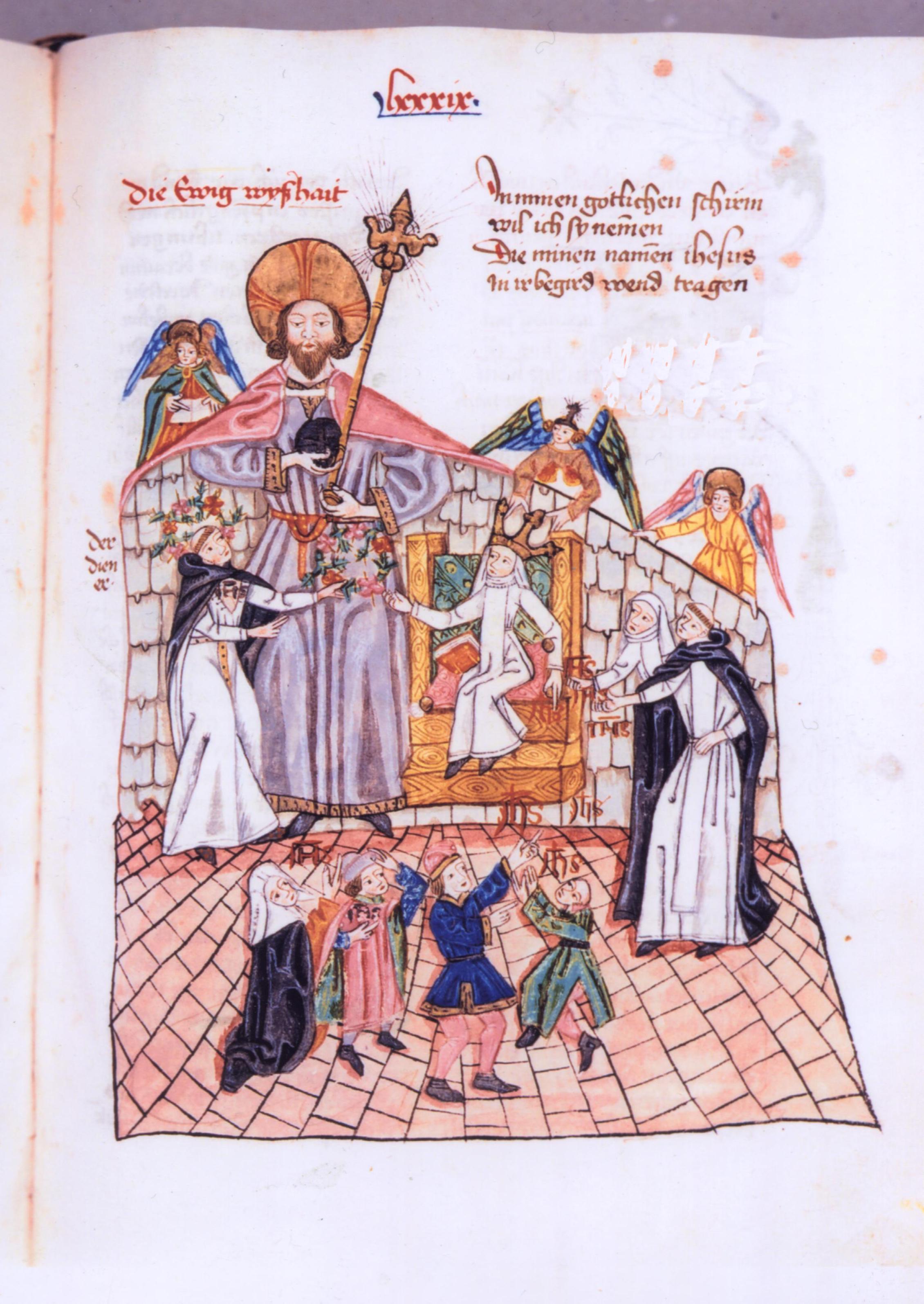
Einsiedeln, Cod. 710 (322), fol. 89, Henry Suso and
Elsbeth Stagel sheltering under cloak of Sapientia
A thread on the Medieval Religion List was a query
about a Carol sung each Christmas in Germany, said in its
legend to have been sung by the Angels when they danced with
Henry Suso.
The Horologium Sapientiae ('Clock of
Wisdom', the 'Computer of Wisdom'), was written in 1339. Henry
Suso died at Ulm, 1366. Immensely popular throughout Europe
this work was translated into other languages.
Henry Suso's Horologium
Sapientiae, in British Library, Add. 37,790, fols.
135v-136v, presents part of Chapter Four's dialogue between
Wisdom and the Disciple. British Library, Add. 37,790, the
Amherst Manuscript, also contains Julian of Norwich's Showing
of Love, Marguerite Porete's Mirror
of Simple Souls, Jan van
Ruusbroec's Sparkling Stone , and works by Richard
Rolle , Walter
Hilton and Birgitta of Sweden
. It may have been copied out by Richard Misyn himself for the
recluse Margaret Heslyngton, and these earlier layers of the
manuscript could have even been written as early as circa
1413, and represent Julian's own contemplative library. You
may be reading what she once read.
Both Henry Suso and Richard Rolle
stress Jesus ' name, Suso inscribing it upon his own flesh
over his heart with his writing stylus, Rolle wearing it as an
embroidered badge upon his hermit's garb, Charles de Foucauld
as a hermit using a similar practice in our own century. Women
were more likely to centre such a concept upon the heart of Jesus,
as did Mecthild of Hackeborn, whose Book of Ghostly Grace
in British Library, Egerton 2006, is copied out by the same
scribe as that of this Amherst Manuscript, and as did Julian
of Norwich herself
The concluding reference in this text to the Desert
Father Arsenius is also
to be found in the booklet 'Colections
'. Manuscripts of this text by Henry Suso are sometimes
illuminated with Henry Suso, who was Swiss, and his translator
together gazing upon the medieval form of a computer, an
elaborate Swiss clock, presented to us by the figure of God as
female Wisdom. The rubrication here follows that in the
Amherst Manuscript.
A hard copy booklet of this text giving the Middle
English with its thorns and yochs in parallel text with the
modern translation, may be obtained from holloway.julia@tiscali.it
.
A Brief Formula for the
Spiritual Life:
 N the fellowship of saints
which as the morning stars
N the fellowship of saints
which as the morning stars
shone in the dark night of this
world and as the sun and moon
shed forth the beams of their
clear knowledge you shall find some who
surpassingly were perfectly
grounded not only in active life and virtue but
also in contemplation, of whose
teaching and example you may take
the most perfect doctrine and
love of true spiritual life. And nevertheless I
willingly and condescendingly to
your youth and inexperience shall give you
some principles of spiritual
living for a memory to have always
at hand to set you in the right
working if you desire
to have the perfection of
spiritual life that is to be desired by all men
and if you will and desire to
take it up manfully you shall first
withdraw from ill fellowship and
harmful company of all men who would
hinder you from your good
purpose, seeking always opportunity when and what
time you may retire and there
take privy silence for contemplation
and flee from the perils and
turbulance of this harmful world. Always it
belongs to you first to study to
have cleanness of heart, that is to say
that you keep your sensory
perceptions turned into yourself and there you have as much as
is
possible the doors of your heart
busily closed from the
[Fol. 136]
forms of outward things
and images of earthly things. Truly
among all other spiritual
exercises cleanness of heart has the sovereignty,
as a final intent and reward of
all the travails that a chosen knight of Christ is to receive.
Also you must lessen your
affections from all your business about all the things that
might
hinder your freedom from such a
thing that in any manner has might and power to bind and
draw down your affection to it. As it is
written in Moses' Law, 'Remain
living in your own
dwelling and do not go out your
door on the day of the Sabbath.
Every man shall live by himself and
no man go out through the door of his house
upon the Sabbath day'. This is as
much as to say
that for a man to dwell with
himself is to gather all the various
thoughts and affections of his
heart and have them knit together into
one true and sovereign good,
that is God. And to keep the Sabbath is
to have your heart free and
unburdened from all fleshly affections that might
defoul the soul and from all
worldly cares and business that might distress
it and so rest sweetly in peace
of heart as in the haven of silence and
the love and feeling of his
Creator God. Above all other things, let
this be your principal intent
and business, that you always have your soul
and your mind lifted up to
contemplation of heavenly things, so that
frail earthly things be left, to
be continually drawn up to
the things that are above and
what thing so ever it be that is different
from this, though it seem great
in itself as chastising of the body, fasting,
vigils, and such like exercises
of virtue, they shall be taken
and considered as secondary and
less worthy and only so much expedient
and profitable as they profit
and help to cleanness of heart. And there
fore it is that so few go on to
perfection for they waste their time and their
strength in mean things that are
not greatly profitable and the due
remedies they leave and discard.
But if you desire to know the
right way to fulfil your intent
you shall sovereignly desire
to continual cleanness of heart
and rest of spirit and tranquillity and
to have your heart lastingly
lifted up to God.
Disciple: Who is he who in this
mortal body may always be knit to
that spiritual contemplation?
Wisdom: There may be no
deadly manner always fasten and
set into this contemplation but
from this cause, as said earlier,
that you may know. Where you
shall fasten and solemnly set the
intention of the spirit and to
what mark you shall always draw
the beholding of your soul when
at that time the mind may
get them he will be glad and
when he is distracted and drawn
away then he is sorry and sighs
often as he feels himself
separated from that beholding.
But if by chance you will ever turn against
me and say that you may not long
abide and dwell in one's man's state
you shall know and understand
that the power of God may do
and work more than any man may
think. Therefore it falls
often that that thing that a man
binds him to at the beginning
with a manner of violence and
difficulty, afterwards he shall
[Fol. 136v]
do it lightly and at last
with great liking, if he continue and
leave not what he has first
begun. Hear now, my dear son,
the teaching of your father.
Heed carefully my words and
write them in your heart as into
a book. Follow not the multitude
of those who go back to the
desires and lusts of their hearts
in which devotion is slackened,
charity grows cold and meek obedience
is cast aside, in those who
covet to be over other men in
prelacy and busily seek esteem
and delicacies for the stomach,
desiring overmuch gifts and
questing rewards that in this
world are gained, which they
covet for as reward of their work. But
in another world they shall be
left empty of everlasting
joy. And therefore follow not
this manner of people but take
heed busily to the worthy
flowers, that is the holy Fathers, that
spread about the sweet odour of
the sovereign holiness and busy
yourself to take the purpose
with like intent and conversation as is now
shown to you. Wherefore, whether
you eat or drink or any other
thing do it late. Ever this
voice of your sweet father sounds in your
ears saying, 'My son, turn again
into thy heart. Withdraw
yourself from all outward things
as much as
is possible to you and with a
fervent love cleave ever to the
sovereign good that is God and
having always your mind lifted
up in contemplation of heavenly
things. So that all your soul
with the powers and strengths
thereof gathered together into God
be made one spirit with him in
whom stands sovereign
perfection of our way and living
in this world. This short
doctrine for form and manner of
living is given to you in
which stands the sovereignty of
all perfection. And in which
if you will busily study and
truly fulfil it, in effect you
will be blessed and in this
manner begin here in this frail body
everlasting felicity. This is
the healthful way that Arsenius,
taught by the Angel, kept
himself and bade his disciples
keep. That is to say, 'Flee,
Keep Silence, and Be in Rest'. 'These', he
said, 'Are the principles of spiritual
health'. God be
Thanked.

P. Odo Lang O.S.B., Librarian,
Einsiedeln Abbey, which owns major Suso manuscript, Cod. 710
(322), also major Mechtild von
Magdebourg manuscript
Foto: Frau
Liliane Géraud, Zürich
See also Amherst Manuscript
Indices to Umiltà
Website's Essays on Julian:
Preface
Influences
on Julian
Her Self
Her
Contemporaries
Her
Manuscript Texts ♫ with recorded readings of them
About Her
Manuscript Texts
After
Julian, Her Editors
Julian in
our Day
Publications related to Julian:


Saint
Bride and Her Book: Birgitta of Sweden's Revelations
Translated from Latin and Middle English with Introduction,
Notes and Interpretative Essay. Focus Library of Medieval Women. Series Editor,
Jane Chance. xv + 164 pp. Revised, republished,
Boydell and Brewer, 1997. Republished, Boydell and Brewer,
2000. ISBN 0-941051-18-8
 To see an example of a page inside with
parallel text in Middle English and Modern English, variants
and explanatory notes, click here. Index to this book at http://www.umilta.net/julsismelindex.html
To see an example of a page inside with
parallel text in Middle English and Modern English, variants
and explanatory notes, click here. Index to this book at http://www.umilta.net/julsismelindex.html
Julian of
Norwich. Showing of Love: Extant Texts and Translation. Edited.
Sister Anna Maria Reynolds, C.P. and Julia Bolton Holloway.
Florence: SISMEL Edizioni del Galluzzo (Click
on British flag, enter 'Julian of Norwich' in search
box), 2001. Biblioteche e Archivi
8. XIV + 848 pp. ISBN 88-8450-095-8.
 To see
inside this book, where God's words are in red, Julian's
in black, her editor's in grey, click here.
To see
inside this book, where God's words are in red, Julian's
in black, her editor's in grey, click here.
Julian of
Norwich. Showing of Love. Translated, Julia Bolton
Holloway. Collegeville:
Liturgical Press;
London; Darton, Longman and Todd, 2003. Amazon
ISBN 0-8146-5169-0/ ISBN 023252503X. xxxiv + 133 pp. Index.
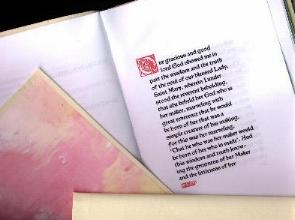 To view sample copies, actual
size, click here.
To view sample copies, actual
size, click here.
Julian of
Norwich, Showing of Love, Westminster Text, translated into
Modern English, set in William Morris typefont, hand bound
with marbled paper end papers within vellum or marbled paper
covers, in limited, signed edition. A similar version
available in Italian translation. To order, click here.

'Colections'
by an English Nun in Exile: Bibliothèque Mazarine 1202.
Ed. Julia Bolton Holloway, Hermit of the Holy Family. Analecta
Cartusiana 119:26. Eds. James Hogg, Alain Girard, Daniel Le
Blévec. Salzburg: Institut für Anglistik und Amerikanistik
Universität Salzburg, 2006.

Anchoress and Cardinal: Julian of
Norwich and Adam Easton OSB. Analecta Cartusiana 35:20 Spiritualität
Heute und Gestern. Salzburg: Institut für Anglistik und
Amerikanistik Universität Salzburg, 2008. ISBN
978-3-902649-01-0. ix + 399 pp. Index. Plates.
Teresa Morris. Julian of Norwich: A
Comprehensive Bibliography and Handbook. Preface,
Julia Bolton Holloway. Lewiston: Edwin Mellen Press, 2010.
x + 310 pp. ISBN-13: 978-0-7734-3678-7; ISBN-10:
0-7734-3678-2. Maps. Index.

Fr Brendan
Pelphrey. Lo, How I Love Thee: Divine Love in Julian
of Norwich. Ed. Julia Bolton Holloway. Amazon,
2013. ISBN 978-1470198299

Julian among
the Books: Julian of Norwich's Theological Library.
Newcastle upon Tyne: Cambridge
Scholars Publishing, 2016. xxi + 328 pp. VII Plates, 59
Figures. ISBN (10): 1-4438-8894-X, ISBN (13)
978-1-4438-8894-3.

Mary's Dowry; An Anthology of
Pilgrim and Contemplative Writings/ La Dote di
Maria:Antologie di
Testi di Pellegrine e Contemplativi.
Traduzione di Gabriella Del Lungo
Camiciotto. Testo a fronte, inglese/italiano. Analecta
Cartusiana 35:21 Spiritualität Heute und Gestern.
Salzburg: Institut für Anglistik und Amerikanistik
Universität Salzburg, 2017. ISBN 978-3-903185-07-4. ix
+ 484 pp.
JULIAN OF NORWICH, HER SHOWING OF LOVE
AND ITS CONTEXTS ©1997-2024
JULIA
BOLTON HOLLOWAY || JULIAN OF NORWICH
|| SHOWING
OF LOVE || HER TEXTS
|| HER SELF || ABOUT HER TEXTS || BEFORE JULIAN || HER CONTEMPORARIES || AFTER JULIAN || JULIAN IN OUR TIME || ST BIRGITTA OF SWEDEN
|| BIBLE AND WOMEN || EQUALLY IN GOD'S IMAGE || MIRROR OF SAINTS || BENEDICTINISM || THE CLOISTER || ITS SCRIPTORIUM || AMHERST MANUSCRIPT || PRAYER || CATALOGUE AND PORTFOLIO (HANDCRAFTS, BOOKS
) || BOOK REVIEWS || BIBLIOGRAPHY ||


