JULIAN OF NORWICH, HER SHOWING OF LOVE
AND ITS CONTEXTS ©1997-2024 JULIA
BOLTON HOLLOWAY
| || JULIAN OF NORWICH
|| SHOWING
OF LOVE || HER TEXTS ||
HER SELF || ABOUT
HER TEXTS || BEFORE JULIAN
|| HER CONTEMPORARIES || AFTER JULIAN || JULIAN IN OUR TIME || ST BIRGITTA OF SWEDEN
|| BIBLE AND WOMEN || EQUALLY IN GOD'S IMAGE || MIRROR OF SAINTS || BENEDICTINISM || THE CLOISTER || ITS SCRIPTORIUM || AMHERST MANUSCRIPT || PRAYER || CATALOGUE AND PORTFOLIO (HANDCRAFTS, BOOKS )
|| BOOK REVIEWS || BIBLIOGRAPHY || Amherst Manuscript ♫
Click on red arrow
below for soundtrack of reading
JAN VAN RUUSBROEC
THE
SPARKLING STONE
FROM THE
AMHERST MANUSCRIPT

Hans Memling, 'St
John Writing Revelation', 1479, St John's Hospital, Bruges.
Reproduced by permission of Memlingmuseum, Stadelijke Musea
Brugge, Belgium
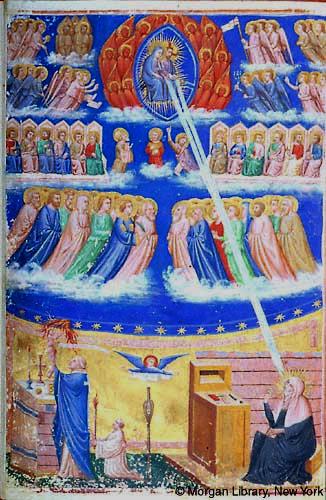
Compare with Birgitta of
Sweden, Revelations,
1400, Pierpont Morgan Library, both centred on the
Eucharist:
♫
 mmediately after Julian of
Norwich's Showings in the British Library Amherst
Manuscript, 'Explicit.Juliane de
Norwych ', follows a treatise by
Jan van Ruusbroec, generally
called De Calculo or Sparkling Stone, but in
this manuscript titled 'Treatise of Perfection of the Sons of
God'. The text that follows replicates the manuscript's
folios, layout, capitals (which are blue with red penwork
ornamentation, as here, but which drop, taking up two or three
lines, impossible to do on the Internet) and rubrication, but
cannot give the contractions, thorns, yochs and long tailed
s's. These are transcribed into a hard copy booklet which may
be ordered from Julia
Bolton Holloway
mmediately after Julian of
Norwich's Showings in the British Library Amherst
Manuscript, 'Explicit.Juliane de
Norwych ', follows a treatise by
Jan van Ruusbroec, generally
called De Calculo or Sparkling Stone, but in
this manuscript titled 'Treatise of Perfection of the Sons of
God'. The text that follows replicates the manuscript's
folios, layout, capitals (which are blue with red penwork
ornamentation, as here, but which drop, taking up two or three
lines, impossible to do on the Internet) and rubrication, but
cannot give the contractions, thorns, yochs and long tailed
s's. These are transcribed into a hard copy booklet which may
be ordered from Julia
Bolton Holloway
Treatise of Perfection of
the Sons of God
 n the Name Off The
Blissed. Trinite In Whom at alle
n the Name Off The
Blissed. Trinite In Whom at alle
tymes I putt my dispocicoun
and werkes. Iintende to transpose
for myne Owne lernynge
Atrettesse frome latynn into engly
sche compiled bi Dan John
Rusbroke the ffirst Prior of the
chartyr howse in valle viridi
iuxta bruxellam. whiche tre
tysse is called the tretesse
of perfeccioun of the Sonnys of god
that es to saye the grownde
and the ledere. vnto the trew
crayse of perfeccioun.
Wherefore yif ony man happenn to rede it
or yit here it redde Whiche
Approbately can defete it. Meke
ly I beseche thame to
withedrawe the defawte and gyffe stede
to the trowthe. And att my
begynnynge be mary the blys
sed virgynn. and so forthe
procedynge vnto the ende. Amen
 Ere begynnes a trettesse.
/Explicit prologus.
Ere begynnes a trettesse.
/Explicit prologus.
the Whiche es called the
tretesse of perfeccoun
Off the. Sonnys. Of. God.
Deo gracias.
 ho so euer will lyffe in
the most perfytt state of the modere
ho so euer will lyffe in
the most perfytt state of the modere
holy chirche. fyrste it es
necessary that he be agoode man
and besely actualle. The
Secounde is that he be alonlye A
Spiritualle louere. The
thyrde that he be contemplatyfe and lyfte
vp vnto god by loue and
affeccioun of the immortalle man which
is the The fowrthe that he
be abowndynge in charite com
moun and generalle.
fforsothly whate tyme theys fowre comme to ge
dere in Aman than his state
is perfitly growynge and perseuerynge
[A115v]
In alle Vertew and grace and in knawliche of
verteues. both in
the sight of god and alle
resonable menn. Wherfore it is behofulle
thre thynges to considere whiche
makys a man goode and acce
ptable to allmyghty god. The
ferste is clennes of conscyence
with owte accusynge of dedely
Synne. Soo that who so wille
be agoode man. he awe to examyne
hym selfe and nought with
alyttelle strayghtnesse to
behalde fro the tyme in the whiche he
myght do synne. and than of alle
offensis in the meene tyme do
ne aftyr the ordynaunce. of
holychyrche trewly to clence hym.
The Secounde thynge makynge aman
to be goode is that he be
obedyent to god. vnto holy
chyrche. and to his conscience or his
resoun. or elles to the
conscyence or the resoun of anothere man
gostelye lyghtened of god. ffor
vnto these thre. is necessarye that
he yelde lyke obedyence and than
schalle he lyeve withoute drede
and withoute inordynat besynes.
And also he schalle in alle his
dedis withinforth stonde
vnrepreved. that is to saye fyndynge in hym
selfe none accusacoun of synne.
so clere he hase made hes consci
ence. The thyrde that makes aman
agoode mann of the whiche
man awght to be partelesse. Is
that he principally intende in alle his
werkys the honoure of god. ffor
yif alle for the multitude of a
mannys werkys lettynge. he hase
nought at alle tymes god be
fore his eyen. that is to saye
in affecioun and remembraunce. atte the
leste it is necessary that his
principalle intente & desyre be to lye
ve and spende his tyme aftyr the
moste thankfulle wille of god
And thus theese thre afore
rehersed vsyngly hadde makis a man
gracyous and goode. And who that
wantys one of thees thre
he is nought perfitely goode,
for he is vnable to resayve the verray
grace of god. But when sum euer
any man purpose in her
te to fulfille thees thre afore
rehersed. howe evylle sumeuer he
hafe bene afore tyme. in the
same momente that he so intend
ys he is made goode and
acceptable vnto god and is repletyd
with his fulle mercyfulle grace.
Moreouer than yif that this goode man
[A116]
man schulde be made alonely a Spirytualle lovere.
thre thynges he
muste hafe. ferste clennesse of
herte The Secounde spiritualle frenes
in desyres. And the thyrde to
feele oned with god. That is to saye
in nothynge elles to hafe desyre
ne wille bot onely in god. And ther
fore euereman that holdes hym
selfe Spiritualle knawe he that
who sumeuere wille hafe
clennesse of herte. he may nought with incly
nacioun of the saule that is to
saye. with a wilfulle affeccioun ony
thynge hafe inpossessyon. nor
yit drawe to nothynge with a wil
fulle redynesse or to
felaschippe hym to ony conuersacioun. bot whi
che es onely for god. Why.
Sothely for euere conuersacoun and euere
loue whiche es nought onely for
the honoure of god it payntys
and filles the herte of aman.
ffor it is not brought forthe of god
botte of the flesche. And
therfore who schalle be made Spiritualle
he hase nede to renownse alle
carnalle love. and knytte hym
in spirit onely vnto god.
haffynge hym in desyre & love of alle
creatures. And in the havynge of
god with loue is the inwarde
man clensyd frome all
ymagynacouns. ffor god is a spiryt. whiche
no man kanne propyrly fygure or
ymagyn. Neuerthelesse in this
werke awe aman to putte before
hym goode ymaginacouns as
the passyoun of oure lorde. and
alle othere thynge that maye bry
nge hym to the encrese of
deuocioun the whiche hadde. it is to
be holde vnto the cause of
clennesse. whiche is god and that is
the fyrste grownde of
spiritualle lyffe. The secounde as y sayde afo
re is inwarde fredomme that is
to saye. that a man excludynge
alle thynge. and also the fourme
and the schappe of alle thyn
ge may in alle inwarde exercyse
lyfte vppe hymselfe vnto god
in louynges that is to saye. in
gyffynge thankynge and reuerence
in devoute prayere and hertely
loue. and in alle thynge whiche
desyre and loue maye wyrke
thorowe helpe of the grace of god
and euer lastynge dyligence vnto
spyrituelle exercyse. And so be this
euerlastynge exercyse it is
comme to the thyrde whiche is te fele on
ed with god. ffor when sumeuer a
man hase clere and fre desire
to his god alonely for the
honoure of hym. and nothynge elles
intendynge. Than it folowes
necessarely that he sauerys the
[A116v]
goodnes of god. and also that he felys with his god
trewe oned
thorowe the whiche is fulfilled
spiritualle lyfe. ffor why oute
of it the desyre alwaye newly
spryngys: and vnto newe thyn=
gys the inwarde werkys it
stirres ffor in wirkynge the spirrit
ascendys into newe vnyciouns.
and so alwaye the werke and
the oned ar renewed. And the
renewynge of the werke and
of the vnycioun is Spiritualle
lyfe. So that we may see thann
howe that aman ys a goode man be
inwarde moralle vertewe
And by the vnicioun of god.
/Capitulum. 2 dum
 Ot and this goode
Spiritualle man schalle be made con
Ot and this goode
Spiritualle man schalle be made con
templatyfe vnto that are othyr
three thyngis required
ffyrste that he fele his
grownde vnserchable. that is to saye
That his conscience be cleene
frome alle synne. And so he awght
to kepe it. The Secounde is
that his exersise want alle manere. that
is to saye to sette hym to a
certeyne laboure. And nowth ere more
nor lesse. ffor he that dose
so. hase nought verrey fredome of
spirit. The thirde thynge is
that it is necessary that his affe
ccioun be continually knytte
vnto god. This knyttyng or vnycoun
that is to saye oned that a
spiritualle man feles with god. Somme
tyme he felys in spyrit with
hymselfe as afelynge vnable to be
borne so hy thynkys it with
oute mesure. and in that felynge or
openynge of the spyrrit be the
meene of loue. persayues hym
selfe frome hym selfe. errynge
in wisdome atte alle tymes.
felynge hym one lyfe with god
so stedfastly. he abydes in that
vnknawen knawlege. And this is
the fyrste grounde of contempla
tyfe lyfe. And oute of this
spryngis the secounde. that is to saye
the most hyghe beynge which is
wantynge alle maner in wir=
kynge. ffor the oned of god
whiche euer e contemplatyfe spiritte
pretendys in loue it is euer
lastynglye drawynge yn. and in hym
selfe askynge dyuyne persones
and alle lovynge spyrrytys and
this drawynge in felys euer
louer owthere more or lesse. ffor aftyr
mesure of his loue and the
manere of his exercyse is his felynge. for
sothelye who that gyffes dewe
dyligence to this indrawynge and
[A117]
contynually bydis therin into the felthe of dedly
synne he maye
nought falle. Botte euer e co n
templatyfe man whiche hafe forsa=
kene hym selfe and alle other e
thynge. so that in hym selfe he fe=
les none outdrawynge for he
covettys nothynge with a propre
wille botte to eu er e thynge he
is fre. he that. whose he be maye al=
waye entre bare and cleyne the
inwardnesse of his spirit. and
there anone he fyndis brought
forthe a manere of euerlastynge lyght
in the whiche gostely lyght he
feles the euer lastynge inwarde mo=
nycoun of the oned of god. And
also he feles hym selfe as the perpe=
tualle brande of love. be the
whiche above alle thyngys he de=
lytes to be oone with god. so
frely he kanne yelde his dette whi=
che is moynest hym be alle
myghty god. This sayde inwarde
monycoun of the oned of god
kyndles in the spyrit euer lastynge
heete. Bot where that the dewte
is dewly done. ther is the
perpetualle burnynge kyndelt.
ffor sothely in the selfe informacoun
of the oned alle spyrrytis want
ther wirkynge. And nothynge th
ay fele in that symple oned.
safe onely a gostely burnynge the
whiche no man may fele. ne hafe
withoute he be contynually
abydynge in grete clerete and
loue. wantynge manere that is to
saye whiche kanne be mesured by
consayvynge of the sonn of man
In this standynge the spirit
feles it selfe the perfyte burnynge of
euer lastynge loue. In the
whiche it fyndis nowth ere the beygynny=
nge ne ende bot euer more he
feles hymselfe oone with hymsel=
fe as a spirit gostely burnynge
and inselfe alwaye abydynge
ffor his loue is indurable and
euere felys hym selfe burnynge
in loue. ffor he is alwaye
drawyn in the be informacoun of the
ooned of god. And where that the
spyrit burnys in loue con
syderynge it selfe there it
persayues the dyuersyte betwix god and
it. Bot where that the spirit is
burnt in loue. there it is symp=
le and in no wyse havynge
discrecoun . And therfore he felys no
thynge saue onely the oned of
god. ffor why the grete flaw
me of the loue of god consumys
and devoures alle thynge
that the spirit may be the
frelete of hit selfe consayfe. Soo
[A117v]
Than that we schalle verrely knawe that the
indrawynge oned
of god is not elles bot inwarde
loue drawynge in the ffadere
and the sonne and alle thynge in
thame lyffynge into euere
lastynge beynge. ffor in that
loue is the felicite of alle spiritis
Wherfore vs behoues to grouwnde
oure lyfe vpon a profounde
depenesse and so we maye in euer
lastynge loue drowne and
alle of oure selfe into
inserchable depnesse be drowne. In the
whiche loue we schalle be
alterate in to ane incomprehensible
heyght And also with that loue
whiche is wantynge maner
we schale grope and it schalle
lede vs and brynge vs agay
ne in to the gate of the
incomprehensible depnesse of charite. in
the whiche we schalle flowe
frome oure selfe. and flowys A=
gayne in vnknawyn swetnesses
thorowe the spirit of the good=
nes of god. in the whyche we
schalle be made ligued and stab=
le euerlastyngly be the ioye of
god. So that I schewe than that
in eche of thees symylitudes is
exercyse to be contemplatyfe. /cap.3.ium
 here may no man entere the
sayde exercyse be cunnynge
here may no man entere the
sayde exercyse be cunnynge
ffor contemplatyfe lyfe may
nought be taught oone be anothere
bot where as god whiche es
verrey trowthe manyfestys hym
selfe in spirit. ther all
necessaries moste plentevously are lerned
and that is that the spirit
says in the Apochalips vincenti
says he schalle gyffe hym a litil white stone and in it
a newe
name the whiche no man knowes
but who that takys it. This
litel stone promysed to a
victorious man it is called. Calcalus.
for the litelnes ther of. ffor
yyf alle a man trede it with his fete
yit he is not hurte th er
with. This stone it is red with a schyny
nge witness to the lykenesse
of a flawme of fyre. litylle and
rownde and be the serkle ther
of it is playne and smothe. Be this
litel stone we vndyrstande
oure lorde ihesu cryste. whyche by
his dyuynyte is the whitnesse
of euer lastande lyght and the
schynere of the ioye of god.
Also the myrroure withoute spotte
in the whiche alle thynge hase
lyfe. Whosumeuere therefore
[A118]
owrecommys and ascendys aboue hym selfe and alle
othere thyn
gys that maye be consayved be
bodely exercyse to hym his gyffyn
this litelle white stone, and in
it he takis clereness and lyfe
This litel whyte stone is
symulate to a flawme of fyre for
burnynge loue of the euer
lastynge worde hase sacyate alle the
worlde with charite and with
alle lovynge spiritys in loue
burne to nought And also this
Calcalus is so lytle astone
that whate tyme it is trodunn
apon vnnethes it is feled. And
therfore it is called Calcalus.
As who say trodunn apon
with the heyle. the whiche the
Apostele exspoundys where
he says that the sonne of god
sette hym selfe atte nought A=
nd also he was obedyente to the
deth vnto the whiche
Acordes the wordes of oure lorde
sayde by his prophet. Isays
oure lorde am aworme and no man.
reproued of men and ab=
iecte of peple. Wherefore the
same tyme that the iewes tre=
tyd hym downe. he made hym selfe
so lytell. that is to saye. so
meke. that vnnethes they myght
fele hym. ffor yif they hadde
knawynge hym for the sonne of
god they durste of no wyse
hafe crucyfyed hym.
Neuerthelesse yit he is botte litle in ther hertes
that loues hym nought and
therfore thay sette hym atte nought
Also this litel stone the whiche
I spake of. it is rounde and be
the circumference playne. The
rowndenesse thereof teches the de=
uyne trowthe nowthere to hafe
begynnynge ne endynge And
the playnesse ther of informes
vs that is to delyuer vs and to re
warde euere man aftyr he hase
atheled whiche rewarde be it
goode or euylle abydes be the
havere ther of with owtyn ende
The laste proprite that this
Calculus hase is that it is smothe
And so the euer lastynge worde
of the ffadere hase no burdene
And yit by the vertewe ther of
it beres bothe hevynn and erthe
And also it is nere euer
ethynge. And yit nithynge may cumme
tille it. ffor it excedes abofe
and gase before alle creatures. And
therfore to none botte to whome
he wille and where he wille
[A118v]
He shewys hym selfe. So than that in his smothenesse
the
humanyte ascendys aboue alle
hevenesse there abidynge cro=
wned on the ffadere ryght hande,
Considere nowe wele thann
that this is the litle white
stone whiche is gyffen to a contem =
platyue mann in the whiche is
gyffenn written anewe name
that noman knawes bot who that
takys it And therfore it is
to knowe that euer e spyrrit is
named in his reuertynge vnto
god. And that specyally be the
nobilite of his seruys, And also
be the hete of his loue. the
whyche name is the fyrst name
of innocentry gyffyn vs at oure
baptyme whiche newe
haue loste thorowe oure synne
and wrechidnesse. And yit be
the merites of oure loue and
infynyte grace of god. we
are merked and putte in
knawelynge ther with agayne And therfore
yif we wille obey to alle
myghtty god in thre principalle
thynges, whiche he wille wirke
in vs. yit we schalle be
baptysed agayne thorowe the
holigoste. And we schalle
resayfe a newe name whiche
schalle abyde with vs euer
he fyrst than of thees
werkes which lastingly
oure lorde werkys in euer e
man. that is at saye vny=
uersalye alle men he calles
and meves vnto his oned. Howe
be it that summe here his
calle and summe here it nought. And
therefore alsolange as any
synnere mys hyerys this calle. so
lange it is necessary that he
wante the tothere two gyftys. wh=
iche immediatly folouys the
fyrste/ Now therfore it is to con=
sydre that the synnes of alle
synners are deuyded into fyve
kyndes. The fyrste kynde is of
thame that hase no charge of
goode werkys willynge euere to
lyffe aftyr the delycatnesse of
the bodye. And aftyr the
delyberacion and the wille of there
owne sensualyte. Thees persons
are vnable to resayfe the grace
of god. ffor in case thay had
it. yit thay myght nought lange
kepe it. The secounde kynde
than is of thame that wilfully
fallys into dedely synne. And
nought withstandynge that yit thay
do goode dedis euer dredynge
god and lovynge goode men and
[A119]
desyrynge to be helpede thorow there Prayers. Also
puttynge there trust
and there helpe in thame
Neuerthelesse als lange as the auersyoun and the
delectacioun of vice oue re
commes in man the conuersioun and loue that man
schulde hafe vnto god. So lange
is he vnworthy to resayve the grace
of god The thyrde kynde than is
of herytykis. and of thame that be erryn=
ge in the faythe. ffor whate
sumeuer goode deede thay do or whate degre
of Religioun thay pretende in no
wyse whilys thay do soo thay maye
plese god. ffor verrey trewe
fayth is the sadde grownde and vertewe
of alle halynesse. The fowrthe
kynde is of thame. whiche withoute
drede or schame lye in the denne
and the fylthe of dedely synne. hauy
nge no drede ne ferdnesse of
god. nor yit of his goodnesse alle vertew
settynge at nought. and
spyritualle lyfe haldynge botte ypocrysye or
fantesy. And whate sum euere is
sayde thame of god or of vertue. euen
as constreyened to here thay
here it. And why. Sothely. for thay are
so indurate in herte that thay
thynge there is no god. ne yit heven ne
helle. And therfore thay wille
knawe nothynge elles bot onely that thay
principaly fele be ther awne
consayte and false witte. So that thaye
arre cast awaye and forsakene of
god. for thay synne in the holygoste
Neuerthelesse thay may be
convertede. bot that is begrete difficulte. and
seldome sene. The fyfte is than
of ypocritys. whiche dothe the owt
warde dedys. not for the honoure
of god. ne yit for there awne helpe.
bot anely for to hafe the name
of holynesse in the mowthes of men
or elles forto obteyne worldly
goodes. or wyrschippys ffor yif alle thay
appere owtwarde goode and holy/
yit with inforthe thay arre false.
turned frome god. Therefore thay
are voyde of alle vertue and grace
Thus than are deuyded the fyfe
kyndys of synners. whiche lette a saule
to comme to the oned of god.
ffor also longe as a synnere is redy to the
servyse of synne. so long he
abydes. deffe and blynde. and vntawht
to taste or feele the goodnesse
that oure lorde wille wyrke in his gos=
tely lovere . Neuerthlesse yif
that he reverte frome synne and consydere
hym selfe haffynge a grete
dysplesynge with his synnys. Than he
drawes vnto godwarde. And yif he
wille gyffe hym vnto the cally=
nge and the styrrynge of god.
that is necessary that he purpose to
lefe his synnes and do penaunce.
And so he schalle be one herte and
saule with god. and resayfe the
grace of god. wherfore atte the furste
vs muste behalde vnto god, the
whiche of his awne goodnesse withouten
[A119v]
any difference. causes & styrres alle men vnto
one oned. bothe goode.
and eville he refusys none. The
Secounde vs muste feele the goodnesse
of god. that with grace
abowndys. to alle that verrely inclynes vnto
his incallynge. The thyrde vs
muste hafe trewe experience and vn=
dyrstandynge in oureselfe. that
we may be made one lyfe. and one
spirit with god. yif that we
wille forsake oure selfe. folowynge the
grace of god the whiche
ordinatly wyrkys in euere man aftyr the
persayvynge of his loue and be
the vniuersalle styrrynge of grace
euer e synnere takes wysdome and
powere of levynge of synne. and
of turnynge into vertue. ffor be
the wyrkynge of grace. may euere
goode man overe comme vice and
resyste temtacioun , and so encrese
in vertue and perseuer in
perfeccoun yif that we wille in alle thynge gyff
lovynge vnto the grace of god.
ffor sothely alle that we are and
alle that we hafe be inwarde
gyftys or outwarde. thay are of the
thankfulle gyftys of god. for
the whiche we be bunne to yelde hym
thankynges. ffor with thame it
is necessary we be filled. yif that we schalle ple=
E schalle knawe. that ther be
many gyftys of god which /se god.
vnto goode men bene occasyoun
and helpe vnto vertewe. and to
evylle men bene occasyoun and
helpe vnto vyse. of the whiche gyftys
summe be thees. helthe and
fayrenesse. witte and Riches. wordelye
wirschippe and prosperite. Thees
bene the lowe gyftys. that oure lorde
gyffes generally. bothe to his
fryndes & foes. the whiche goode men ser =
uys. bothe god and there
fryndes. And the eville men servys the deville. fle
sche and the worlde. And also we
schalle knowe that summe takys
the gyftys of god as mercenaries
sum as trewe seruandys. Thees two
be contrarye in wyrkynge and
loue. And therfore late vs take heede
vnto there dyuersyte. Knawe we
that euery man so inordynatly luffynge hym
selfe that he wille nought serve
god. but onely for his owne lucre and
rewarde. he that or thay whate
so thay be sequestrate thame from god
and makys hym selfe
proprietaries & vnfre. ffor thay intende in alle
there wyrkynges there awne
lucre. and thay be inordinatlye knytte
vnto thame selfe. And therfore
thay abyde euere more onely with thamm
selfe. So that trewe love they
wante be the whiche thay schulde
be knytte vnto god and vnto alle
goode menn and therfore yif alle it seme
[A120]
that thees kepe the lawes and commawndementys of god
and of
the chyrche. yit they kepe not
the lawe and the bande of charite
ffor that that thay doo thay doo
it not of charite bot for cause thay
may doo none oth er. lesse thay
be dyspysed or slawndret: ffor thay
that be vntrewe inwarde dare not
trayst strangly in god bot
alle ther inwarde lyfe is drede
and ferdnesse. labore and wrech
ednesse behaldynge on the ryght
hande the blysse euer lastynge
the whiche they drede to for
goo. And on the lefte hande the
payne of helle ay indurynge
whiche thay drede thay mon to
ffor alle the laboure and the
goode dedys aman does. to putt
away this drede avayles hym
nought alsolange as ther remay
nes a false loue to hym selfe.
ffor the more feruently and inordy
nately men love thame selfe. the
more thay drede the payne and
the tormentynge of helle. Soo
that it maye be clerely knawynn
that propre wille makys a man
inuyous agaynes hym selfe. for
it puttys in hym the drede of
helle whiche is the begynnynge
of fole. And therfore of the
contrary wyse as the prophet. And also
Salomoun in the Proverbes says.
Drede of god is the begynnynge
of wisdome But this manerre
drede is of thame that beholde to
the ryghthande of god. That is
to saye of thame that drede to lese
the blysse euer elastynge. ffor
this drede spryngys of naturelle incly
nacoun . thorowe the whiche
euere man desyres to be blyste. Wherfore
yyf alle a mann be vntrewe vnto
god. yit and he beholde hym we
le within he felys hym selfe of
hym selfe vnto blyssednesse with
his god sumwhate inclyned. And
therfore he dredys to lese this blys
sednesse. and so he loues hym
selfe more than god. ffor not for
god he loues this blyssednes and
dredys to leese it bot for hym
selfe whiche drede is of thame
that be vntrewe lovers. and it
is calde the drede. which is the
bygynnynge of wysdome. And
the lawe of vntrewe seruauntys
of god. Neuerthelesse it causes
men to leue synne and to desyre
vertue and to doo goode werkis
whiche inwardly dysposes a man
to ressayue grace. and to be
made a trewe seruande of god.
for in the same momente that a man
[A120v]
thorowe helpe of god forsakys and puttys awaye for
the love of god his
owne propre loue and knowleges
almyghty god in alle his necessitees
for his helpere and lovere in
that same deid it pleses oure lorde sowele
that he wolle wochesafe to
graunt & sende hym his grace. Be the
whiche grace the have rether of
feles betwix hym and god verrey trewe
loue puttynge owte of his
consayte alle dowte and drede. And thus
than he is made the trewe
servande of god. beynge and intendynge
to loue god in alle his dedes
And this is the difference betwyxe
trewe seruaundis and vntrewe
mercenaries.. /Cap itulum.6.m
Ot yit forsothe we maye
persayve grete difference betwyxe
the trewe seruaundys and the
dere frendys of god. ffor the tre
we servandys cheses be grace
to wyrke and to kepe the commawnd
mentys of god That is to saye
to obey vnto hym and to holy chir
che in alle manere of vertue
and goode manners. the whiche is called
vtwarde lyfe or elles doynge
or wyrkynge lyfe. Bot the dere fren
dys of god chese to kepe the
counselys with his commawndementys
That is to saye inwardlye thay
intende to drawe to god and vnto
his euerlastynge worshippe
alle thynge that thay hafe with a willfulle
forsakynge anence therselfe
and a verrey loue vnto god they possesse it
That is to saye. vttyrly
submyttynge thame selfe and that thay hafe
vnto the dispocicoun and the
wille of god. Thees manere of men oure
lorde calles his frendys. and
he teches thame discrecioun in inwarde
wyrkynge. That is to saye in
many hid maners of spiritualle lyffynge
sendynge owte ther seruantys
that is to say. ther outwarde curiouse wir
kyngys. so that vnto hym in
alle servyse and in alle manere of goode
outwarde werkys they are
Simple. Loo this oure lorde grawntys
grace & helpe vnto euere
man eftyr he is apte to take it. That is to
saye aftyr his wirkynge is
vnto god. owthere in vtwarde goode wer
kys. or ellys in inwarde
exercyse of loue. Neuerthelesse ther may noman
be viset with inwarde loue. ne
yit fele it with oute he be inwardlye
alle to geddre turned vnto
god. ffor howe longe aman be devyded in
harte so longe he is
behowdynge vtwarde an is vnstable And also
his saule is lyghtlye meued
frome hatredynn vnto loue and frome lo
ve vnto hatredynn of
temporalle thynges of the whiche the desyre
yit lyffys in hym. And
therfore yif alle siche a man in his lyffynge
[A121]
kepe the commawndementis of god neuerthelesse yit he
is fulle litle inwar
delye lyghtned nor yit he knowes
whate his inwarde exercyse is. ffor
howe he schulde he is nought
taught. Neuerthelesse he holdys hym con=
tente in that he knowes, and
feles that he intendys god. and in alle
his werkys he covetis to
fulfille his moste plesable wille so that he
fyndes hym selfe in his
intencioun nought feynynge bot trewe and dy=
ligente in his service. Whiche
two funne in hym. it semes hym that his
vtwarde goode dedys done with
atrewe intencoun . are more holye
and more profitable than any
inwarde exercyse that he cowthe hafe
ffor alle the helpe that he
covetis of god. it is vtwardlye chosene
And therfore he hawntys more
vtwarde werkis with discrecoun than
he dose hym for whome he wyrkys
with alle his myght and loue
And that is the cause that
rathere in his harte are put the werk es
that he dose. than god. for
whome he dose thame. And therfore he A=
bydis Actyfe put alle in vtwarde
werkys. And so he is not apte to
fulfylle the cownseyles of oure
lorde. ffor cause his wyrkynge is
rathere owtwarde than inwarde
bodely more than gostelye wher
fore yif alle he be the trewe
seruant of god in vtwarde exercyse. yit
that. at the secret frendys of
god feles in wyrkynge. that is vn tohym
hid and vnknowen. And that is
the cause that many rude vtw=
arde wyrkers allwaye deme and
chalans inwarde wyrkers as
Actyfe men thame that be
contemplatyfe. for thay thynke that the
contemplatyfe men are occupied
both with ydelnesse. And that was the
cause that Martha made Playnte
of Mary hir sustere. ffor Mari
helpyd hir nought to mynystere.
And ther fore Martha thought sche dyd
grete seruyce & profetable
And hir Sustyr Mari sate voyde and ydle
Bot oure lorde gafe Sentence and
dome of thame bothe . blamyn=
ge Martha. bot not for hire
ministracoun for that was both goode
and profitable. Bot he increpate
hyre for cause sche was so besye
hevy and trubled abowte vtwarde
occupacoun . Bot he praysed
Mari for inwarde exercise
sayinge that one thynge is necessary the
whiche Mari hase chosene And
that schalle neuer be takyn from hire /capitulum 7m .
his beste thynge that Mari
chase. is euer lastynge lyfe and
that one thynge that is to
euere man necessary it is the loue
of god. the whiche the secret
fryndes of god cheses afore alle other
[A121v]
And so dyd Marie/ Bot Martha chase trewe vtwarde
actyfe
lyfe & not feyned. And that
is the tothere partye thorow the
whiche god is loved and served.
Bot it is not so perfite nor so
goode as that that the trewe
seruantis of god hase chosene for
the loue of god. And yit ther
are sum menn whiche be fonde that
wille be bad inwarde and ydle.
And nowth er thay wille wyrke
ne yit seryf to ther neyghtburs
in the tyme of necessyte. And
thees manere of men are nowther
the secrete frendys of god
ne yit his trewe seruantys. Bot
thay are false and dysceved
ffor ther may no man fulfille
the counselys of god that wille
not kepe his commawndementys.
And therfore alle the secrete
fryndys of god are alle way his
trewe seruantys. Bot not
alle trewe seruantys are secrete
frendys of god. ffor thay kn=
owe not the exercyse that longys
to a secrete frende. Thus
than is manyfeste the dyfference
betwyx the secrete fren=
dis of god and his trewe
seruantys, Bot yit ther semes a neue
difference be twyx the forsayde
howe be it that ayther ylyke is
raysed vp with inwarde exersice
before the syght of god Bot alle
the secrete frendys of god
possesse ther inwarde exercyse that is to
saye ther inwarde wyrkynge with
a trewe wille . ffor thay che=
se the drawyng nere
loueablenesse. for the beste and for the
moste excellent to the whiche
thay may or desyre to comme
And therfore thay maye not latte
thame selfe ne yit ther werkys
passe into a voyde barenesse. or
with the ymage of ther selfe
and of ther werkys thay are
inwardlye hid and paynted so yif
alle in ther drawynge nere
loueablnesse thay fele with god
oned Neuer thelesse yit thay
fele difference betwyx god and
thame. ffor that symple entrynge
into the barenesse is vn
to thame vnknowen & vnloued
And therfore the most hyghe in=
warde lyfe of thame euer more
abydes in resoun and in manere
yif alle thay hafe clere
vndyrstondynge & discrecoun of alle
resonable vertwys. Neuerthelesse
that symple behaldynge tho=
rowe mynde in the clerenesse of
the godhede abydys vnto tha=
[A122]
hid. yif alle thay fele thame selve lyfte vp vnto
god in a feruent bur=
ning of loue. Ne er thelesse yit
thay withholde vnto thame selfe som=
whate of th er spirite so that
thay are not alle consumed & in vnycoun of
loue burnt vnto nought. ffor yif
alle thay wolde lyeve alle waye
in the seruyce of god. And
euerlastyngly in desyre to plese hym Neuer =
lesse yit thay wille not dye in
alle propre tarynesse of spirit ande
one lyffe bere with god. And
moreouere yif alle thay sette at litle
alle owtwarde accydentalle ryste
yit thay holde grete the gyftys of
god and the inwarde werkys. And
also the consolacioun and the swet=
nesse thay fele with inforthe.
Thus in there Jurney they rist. nought
pleynerly dyynge for the
gettynge of the heye felicite and alle to
geddyre beynge occupied in the
nakede loue of god. ffor sothly yif
they myght exercyse and with
discrecioun knowe alle drawynge nere
loueablenesse. And also euere
inwarde ascendynge desyre whiche
is possible to hawnt in the
sight of god Neuer thelesse yit ther abydes
with thame the hid and vnknowen
presynge the whiche is desyre
wantynge mesure. In that
Aboundande gyfte inloue superexcensialle
that is to saye above alle
othere loves in the whiche nevere his
fonde begynnynge ne ende ne yit
ordyr ne manere. /8m
Ot there is grete difference
be twyx the secret fryndys of
god and his hid sonnys. ffor the
secrete frendys of god
felys nothynge elles bot a wyse
loueable ascencoun in manere Apo
the whiche the hid sonnys feles
asymplylle dyinge desyre withoute
manere. And therfore the inwarde
lyfe of the frendes of god is the
exercyse that is to say the
occupacoun of loue goyinge vp to god in
atrewe faythe Abydynge god
traystynge certaynly to have euer
lastynge blyssydnesse. And
therfore thay festyn there Ankyre in god by
perfyte charite. And so it
happyns thame the beste for thay plese
god. Neuerthelesse thay are in
certayne of the blysse euerelasty
nge. for thay are not yit
mortyfyed vnto ther selfe and vnto alle
propre tarye in god. Bot for
soth alle men in ther exercyse and in that
they haue chosyn perseuerynge.
god hase chosen in euer lastynge be
ynge. and ther names with ther
werkys be written fro the begynnynge
[A122v]
In the book of diuyne predestynacioun Bot thoo that
cheses alle other thyn=
ges. and ther inwarde face that
is to say. there inwarde wille turnes in
to the contrary perseuerynge in
ther synnys; yif alle there creatur names
be writen and knowen of god be
the temp or alle ryghtwysnes the exercyse
in the whiche thay perseuere not
vnto dede. therfore ther names are putte
oute of the booke of lyfe. and
nowthere god. ne yit eny fruyte of
vertewe fro thens furth thay
schalle taast wherfore it is behofulle
to vs alle that we with alle
oure desyre vnto god. and with a grete
loue inwarde and vtwarde
diligently anowrn vs with goode werkys
and so we may abyde in hope and
Joye the dome and the commynge
of oure lorde Ihesu cryste. Bot
and we cowth forsake oureselfe and
alle propretarynes in oure
werkys. Anone than we schulde passe alle thy=
nge with oure bare and clere
spyrrit. And we schulde do alle thynge
thorowe amanere of
proprietarynesse wrought immediatly frome the spirit
of god wherebye we schulde feele
certaynly that wer were the son=
nys of god. ffor whate so thay
be that wyrkes or dose by the spyr=
it of god thoo says the Apostle
are the sonnys of god And neuerthelesse
it is to knowe that alle goode
trewe men be the sonnys of god. ffor
thay be borne of the spyrrit of
god. the whiche spyrrit dresses and
puttes forthe euer e mann onely
vnto verteuse and goode werkys
aftyr he is apte thorowe the
whiche he pleses god. Neuerthelesse
for the dyuersyte of inwarde
loue and of vtwarde laboure. summe
I kalle trewe servantys of god.
Summe secrete frendys of god. And sum =
me the hid sonnys of god. So
that alle are owthere servantys. frendes
or sonnys. ffor vnto one god
thay alle serve. And one thay alle lo
ve. And also of the free spyrryt
of god thay lyffe and wyrke. ffor
god grawntys vnto his frendes
alle his commawndementys and
obseruancys And who that are
bunne vnto the counselys it is sertaynn
that they be bunne with the
bande of commaundement wherfore
it is schewed no man to be
inobediente vnto god ne yit contrary
bot onely he that kepes not his
commaundementys. And therfore alle
thynge that god commawndys or
forbyddys in holy scripture or in
[A123]
Holy chirche or in oure conscience. thees it is
necessarye that wee
do or leue. or elles we be
conuycte to be inobedient And so anone
forto lese the grace of god Bot
that we falle in to daly lyght de
fawtys. oftyn tymes it happyns
be the soueraunce of god. and also
cause of necessyte the whiche in
no wyse we may avoyde. wher
fore the defawtes makys vs not
inobedient for thay nowthere
put awaye oure ryst ne pees. ne
yit the grace of god Neuerthelesse
howe litle or howe fewe thay be.
vs owe to sorowe for thame
And with alle oure diligence
beware we falle not to thame agay
hus than in this late sayde
I haue made opunn the /ne
whiche I remembre me I sayde
in the begynnynge that is to say
it is necessary and behofulle
that euere man be obedyent vnto god
to holy chirche and to the
resoun of his conscience. ffor in thees
maners I wille that euere man
forsake vnryghtwys lettyng es . And
thus I leue sayde the fore
writen as thay are sayde. Neuerthelesse
yit moste gladlye. I wolde
knowe howe that we may be made the
hyd sonnys of god and to comme
to haue in wyrkynge contemplatife
lyfe. ffor the whiche sothly
the inwarde thynges and rather the
superior thyngis I haue ashet
counselle and playnly I haue consayued
the trewthe. as thus. It
behoves vs as it is aforsayde in alle thy
ngys to lyffe and wake in
vertuse. and abowe alle vertuse to dye.
and in god to slepe. ffor
sothe it es necessarye that we dye fro syn
and to be borne in god in
vertuouse lyfe. And also it is necessarye
we forsake oure selfe. and in
god dye in to euerlastynge lyfe. Wher
fore thus passis furthe this
ordere yif that we be borne of the holye
goste. thanne we are the
sonnys of grace. And our lyfe is made
fayre with vertuse. And so
alle thynge that is contrary vnto god
we overe comme. ffor as the
Apostle says. Alle that is borne of god.
overe commys the worlde. ffor
sothely in that byrthe alle goode men
are the sonnys of god. And the
spirrit of god meues. and dryffes
euere man syngulerlye vnto
thoo vertewes and goode dedes the whiche
he is redy and apte to resayue
and to do so that thu plese god alle
and iche one synglere, aftyr
the gretnes of loue and excellentne
[A123v ]
of exercyse. Neuerthelesse thay fele not there selfe
stable nor yit havyn=
ge god perfyghtly. ne certayne
thay be not of the blysse of heuen
ffor yit thay may turne and
falle in to synnys. And therfore. I calle
thame rathere servantys than
othere frendys or sonnys Botte
how mekylle that so euer we goo
aboyfe oureselve in oure ascen=
dynge vnto god. so mekylle we be
made symple that the naked
and pure loue maye consayve vs
in the heyght where he exer =
cyses hym selfe above alle
exercyses of vertues in oure beynge
where we are spyritualle borne.
And where we are transform
ed. And also in god bothe vnto
oure selfe and to alle othere thy=
nges we dye. In that intencoun
sothely we are made the hid son=
nys of god. And so we fynde in
vs a newe lyfe the whiche ly
fe is euerlastyngnesse Off thees
sonnys spekys the Apostle whe
re he says ye are dede and youre
lyfe is hid with cryst in god. decimum
Ake hede therfore nowe for
this is the ordere of oure entry=
nge vnto god. We owe to bere
oure selfe and oure wer=
kys before vs as euerlastynge
offerande of god vnto the presen=
ce of god we schalle brynge oure
selfe and oure werkys dyyn
ge in loue. ffor than we excede
alle create thynges into the
Substancyalle ryches of god.
ther we schalle hafe god in euerlas=
tynge mortyfyinge, And therfore
says the spirit of oure lorde in the
Apocalips: Blissed be tho dede
the whiche are dede in oure lorde
Worthely for sothe he callys
thame blystlye dede the whiche by=
dys euerlastyngly dede. that is
to saye fro thame selfe and in to
that vsable oned of god thay are
drownde And also thay are
evere more newly dyinge in loue
be the in entrynge formacoun
of the same. Wherfore fro nowe
forthe says the spirit that thay
myght ryste of ther labores for
ther werkys folowes thame. ffor sothe
ly in the same manere where that
of god we are borne in spiry=
tualle verteuouse lyfe And where
we bere oure werkys afore vs
as oure oblacoun vnto god. And
also in that hyest where in god
we dye into euer lastyinge
blissed lyfe. ther forsothe oure werkys
folous vs. for thay are one lyfe
with vs. And more overe in
[A124]
Oure taryynge with vertuse vnto god dwellys god in
Vs. bot in that
we goo fro oure selfe and fro
alle thynge we dwelle in hym. ffor=
Sothly yyf we hafe faythe hope
and charite. than with owt dow=
te we hafe taken god. ffor he
with his grace dwellys in vs and
sendys vs furthe as trewe
seruantys to kepe his commawndmentis
And he callys vs agayne inwarde
as his secrete frendes yif alo=
nely we folowe his counseyles.
And be that he schewes vs that
we are his sonnys yif onely we
knowe oure lyfe contrary to the
worlde/ Bot forsothe yif that we
wille taste god overe alle thy=
nge or fele in vs euerlastynge
lyfe. it is necessary as I consayve
that above resoun of our
consayte we intende god abydynge ther
ydle that is to saye from alle
ymaginacoun and feynynge of alle
erthly symylitudys lyftynge vop
be loue oure mynde unto the ma=
nyfeste barnesse where sothly in
loue alle thyngis we ouerepa=
sse dyynge be alle
consyderacioun into Amanere of ryghtwysnesse
and derknesse. tho we do and
wyrk in the euerlastynge worde the
whiche is the ymage of the
fathere . And in that ydlenesse of
oure spyrrit we take that
vnconsauable clerenes the whiche takyn. we
flowe ouere that is to saye we
passe mesure of resoun in consay
vynge the clere syrkle of the
sonne yet ouere the substaunce and
that trewe clerenesse is nought
ellys bot a byholdynge and A in=
speccoun of ane unknawen ende.
ffor that . that we are we be holde
and that we be holde we are .
And why. ffor sothly oure lyfe. myn=
de. And alle othere thynge that
we hafe allonely are lyfte vp an
knyt to the verrey trewthe
whiche is god wherefore in that allon=
ly beholdynge we be one lyfe.
and one spirryte with god. And
this I calle contemplatyfe lyfe.
for where that we drawe nere
god in loue. ther we exercyse
the best parte. And where as aboue
alle thynge ascendynge
supersubstancyally we serche. ther holye
we possesse god. And vnto this
contemplacioun euere more draw=
es the exercyse of the vnknawen
manere. that is to saye. lyfe dra=
wynge to nought. bot we forsothe
hase drawyn oure selfe in to
[A124v]
a derknesse and into an unsershable wantynge manere.
thayre euermo=
re schynes that simple beynge of
the clernesse of god in the whiche
we be growndyd. that is to saye
the whiche of oure selfe drawys
vs into the moste hyghe beynge
and felaschip of his loue vnto the
whiche felaschippe of loue
exercyse that es to saye bysenes is the
drawere in and the folowere of
trowthe trewe loue wantynge
manere. ffor loue may nought be
ydle bot thorow thyrst and smellyn=
ge it is aboutwarde to serche
unsersable ryches lyffynge in his
grownde that is to saye in the
grownde of loue. /capitulum 11
his forsayde Sothlye is the
impacient hungre besylye
goynge as a floode swyftly
rynnynge. It may not be
lefte ne yit takynn to wante
it is intollerable to folowe it im=
possible. It may not be
schewed openn ne yit hid in silence. It ex=
cedys alle resoun and witt.
And it is abofe alle creatures And
therfore it may on no wyse be
touched. Neuerthelesse beholdynge
oure selfe we feele the spirit
of god dryfe vs and put vs in
to that inpacient taryynge.
Bot beholdynge above oure selfe
we persayve the Spirit of god
of oure selfe drawynge vs and
turnynge vs to nought in hym
selfe. that is in cryste with A superessencialle
loue vnto whome we be euer
ychone lovere and alle thynge we
possesse largere. This hafynge
is meke sauoure of the insaable
depnesse of alle goodnesse.
and of euer elastynge lyfe. in the why=
che taste we are made wyde
owte take that resoun passes into the
moste depe vnmeuable euer
lastynge rystfulnesse of dyuynyte
of the whiche the verre
trewthe allonlye teches experience ffor
whore. howe or whate it is.
nowther resoun ne exercyse may ser=
che or knowe And therfore oure
folowynge exercyse abydys vnstabille
and not knowynge manere. for
that infynyte goodnesse. the whi=
che we taste and possesse. we
may not consayfe. ne yit vndyr=
stonde. nor oure exercyse vnto
it any tyme comme. Wherefore in oure
selfe we are pore. bot in god
more his is oure discrecoun . ffor betw=
yx vs and god we may fele that
ther is no discrecoun. Neuerthelesse
oure resoun abydes beholdynge
with opunn eyghe. into the hye
[A125]
dyrkenesse. and into ryghtwysnesse withoute ende. In
the whiche der=
knesse is hid vnto vs the hie
clernesse. for his infynytenesse com =
mynge abofe. dymmys oure resoun
. goynge abofe vs in symplenesse
it selfe infourmynge abofe his
consayvynge. So no meruelle than
yif we be drawyn thorowe the
folowynge of god that is to saye. thorow
the helpe of the ryght hande of
god. As who saye we are led by the
ryght hande of god acordynge
with the syngere that syngys thus. The
kynge has ledde me into his
cellare. And for cause that a cellare ha=
se his name of hydynge. therfore
conueniently the depe derknesse of the
loue of god is called a cellare
. ffor lyke as the derknessys of god be
comforth with alle lyghtes . and
thay be hyd frome all knawlleges
aftyr the sayinge of saynt
Dyonyse so is hid vnto vs the selfe Dionisus
dyuynyte. Where that alle
happenesse we possesse with god.
And when that we be so knyt to
god. than there abydes in vs a manere
of whik thryst. and actyfe loue.
ffor with oute oure thryst that is at
say oure desyre we may not hafe
god ne yit with oute exercyse of loue
be knyt vnto god. ffor yif
withoute oure thryst we may not be blyste. belyke
resoun a stone the whiche hafe
no kunnynge may be blyste. Also yif
that me vnknowynge I ware made
the lorde of alle this lande. wh=
ate sollace and comforthe
schulde it be vnto me. Therefore latte
vs fele oure selfe euerlastyngly
tastynge and possessynge. and than
beres criste witnesse of vs.
thus sayinge vnto the fathere : That
is says he euerlastynge lyfe.
that thay knowe the alonly verrey god
and whome thou sente Jhesu
criste. Thus than it is open that oure
euerlastynge lyfe is in the
discrete cognycoun of god. Nowe late
than I haue sayde vs to be one
with god. the whiche in dyuerse pla=
ces holy scripture beres
witnesse. Bot nowe I saye vs behoues
in somme euerlastyinge thinge to
abyde. the whiche bothe be ne=
cessary to be felte in vs &
vndyrstondyng yif that oure lyfe schalle
be lyke vnto euerlastynge
trewthe. And therfore I say that the chere of
god or of oure felynge of
clerenesse of loue. in oure inwarde
face teches and informes vs the
trewthe of loue and of alle
[A125v]
Verteuse. And namely that we a rein thame taughte to
fele wele of god
and of our selfe. Thus when we
fele in oure selfe be grace we
may nought be ydle. ffor lyke as
the sonne thorowe his clerenesse
and be his hete lyghtnes and
gladdes alle the worlde. so god be
his grace schynes and makys mery
euere man to hym beynge obe=
dyent. Therfore yyf we wille
fele god in vs and the fyre of his
loue burne in vs euerlastyngly.
it es necessary that we norysche
hym with a foure fawlde
frewille. that is to saye. ffyrst that we A=
byde knytt within oure selfe
vnto that fyre of loue with ane inwar=
de hete. The Secounde is that we
goo furthe of oure selfe vnto oure
neyghtbore with trewthe and
fraternalle charite. The thyrde that
we descende within oure selfe.
doynge penaunce and in goode wer=
kys beyng besye. euer alle
inordynate covetynge refrenynge. The
fourth than is that be the
flawme of the fyre of loue we ascen=
de abofe oure selfe with
devocioun and lovynge to the kynge of gra =
ce. And also with inwarde
prayere drawynge vnto god besylye
with atrewe intente and a hartly
loue. Be thees god dwelles
in vs abydynge be his grace.
ffor in thees foure maneres is vn=
dyrstonde alle maner exercyse
that may be done be prayere in manere
And with oute thees no man may
plese god. And therfore who that
is funne in the exercyse of hemm
moste perfyte he is moste nere oure
lorde. Wherefore euere man hase
nede to thees foure . ffor owte
take contemplacoun . ther is no
exercyse abofe it. Therefore as it is say
de afore. when we fele vs
wyllynge to be the lovers of god than
we fele oure lorde in vs be his
grace. And also yif we hafe con
templatyfe lyfe than we feele vs
lyffynge in god. And so owte
of that lyfe schynes a manere of
clerenesse in owre inwarde fa=
ce. that is to saye in the eye
of oure sawlle. lytenynge oure
resoun and beynge the mene
betwix god and vs. & when that in
that schynynge clerete. be
resoun we abyde with in oure selfe than
we fele oure spirite withoute
cesynge wyrkynge and in his euerlasty=
nge lyfe euer more serchynge/
Bot where that we folowe oure
clerete above resoun that is to
saye oure felynge in loue with
[A126]
ASofte beholdynge and a voluntarye inclynacoun vnto
the moste hye
lyfe. There we take the selfe
perfytnesse of god in alle oure beynge And
also there we fele oure selfe in
god alle to gydre vnbelappyd. C.m 12.m
he thyrde dyfference be the
whiche we are one with god
is whereby we fele the
informacoun of god. And also
where thorowe we fele vs
sunken into ane infynyte depnesse
of oure euerlastynge
happenesse. where that be twix god and vs we
may fynde no dyfference. And
that is oure moste hye felynge
the whiche we may nought hafe
save onely in the swalowynge
of loue wherefore when we are
lyfte vp into the hyest felynge
than we be raveste. Alle oure
power es dyinge in Amanere of beynge
fruycoun . Not that they be
vtterly turnyd into nought. for than
we schulde forgo oure
fourmynge that is to say oure makynge or beyn=
ge. Also longe sothly as the
spirit is inclynynge with opene.
gostely eyen. And with oute
consyderacioun . so longe we abyde
ydle. that is to saye not
laborynge nor wyrkynge. bot as the
spyrit freyly is meved by the
towche of gostely felynge. And
so longe we may be in
contemlacioun. And vse the spirit gyffyn for
the tyme. ffor in the same
momente in the whiche we be abowt=
warde to have experyence, and
to consyddre whate it is that
we fele. Anone than we falle
into resoun and so we fynde be=
twyx god and vs a manere of
dyfference And also we fele god with
oute vs in heyght
incomprehensible. And this is the fourt diffe=
rence. in the whiche we fele
our selfe and god. ffor we fele
vs stondynge in the presence
of god that is to saye the trewe conscy
yence whiche of the chere of
god we take berys vs witnesse
we wille oure lorde to be alle
to gydre oures. And lyke wyse
hym to wille vs to be alle to
gydre his. ffor in the same inst=
ant in the whiche we fele vs
wille god to be alle oures. spry=
nges in vs aglad abydynge
desyre frome god welle smelly=
nge depe and wyde. so that yif
god gaffe vs alle thynge owt septe
[A226v]
hym Selfe yit thay may not suffice to sucyat the
desyre . for in that
we fele hym selfe to informe
oure desyre in that we coveite hym
to tayste with alle oure desyre
and affeccoun the whiche also we
be taught in the trewthe of his
techere that is to say in the trewe
beholdynge of hym and that we so
tayste is in comparysoun of the
tothere as Adrope of watere vnto
alle the watere in the see./.13.m
N this consideracioun is
oure spirit lyfte vp and be grete
burnynge styrd in to impacyens
of loue And the more
we tayst the more is incresed
oure appetyte and hungre . ffor the to=
ne is cause of the tothere .
In this heete we are knowen to Abyde
be incomprehensible loue
thorowe the whiche we be fedde And no
mervayle yif we may not
swalowe it for we be abowte his infy=
nytenesse bot we may not reche
it And for burnynge impacy=
ence of loue we may not
forsake oure selfe. Wherfore for that cause
is the heyte so intemperate
that the exercyse of loue betwix god and
vs goos & commes in the
manere of the lefnynge schynynge. And
yit we may not burne. ffor in
that loue alle oure werkys exce=
dys alle resoun & manere.
ffor loue be desyre covetys to ateyne vn
to a inpossible resoun . vnto
the whiche he may not comme vnto
the tyme we persayve that
thorowe the inwarde feruentnesse
of contemplacoun oure wille is
god ys wille Ad godys wille oure wille
Also oftynn tymes it happyns
that the goodnesse of god and oure fer=
uent desyre And the impacyente
heyt of loue styrres vs to loue
euer lastynge loue. And of the
contrary wyse inwarde drawynge
be the techynge of god takys
vs forthe of oure selfe. styrrynge vs to
melte and in oned to be turned
to nought. In this drawynge in and
techynge we fele god wylle vs
to be his. And in that it behoues
vs to forsake oure selfe and
suffre hym to wyrke oure helthe. ffor whare
that he towches vs begrace
flowynge ther le leves vs at oure owne
powere gyffynge vs lyberte
settynge vs in his presence techynge
vs to wyrschippe in spyrit and
trewthe. And to aske with A
famylyare lyberte. And also
schewynge vnto vs his in comprehensib=
le ryches so many folde
infynyte more than we kanne thynke
it. ffor whate sum evere
swetnesse that maye thorowe mynde
be consayved, in hym with
owten mesure it is funne. therfore when
[A127]
When we fele with alle the ryches oure wille to be.
and hym and tha=
me with vs euere more dwellynge
vnto that than consentys alle our
myghtys. And namely the
devourynge appetyte of oure desyre synkis
in to hym And also alle the
ryuers of the goodnesse of god rynnes in
to vs the whiche the more we
tayste. the more we desyre to tas=
te And the more that we be made
depe and thyrlde be loue the mo
re clerely we knowe the
inconprehensible swetnesse of god to be infy
nyte. Vnto the whiche the
prophet says Taste ye & see ye that swete is
oure lorde. ffor cause that his
swetnesse is hye & grete. therfore we
may not lyghtlye gytt ne swalowe
it; vnto the whiche beres wit=
nesse the holy goste in
Canticles, where he says that vndyr the schadow
of hym whome I desyre I hafe
sittyn And his fruyte is swete vnto
my throte. Grete is the
dyfference be twyxe the clerete of the good
nesse of god and the moste hye
clerete of god vnto the whiche in
this lyfe we may not comme. ffor
the schadowe of synne couers oure
wyldyrnesse that is to saye oure
state that schulde be vertuus. Botte
in the heyghtys of hy hillys is
no schadowe bot euerlastynge clere
nesse. Neuerthelesse the same
sonne & the same clerete lyghtnesse oure
deserte and the hyght of hillys.
Bot the state of thame that be blyssed
is litle & glorious. And
therfore the myddes remeuyd thay that resayfe
glorious clerenesse. Bot oure
state whiche is yit mortalle & rude
cawses and schaddowes oure
vndyrstondynge that god ne yit hevenlye
thynges as sayntys we may knowe.
ffor it is manyfestly knowen
that we may not se the sonne in
his substaunce that is to say his
perfyte beynge Also longe as we
goo in aschadowe wherefore that
oure knowlyche is be Amyrroure
in a schadowe the Apostle beres
witnesse. Neuerthelesse owre
schadowe yit in so mykylle of the
lyght of the sonne is schyned
that we may lere discernynge
of vertues & alle treuthe.
vnto oure mortalle state necessary bot
and we wile be knyt vnto the
clerenesse of the sonne than it
is necessary for vs to folowe
loue wantynge Invy And to goo
furthe of oure selfe. And so we
made blynde the sonne schalle dr=
awe vs vnto the clerete of hym
selfe where that we schalle passe
into oned with god. ffor lyke as
to fele & to vndyrstonde is contempla=
tyfe lyfe acordynge vnto oure
degre. So the state of Jewes in the
[A127v]
Olde testamente was nyghtly. And therfore thay
walked in derknesse
and stay stode in the schadowe
of dethe as says the prophet Ezechiele
The schadowe of dethe was caused
of the orygynalle synne for the
whiche necessarely thay wanted
the ioy of god/ Bot oure state of cristen
faythe thorowe the tymely
morntyde begynnes to wexe colde bot
than yit the daye of grace vnto
vs spryngynge causes vs to wauk
in lyght and to sitte in the
schadowe of god betwixe whome & vs
the mene muste be grace thorowe
whome alle thynge owrecommy=
nge. And alle thynge vnto vs
dyinge we owe to passe into ane oned with
he state of good men is
feruente & clere for why /god 14m
thay lyffe and wauke in the
mydday. and with open and cle=
re eyen the goodly sonne in his
clerenesse thay beholde. And thay
sacyate with the ioye of god.
And therfore as euere man ys inclerete
so he persayves & knowes the
frute of alle vertuse geddyrde togyd
dere with the sayntes, Bot that
at thay synglerly taste & knowe
the blyssede trinyte in vnyte.
And the oned in the trinyte is vnto
thame the moste excellente mete
fedynge and in hym selfe
makynge to ryst syche ane
experyence. Thus sayinge the loue vn=
to the lovere in the songe of
songys. Schewe vnto me whome
my soule loffes Where fedys
thou. Where lyes thu in the myddys
of the daye In the lyght of ioye
says saynte Bernarde. Alle myght
the whiche ys gyffen vs in this
morne tyde schadowe is not
ellys bot a preuynge of the
myght that is to comme in the mydday
of the ioye of god. and yit
neuerthelesse the louer says sche syttys
vndyr the schadowe and his
froute is to be swete vnto hire thro=
te. ffor when we feele vs
withinforthe touched. than wee
taste frute the whiche is mete.
for vnto hym it perteynes
to feede vs. So that lyke as it
is afore sayde that the towchyng
of god owthere is the indrawynge
or ellys fyllynge in. thorow
the whiche vs behoves to be his
An ther we be teched to dye
and to be contemplatyfe ffor in
his fyllynge he wille be alle our=
es And more overe he teches vs
to lyffe in the heyght of ver
tues, in the whyche indrawynge
touchynge alle oure streng=
thes and myghttys fayles vs.
than we sitt vndre his schadow /thes
[A128]
ffor his frute is swete Vnto oure throte The frute
of god is the
Sonne of god whome the fadere
brynges furthe in oure spyrit this
frute sothly ys so swete vnto
oure throte that is to saye vnto oure
Spyrite that neythere we may
swalowe hym. ne yit syuke hym
in to vs bot he hym selfe
schalle swalowe vs in to hym And so
we schalle taste that hid
Angelle foode gyffynge vs euerlastynge
lyfe. ffor we hafe takyn hym of
whome it is wryten afore
that is to saye. the white litle
stone in the whiche is oure newe
name afore the begynnynge of the
worlde wryttyn. This is
a newe name the whiche no man
knowes bot who that takis it
Euereman felynge hym selfe knyt
with god. persayues his na=
me aftyre the manere of the
vertues wyrkynge in hym and
of his affeccioun for that euere
man schulde purches and euerlastyn=
gly possesse his name therfore
the lamme that is to saye the
manhede of cryste wilfully
offered hym selfe to dethe. And
so folowynge he opened vs the
booke of lyfe in the whi=
che the names of thame that are
electe be wryten the why=
che names with the forsayde boke
of lyfe. that is to saye with
the sonne of god are one of the
whiche names not one
schalle be put awaye. Also the
forsayde dethe of cryste
lowsys dyssposyd be the
euerlastynge wysdome of god. And after
as euery man sekys and laborys
to ouercomme hym selfe and
to dye to alle erthely thynge.
Aftyr that he felys hym
inwardly towched and swetly to
taste the frute of the
sonne thorowe the whiche taste
the holy goste beres hym
witnesse to be eyre of god. So
than that in thees three none
ys lyke anothere aftyr maner in
wyrkynge And therfore euery
chone hase his specyalle name be
the whiche be newe
gyftys of grace and newe werkys
of vertue contynually re
 O mervelle than it es yif that
in the name of /newed
O mervelle than it es yif that
in the name of /newed
Jhesu euere knee bowe for he
fawght for vs and optened
[A128v]
The victorye. He also hase lyghtened oure derknesse
and alle vertue
in the moste excellente degre he
hase ordayned. ffor the whiche
worthely his name is exalted.
for above alle the chosen saules
he is the most pryncypalle. and
more overe in his name we
be called and made free and
fayre for thorowe his grace ande
vertues we Abyde the ioye of
god. Therfore that his name maye be
exaltede and lyghtned in vs.
folowe we hym in to the hille in the
barenesse of oure mynde. lyje as
folowed hym into the mounte
of Thabor. Peter James. And
John. Thabor ys as moche to saye
as commynge of light. Petry
knowyng the treuthe. James ouere
commynge the worlde. And John
full of grace. and havynge ver=
tues in ryghtwysnesse. Than
takys ihesu vs and ledys vs in
to the mount of barenesse of
oure mynde and into Amanere of der=
kenesse when he schewys vnto vs
him selfe thorow the clere
nesse of the godhede made clere
. for than in his name the Al
myghty fadere openes to vs a
boke of euerlastynge wysdome
in the whiche is persayued clere
beholdynge. and Symplenesse
of spirit passynge in to Amanere
of vnknowlyche. of goode or
yuelle . And with oute sauoure
of dyscrecoun . ffor in oure lyftyn=
ge vp alle one is to beholde
inwardly. and to know. to taste
to fele. And to haue. And to be
that . that is hadde. Alle thees a re
turned into one. afore whose
hyenesse we alle are assystente
And the fathere almyghtty gyues
ychone of vs his wysedome &
his goodnesse aftyr the merytte
and nobilyte of euerychone of
oure werkys. Therefore yf we
wolde euermore in the heyght
of oure mynde abyde with cryste
in the mownt of Thabor than
we schulde euermore fele newe
werkys of the lyght of trewthe
ffor than we schulde euermore
fele the paternalle voyce touch=
ynge vs owthere flowynge in be
grace or ellys entrynge be ve=
rteuys. The voyce sothly of the
fathere heyres alle the folowers
of cryste of the whiche
paternalle plesaunce the fathere says
thus. Tho says he are my chosen
sonnys in whome I am gretly
rensed & plesed. Of the
whiche Paternalle plesaunce euere manne
[A129]
Hase grace aftyr the mesure and manere be the whiche
he pleses the
ffathere alle myghtty. And
therfore more ouere be twix the plesure of
god vnto vs and oures vnto hym
wirkys trewe loue be the whiche
euereman feles and knowes his
name and offesse. And also the frute
of his werkys. In this exercyse
alle goode men are hid frome all wor=
ldly lovers. ffor alle warldly
louers be dede afore god. and withoute
name And therfore thay may not
fele the myght whiche alonly is com
mun to thame that be lyffynge.
And therfore the flowynge in touchynge
of god makys vs inspyrryt
lyevynge. and it fyllys vs with grace
thorowe the knowlyche of trewe
vertuse. And also it rutys in vs
discrecioun And we stondynge in
the presence of god inso myghty ver
tewe it kepis vs and causes vs
to consayfe withoute any faylyn=
ge alle the swete sauoure and
the gyftys of god. /16m
Ot the inwarde touchynge of
god we schalle knowe causes
vs to be made one with god to
dye into euerlastynge happe=
nesse & in to that loue
whiche is moste one and symplest thorow the
whiche the ffathere and the
sonne are both consayved And so yf
that we entre vnto the mownte of
clennesse with cryste in a sym=
ple & aclere beholdynge
Anone than we fele the hete of the holye
goste And the oned of god.
burnynge and makynge vs lyquet. And
there we hyre the voyce of the
ffathere drawynge vs in And techy=
nge vs thus spekyn vnto his
welbeloued in his euerlastynge wor
de: This he says is my
welbeloued sonne in whome I am wele ple
sed. Therefore as where as we
fele the foresayde oned ther we are one
lyfe and one beynge with god for
ther is alle thynge consumed. And
also ther is alle thynge renewed
ffor in that hyghe halsynge of the
loue of god. we be baptyste.
where that the ioye of euereman is so gre=
te that none may thynge of other
Joye or consydre. for ther is the haw
ntynge love the whiche in it
selfe is alle thynge And withoute it
nothynge is gotynn Wherfore vnto
Aman desyrynge god. thre thy=
nges be requyred that is to say.
trewe pees & ryst in warde sylence
and quietnes of Spyrit. And a
taryynge drawynge to/. Therfore w=
ho that loves god alonly and
with afre wille. for the honoure of
god. forsakes alle inordynate
loues. and vsable thynges. And also
[A129v]
alle thoo that he vses agayne the honoure of god or
yit be
lyklenesse may vse he that hase
trewe pese be twyx god and
hym/ The Secunde that is to saye
inwarde sylence is ydlenesse
of mynde and of alle vyces the
inremembraunce and also of
alle heryngys and ymaginacouns
vtter priuacoun . The thyrde
than that is to saye ataryynge
drawynge to that is the hawnty
nge of loue. ffor who that of
verrey pore loue knyttys hym
vnto god. not for no
profytablenesse ne for no necessyte of hym
selfe. he that who so he be
loues god trewly and he feles hym
selfe that he loues god And that
he ys loued of god And th=
an he feles and lykes to ryste
where that the loued is loued
of the lovere in clere and naked
beynge loue And there the love=
re with loue is fallyn into the
lovede. the tone trewly knyt
to the tothere in verey ryste
& stedfaste loue. And so aftyr this
fyrst folowes the Secounde the
whiche is called amanere of
slepynge in god where that the
spyrit flowes owte of hym
selfe. not knowynge where ne
howe. And aftyr that than folow
es the thyrde and the laste.
that is to saye abeholdynge of
a manere of derkenesse the
whiche be reson may nought be ser=
ched ne vndyrstondyd in the
whiche the spyrryt feles it selfe
dede and loste & one with
oute any difference with god/ And
thore is god pees and ryst. And
so the loue funne in the tow=
chynge of god the spyrit
inwardly qwykkyns agayne. These
sax therefore nowe lately sayde
yf that ye vnderstonde thame
I dowte not ye vndyrstonde alle
afore sayde. And than I trowe
it be alsolyght vnto yowe to be
contemplatyfe as it is to lyffe in na=
ture. ffor of syche
plentyfulnesse sprynges commun lyfe of the
whiche I spake at the
begynnynge. The whiche is the fourthe
lyfe or ellys the fowrthe manere
of lyffynge. fro the thre there
assyned. of the whiche fourthe.
I intende nowe alytle to saye
he that from that heyght of god
in to the vayle of wrycched=
nesse is ordayned or sente. he
is fulle of trowthe and ryche with
alle vertues he sekys not thoo
thynges that is his owne. bot his
[A130]
That Sente Hym. And therfore in alle His dedys he is
ryghtw
us and trewe euer abydynge and
redy to do whate as god com
mawndys stronge and myghty to
Suffre that he hase pro=
mysed. he beres commun lyfe and
yit he as redy to contemplacoun
as to wirke othere wyse. And so
he is perfytte in bothe. ffor thare
may no man hafe that lyfe the
whiche is commun botte onely
a contemplatyfe mann . ffor to
be contemplatife and vse god no man
may bot yif he hafe in hym
theese aforesayde And be the ordre
aforesayde. Wherefore they erre
alle thoo that trowes thame
to be contemplatyfe and
wyrschyps inordunatlye any creature
or hase in Affeccioun . And also
they erre that trowe thame to
hafe contemplacoun . or the tyme
they be frome alle the forme
and the schappe of the thynge
clensed and put in reste. ffor
almyghty god wille vs to be
conuerted vnto hym with ane
opun harte and arystfulle
conscyance alle feynynge putte
awaye And so we schalle ascende
than frome vertewe to ver
teue beholdynge and hawntynge
one exercise with god and
so fynally possesse trewe
conscyaunce opunn harte & verrey
affeccioun and love in
allemyghty god. who preserve vs fro=
me synne and stabylle vs in
vertewe and specyally gyffe tha=
me grace that this trettesse
schalle rede trewly and chare=
tabely to consayfe & reporte
& euer to praye for the writer
whilke graunt ihesu Amen
Explicit the tretyse of Perfeccoun. Off
the. Sonnes of god.
conteynynge. xvj. Cha
pitures, to man sawle ryght be
hofulle
and necessary. Ihesu mercy.
Deo gracias

Jan van Ruusbroec writes his text, inspired by the
Holy Spirit, upon wax tablets, his scribe putting these words
to parchment pages, both together beneath the trees of
Groenendaal.
For Jan van
Ruusbroec, see also the Julian Library Portfolio booklet,
God Friends: The Continental Medieval Mystics and the
Website essay on Godfriends
and the essay written by the modern contemplative, Don Divo
Barsotti, on Ruusbroec. The Amherst Manuscript gives certain
passages in red, and its capitals are blue with red penwork. The
scribe wrote it in a fine clear Anglicana script, circa
1435-1450 in a Grantham, Lincolnshire dialect, including among
these texts translations made by the Lincolnshire Carmelite
Richard Misyn, for an anchoress, Margaret Heslyngton. It is
possible that Richard Misyn himself is the scribe. Later, a
Sheen contemplative, James Grenehalgh, heavily annotated the
manuscript, usually doing so for a Syon nun, Johanna Sewell. The
text, transcribed here folio by folio and line by line from the
manuscript, is side by side there with the Short Text of Julian
of Norwich's Showing of Love, and, with Henry Suso, Horologium Sapientiae,
and Marguerite Porete, Mirror
of Simple Souls, which are also present in the
Amherst Manuscript, may represent Julian's own library, perhaps
given her, even translated for her, by Cardinal
Adam Easton, Benedictine of Norwich, who defended similar
writings by St Birgitta of Sweden ,
for her canonization, and who is
known to have written now-lost contemplative treatises and
translations in the vernacular. The first illustration is by
Hans Memling in the Hospital of St John, Bruges, where, for
centuries, John writes the Apocalypse amidst the landscape of
his vision. The second is from Birgitta of Sweden's Revelationes. Ruusbroec
bases the Sparkling Stone, like Julian her Showing of
Love, like Birgitta in her Revelationes, upon the Apocalypse, the Book of
Revelation, or Showings, and upon the writings of Pseudo-Dionysius, the third
illustration being from a Ruusbroec manuscript, reproduced on
the cover of Vanden Blinkenden Steen.
__________
Recently, I received an e-mail from China, from Beijing's Global Village's President, Liao
Xiaoyi. She came to Florence with her
seventeen-year-old daughter to speak about Jan van Ruusbroec,
spirituality and ecology. Then, a Belgian visitor, Paul Van Gansen,
shared with me the information of Jan van Ruusbroec's
Groenendaal for her:
The priory of Groenendaal started as a humble
hut in the woods (http://www.filipsport.com/dutch/zonien.php,
near Brussels). The
hut was inhabitated by a hermit. The canons of the church of
St. Goedele (in Brussels) established themselves on that
spot (1343) and founded an abbey of Augustinians. The first
prior was Jan van Ruusbroec. He was the best known mystic of
his time. The priory was wealthy and powerful. Benefactors
not only gave the Augustinian canons privileges and land,
but also works of art, for instance a painting of Rogier van
der Weijden.
The
priory completely burnt down in 1435. Thanks to a plenary
indulgence, granted by Pope Eugenius IV to everyone who
helped to rebuilt, the abbey rose from its ashes. The new
complex however, has not been spared from further
calamities. Again and again the buildings were repaired and
embellished.
In 1578,
during the religious war between catholics and protestants,
the monks fled to Brussels. They returned in 1606.
In 1784
however, the Austrian emperor Jozef II ordered the abolition
of all contemplative monastic orders. Two years later the
greater part of the abbey was already demolished, and all
the works of art were sold.
Fantastic
baroque choir-stalls (1663) can still be admired in the
church of "Onze Lieve Vrouw" (Our Lady) at Vilvoorde (Brussels)
- the main altar can be found in the church of Herfelingen -
the side-altars in the church of Erps, and the confessionals
at Wezembeek-Oppem.
After the
revolution of Brabant (1789), a few monks went back to
Groenendaal (1793), but the cloister was shut definitively
by the French Republic in 1795.
Only a
few buildings were saved: the house of the priors,called in
Flemish "het kasteel" (the castle), and the cloister farm
(1775), now called the "Bosmuseum" (museum of the woods). The castle is now
let to a bridge club.
However,
in the future, the Flemish Community will lay out an
"archeological landscape". They intend to make visible the
remains of ancient gardens, the profile of the terrace
gardens and the alleys. The ruinous abbeychurch will be
restored and fitted up as a centre of documentation of the
priory of Groenendaal.
Everything
is
to be found at the limit of 2 villages:
- Hoeilaart-Groenendaal
- St.Genesius-Rode
A path of 5.7 km leads you to the spot.
Kindest regards,
Paul Van Gansen
I shared with him my reverence for Don Divo Barsotti, a
contemplative hermit monk living above Florence who loved in
turn, St Sergius of Russia, and
their contemporaries, the Friends
of God, Julian of Norwich and Jan van Ruusbroec. Padre
modeled his hermitage, the Casa di San Sergio, upon theirs,
creating within it a great library with these mystics'
books. Next, Nic Peeters, gave me the Ruusbroec catalogue
for our library:
Jan van
Ruusbroec 1293-1381: Tentoonstellingscatalogus Met als
bijlage een chronologische tabel en dire karten
(Brussel: Koninklije Bibliotheek Albert I, 1981).
Our library also has:
Ioannis
Rusbrochii. De Ornatv
spiritvalivm nvptiarvm. Wilhelmo Iordani interprete.
Ed. Kees Schepers, Bernard Desoer. Turnhout: Brepols, 2004.
Reviewed for Speculum,
Cambridge, 2006.
Jan
van Ruusbroec. Vanden
Blinckenden Steen. Lannoo: Tielt en Bussum, 1981.
JBH, Bruges.
John Ruusbroec. The
Spiritual Espousals and Other Works. Ed. James A.
Wiseman. Mahwah: Paulist Press, 1985. JBH.
Somewhere in heaven, in a flowery woodland meadow, these
mystics are dancing together, as in Fra Angelico's painting
of angels and saints carolling upon flowers.

For the Internet
is such a Global Village,
such a Global Hermitage.
See
also Amherst Manuscript and Don
Divo Barsotti, Jan van
Ruusbroec
Indices to
Umiltà Website's Julian Essays:
Preface
Influences
on Julian
Her Self
Her
Contemporaries
Her Manuscript
Texts ♫
with recorded readings of them
About Her
Manuscript Texts
After Julian,
Her Editors
Julian in our
Day
Publications related to Julian:


Saint
Bride and Her Book: Birgitta of Sweden's Revelations
Translated from Latin and Middle English with Introduction,
Notes and Interpretative Essay. Focus Library of Medieval Women. Series Editor,
Jane Chance. xv + 164 pp. Revised, republished,
Boydell and Brewer, 1997. Republished, Boydell and Brewer,
2000. ISBN 0-941051-18-8
 To see an example of a
page inside with parallel text in Middle English and Modern
English, variants and explanatory notes, click here. Index to this book at http://www.umilta.net/julsismelindex.html
To see an example of a
page inside with parallel text in Middle English and Modern
English, variants and explanatory notes, click here. Index to this book at http://www.umilta.net/julsismelindex.html
Julian of
Norwich. Showing of Love: Extant Texts and Translation. Edited.
Sister Anna Maria Reynolds, C.P. and Julia Bolton Holloway.
Florence: SISMEL Edizioni del Galluzzo (Click
on British flag, enter 'Julian of Norwich' in search
box), 2001. Biblioteche e Archivi
8. XIV + 848 pp. ISBN 88-8450-095-8.
 To see inside this book, where God's words are
in red, Julian's in black, her
editor's in grey, click here.
To see inside this book, where God's words are
in red, Julian's in black, her
editor's in grey, click here.
Julian of
Norwich. Showing of Love. Translated, Julia Bolton
Holloway. Collegeville:
Liturgical Press;
London; Darton, Longman and Todd, 2003. Amazon
ISBN 0-8146-5169-0/ ISBN 023252503X. xxxiv + 133 pp. Index.
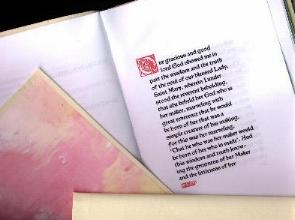 To view sample copies, actual
size, click here.
To view sample copies, actual
size, click here.
Julian of
Norwich, Showing of Love, Westminster Text, translated into
Modern English, set in William Morris typefont, hand bound
with marbled paper end papers within vellum or marbled paper
covers, in limited, signed edition. A similar version
available in Italian translation. To order, click here.

'Colections'
by an English Nun in Exile: Bibliothèque Mazarine 1202.
Ed. Julia Bolton Holloway, Hermit of the Holy Family. Analecta
Cartusiana 119:26. Eds. James Hogg, Alain Girard, Daniel Le
Blévec. Salzburg: Institut für Anglistik und Amerikanistik
Universität Salzburg, 2006.
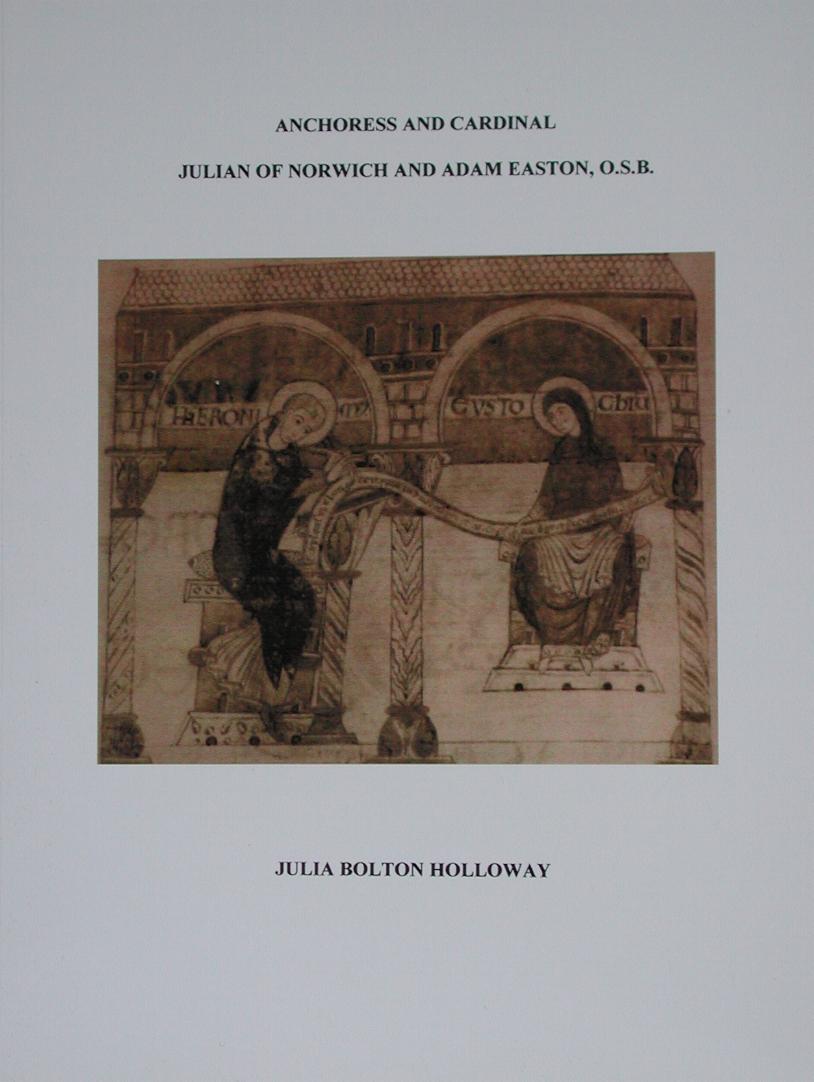
Anchoress and Cardinal: Julian of
Norwich and Adam Easton OSB. Analecta Cartusiana 35:20 Spiritualität
Heute und Gestern. Salzburg: Institut für Anglistik und
Amerikanistik Universität Salzburg, 2008. ISBN
978-3-902649-01-0. ix + 399 pp. Index. Plates.
Teresa Morris. Julian of Norwich: A
Comprehensive Bibliography and Handbook. Preface,
Julia Bolton Holloway. Lewiston: Edwin Mellen Press, 2010.
x + 310 pp. ISBN-13: 978-0-7734-3678-7; ISBN-10:
0-7734-3678-2. Maps. Index.

Fr Brendan
Pelphrey. Lo, How I Love Thee: Divine Love in Julian
of Norwich. Ed. Julia Bolton Holloway. Amazon,
2013. ISBN 978-1470198299
Julian among
the Books: Julian of Norwich's Theological Library.
Newcastle upon Tyne: Cambridge
Scholars Publishing, 2016. xxi + 328 pp. VII Plates, 59
Figures. ISBN (10): 1-4438-8894-X, ISBN (13)
978-1-4438-8894-3.

Mary's Dowry; An Anthology of
Pilgrim and Contemplative Writings/ La Dote di
Maria:Antologie di
Testi di Pellegrine e Contemplativi.
Traduzione di Gabriella Del Lungo
Camiciotto. Testo a fronte, inglese/italiano. Analecta
Cartusiana 35:21 Spiritualität Heute und Gestern.
Salzburg: Institut für Anglistik und Amerikanistik
Universität Salzburg, 2017. ISBN 978-3-903185-07-4. ix
+ 484 pp.
JULIAN OF NORWICH, HER SHOWING OF LOVE
AND ITS CONTEXTS ©1997-2024 JULIA
BOLTON HOLLOWAY
| || JULIAN OF NORWICH || SHOWING OF
LOVE || HER TEXTS ||
HER SELF || ABOUT HER TEXTS || BEFORE JULIAN || HER CONTEMPORARIES || AFTER JULIAN || JULIAN IN OUR TIME || ST BIRGITTA OF SWEDEN
|| BIBLE AND WOMEN || EQUALLY IN GOD'S IMAGE || MIRROR OF SAINTS || BENEDICTINISM || THE CLOISTER || ITS SCRIPTORIUM || AMHERST MANUSCRIPT || PRAYER || CATALOGUE AND PORTFOLIO (HANDCRAFTS, BOOKS
) || BOOK REVIEWS || BIBLIOGRAPHY ||